THE FLOWERS
The first time Wade Larkin noticed the woman, he assumed somebody had died badly.
People left flowers beside highways for only so many reasons.
He had been driving long-haul for thirty-one years, long enough to know the roadside language of grief. White plastic crosses meant teenagers. Artificial roses wired to utility poles usually meant somebody had been gone long enough for fresh flowers to become impractical. Teddy bears faded from brown to gray beneath summer sun. Hand-painted signs asked strangers to slow down where strangers had once driven too fast.
Mile Marker 41 had none of those things.
That was what caught his attention.
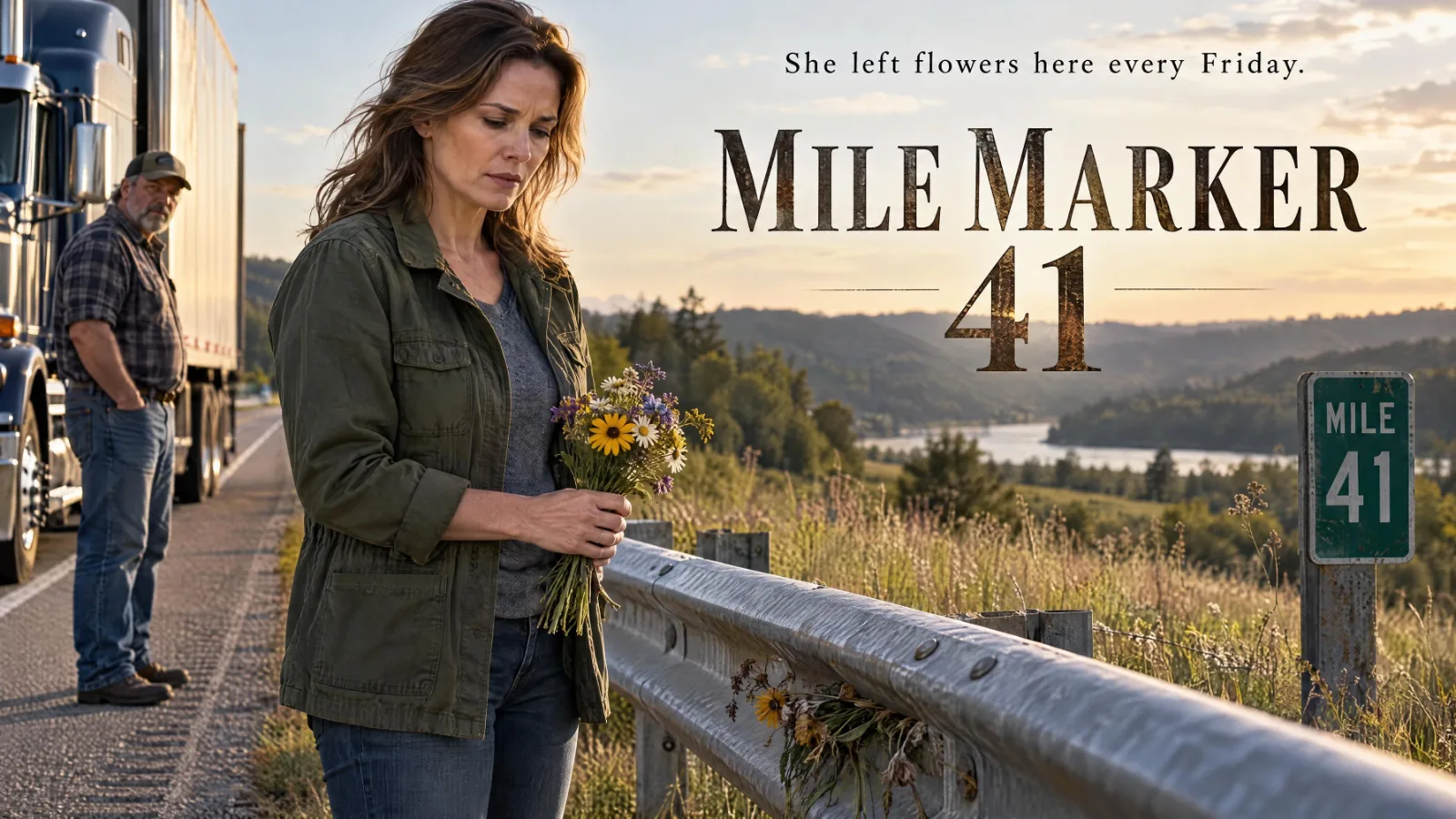
The woman parked a dark blue sedan beyond the gravel shoulder, switched on her hazards, and walked through knee-high grass carrying six yellow flowers wrapped in brown paper.
No cross waited for her.
No plaque.
No photograph.
Just a guardrail.
Wade saw her because he was stopped fifty yards farther down, checking a stubborn trailer light before continuing north.
She knelt, removed the paper, and pushed the stems beneath the lower edge of the rail.
Then she stood there.
Not praying.
Not crying.
Just standing.
Wade finished with the light and left.
A week later, she was there again.
Same car.
Different flowers.
Two weeks after that, Wade saw her from the opposite direction while hauling refrigerated produce south. He caught only a glimpse: blue sedan, woman in a gray sweater, flowers in her hands.
By the fourth Friday, curiosity had begun to feel disrespectful.
By the fifth, pretending not to notice felt worse.
He pulled his truck onto the wide gravel turnout before the marker and shut down the engine.
The woman heard the air brakes and glanced over her shoulder.
Wade lifted one hand.
“Truck’s fine,” he said. “Didn't mean to scare you.”
“You didn't.”
She returned to the flowers.
This week's bouquet was small. Purple asters and something white Wade couldn't name.
He stayed near his cab.
Up close, the woman looked younger than he'd guessed from the road. Early forties, maybe. Brown hair clipped loosely behind her head. Work shoes. Faded jeans. No jewelry except a cheap watch.
Not dressed for ceremony.
That made the flowers seem stranger.
“I've seen you here a few times,” Wade said.
She pushed one stem deeper beneath the rail.
“I know.”
That surprised him.
“You know?”
“Blue Kenworth. Silver trailer most Fridays.”
Wade glanced back at his truck.
“Here I thought I was observant.”
The corner of her mouth moved, though not quite into a smile.
She stood and brushed grass from her knees.
For a moment neither spoke.
Traffic moved behind them in irregular bursts. A pickup. An empty logging truck. Two motorcycles.
Wade considered telling her to have a good afternoon and leaving.
Instead he looked at the flowers.
“Who did you lose here?”
The woman's eyes remained on the guardrail.
“Nobody.”
Wade waited.
She tucked a loose strand of hair behind one ear.
“Nobody died here,” she said.
He frowned before he could stop himself.
She looked at the flowers again.
“That's the problem.”
A tractor-trailer passed hard enough to send a pulse of wind through the grass.
Wade said nothing.
The woman seemed to appreciate that.
After a while she leaned against the rail.
“My daughter was eight weeks old.”
Wade looked toward her.
“Twenty-five years ago tomorrow.”
He did the arithmetic without intending to.
The woman went on.
“I stood right here and handed her through the open door of somebody else's car.”
There were sentences Wade had heard from strangers at truck stops that invited conversation.
This one didn't.
He waited.
“My mother arranged it,” she said. “Private adoption. Couple lived three counties away. Good house. Good jobs. Couldn't have children.”
Her voice had the flat steadiness of something rehearsed privately thousands of times and almost never spoken aloud.
“I was eighteen. Her father was gone before she was born. I had sixty-three dollars in a checking account and a bedroom in my mother's house that still had my high-school track medals on the wall.”
She glanced at Wade.
“You can imagine how many people thought I was qualified to make decisions.”
Wade rested one shoulder against the truck.
“Did you want the adoption?”
She considered the question longer than he expected.
“I wanted her to have more than I could give her.”
“That isn't exactly what I asked.”
This time the almost-smile returned.
“No,” she said. “It isn't.”
She looked down the highway.
“I agreed to it. That's the truth. I don't get to rewrite that because it hurts.”
Wade nodded.
“The couple promised pictures. Phone calls. When she was older, visits if everybody was comfortable.”
“And?”
“For almost two years, that's what happened.”
The woman's name, Wade learned, was Dana Weller.
Her daughter's name at birth had been Lucy.
The Colters renamed her Sadie.
Dana had known that too.
She had received pictures of first teeth, first steps, a disastrous haircut Sadie apparently gave herself with craft scissors.
Once, when Sadie was nearly two, Dana had met the Colters at a diner halfway between their towns.
Sadie had climbed directly into Dana's lap.
Afterward, the calls became less frequent.
Then they stopped.
Dana's mother told her the Colters needed distance.
A month later, she said they had moved.
There was no forwarding address.
Dana wrote anyway.
The letters came back unopened.
Eventually, Dana stopped sending them.
“Did you ever look for her?” Wade asked.
Dana's expression changed.
Not anger exactly.
Something defensive.
“They asked me not to.”
“Who?”
“The Colters.”
“You heard that from them?”
Dana looked at him.
Wade realized he had stepped somewhere he hadn't been invited.
“Sorry.”
“No.”
She rubbed her thumb against the metal rail.
“No, I didn't hear it from them.”
“Your mother told you.”
“Yes.”
Wade let that sit.
Dana crossed her arms.
“My mother isn't some monster, if that's where your mind's going. She was practical. Sometimes cruel about it, but practical. She thought I spent too much time waiting for my life to start again.”
“Did it?”
“What?”
“Start again.”
Dana watched a car vanish around the bend.
“I got a job. Then a better job. Bought a house. Had a relationship for six years that ended because he wanted children and I couldn't figure out how to explain that wanting another child felt like betraying the first one.”
Wade lowered his eyes.
“Sorry.”
“Don't be. He wasn't wrong for wanting what he wanted.”
She picked up the brown paper from the grass and folded it twice.
“I'm not miserable, if you're wondering.”
“I wasn't.”
“You were a little.”
“Maybe a little.”
Dana laughed once through her nose.
Wade looked back at the flowers.
“So why here?”
“It was the last place she belonged to me.”
The answer came quickly this time.
Dana seemed startled by her own words.
Then she corrected herself.
“No. That's not right.”
She pressed the folded paper flat between her palms.
“She was never something I owned.”
Wade didn't interrupt.
“It was the last place where I knew who I was to her.”
That made more sense.
Twenty-five years of flowers suddenly made more sense than Wade wanted them to.
He looked at the guardrail.
“You come every birthday?”
“I used to.”
“Used to?”
“Now I come more.”
“Why?”
Dana took a breath.
“She's turning twenty-five.”
Wade waited for the rest.
It didn't come.
Finally he said, “And?”
“And nothing.”
“That seems like a lot of flowers for nothing.”
Dana turned toward him.
He could tell she disliked that sentence.
He almost apologized.
Then she looked at the bouquets tucked beneath the rail: today's flowers still bright, last week's brown at the edges, older stems pressed flat against gravel.
Wade followed her gaze.
“If nobody died here,” he said carefully, “why are you treating it like a grave?”
Dana's head turned.
Wade immediately raised both hands.
“You can tell me to mind my own business.”
“I probably should.”
“Wouldn't blame you.”
She stared at him another second.
Then she looked back at the road.
Twenty-five years ago, she had stood on the same patch of gravel with an infant against her chest while her mother told her not to make things harder.
She remembered Sadie's weight.
Nine pounds, three ounces by then.
She remembered the yellow sleeper with ducks on the feet.
She remembered Joan Colter crying harder than Dana did.
She remembered David Colter saying, “You can call whenever you want.”
She remembered her mother's fingers closing around her elbow after the car disappeared.
Don't chase it, Dana.
You made the decision.
Let them go.
Dana had spent half her life obeying that sentence.
The truck driver pushed away from his cab.
“I should get moving.”
Dana didn't answer.
He walked around to the driver's side.
“Mr. Larkin?”
Wade turned.
“How would you look for someone,” she asked, “if you only knew the name they had when they were two?”
Wade studied her.
“I'd probably start by finding out whether that name was ever actually lost.”
Dana frowned.
He climbed into his truck.
“That sounded smarter in my head,” he admitted.
For the first time that afternoon, Dana smiled properly.
Wade started the engine.
As he pulled back onto the highway, he watched her in the mirror.
She wasn't looking at the flowers anymore.
She was looking at her phone.