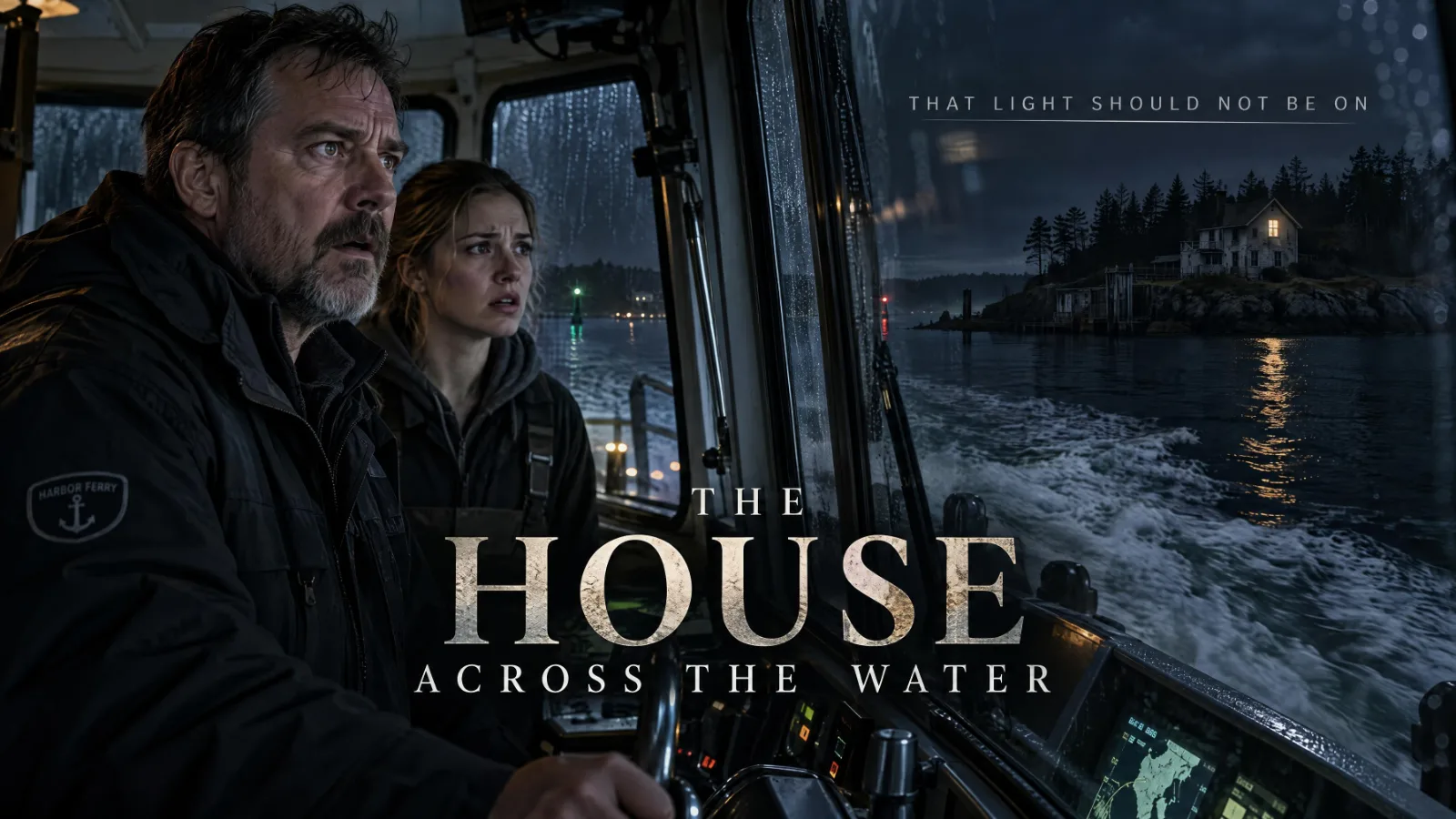
THE LIGHT IN THE WINDOW
Luke Fenner had spent twelve years learning how not to look.
The late run from Bell Cove to Stannard Point cut across a narrow black channel lined with houses that belonged to people who loved the water more in July than in January. Most of those houses were dark on a cold April night. The summer people had not come back yet. Wind pushed low mist along the surface. The ferry’s bow lights turned it silver, then let it dissolve again.
There was one house Luke knew even in darkness.
It stood on a jut of shoreline halfway up the eastern bank, a little above the tideline, with a wraparound porch that had lost two rail posts years earlier. The roofline dipped on the north side. One cedar on the bluff leaned harder toward the water every winter. He could have drawn it from memory with his eyes shut, though he had never tried.
His sister Hannah had lived there alone until the year she disappeared.
After that, the house had become a fixture the way grief sometimes did—still visible, still occupying space, but no longer something people mentioned unless they meant to wound you or help you.
Luke kept his eyes on the channel markers.
Behind him, the passengers were quiet. A few locals, two men with tool belts, a woman in scrubs, a teenage boy asleep against a window. Beside him in the wheelhouse, deckhand Mara Quinn was making a note on the clipboard she carried for reasons Luke suspected were mostly psychological. Mara believed paperwork gave a voyage dignity. Luke believed the ferry had been dignified long before either of them got there.
“Wind’s picking up off the point,” she said.
“I know.”
“You say that every time like I’m criticizing you.”
“You are.”
She snorted softly and moved toward the glass.
Mara was twenty-seven, quick with her hands, quicker with her opinions, and new enough to still find the route beautiful at night. She had worked the line six months. Long enough to know which passengers tried to slip onto the ferry after the gate closed. Not long enough to understand why Luke always grew a little quieter when they approached the eastern bank.
She leaned forward.
Then she stopped moving.
“Captain?”
Luke heard the change in her voice before he followed her gaze.
The upstairs window was lit.
Not brightly. It was not the full yellow square of an occupied home with overhead lights and television glow. It was something smaller, warmer, more focused. A lamp, maybe. One room. One source.
Still, it was light.
In Hannah’s house.
Luke stared so long Mara said, “Wasn’t that place abandoned?”
He did not answer immediately. His body had gone very still, but inside it something had dropped clean through him.
“It was,” he said.
The ferry kept moving.
Mara looked from the house to Luke’s face. “You know it?”
Luke’s mouth had gone dry.
“That was my sister’s house.”
Mara turned back to the window at once. The words changed what she was seeing. He could tell.
For twelve years Hannah’s disappearance had existed for most people as a local story with worn edges. Luke’s sister. The woman from the house across the water. The one who vanished and was never found. The phrase had shortened over time the way all public tragedies did.
But the house itself had never once shown a sign of life since she was gone.
Never a porch light. Never a lit room. Never a curtain moved.
Luke stepped closer to the glass without realizing he had done it.
A shadow crossed the window.
It moved fast enough to be unmistakable and slow enough to be human.
Mara saw it at the same moment.
“Oh my God.”
Luke’s hand tightened on the throttle. Instinct and training argued inside him. The channel there was too narrow and the tide too strong for an impulsive stop. He still had twelve passengers on board. There were rules. There was procedure. There was the physical fact of the ferry itself, which could not become a skiff just because dread had decided to wake up inside him.
He reduced speed enough for Mara to feel it.
“Luke—”
He almost never let crew use his first name during a run. She did now without noticing.
He watched the house until the angle of the shoreline took it away.
By the time the ferry tied up at Stannard Point, his pulse had settled just enough for anger to rise behind it.
Not at Mara. Not at the passengers. At whoever had walked through that room as if twelve years were nothing.
Mara lowered the ramp. Luke stayed at the helm until the last passenger stepped off. She came back up the stairs instead of starting the turnaround checklist.
“You’re going over there, aren’t you?”
“Yes.”
“You want me to call the sheriff?”
Luke thought of Sheriff Dale Wexler, who had worn a different uniform twelve years earlier and spent half that summer telling Luke there was still hope Hannah had chosen to leave voluntarily.
“No.”
“That sounded personal.”
“It is.”
“Then that’s exactly why you shouldn’t go alone.”
Luke looked at her. “I am not taking my deckhand into my missing sister’s abandoned house at night.”
Mara folded her arms. “You say that like it’s crazier than going alone.”
He should have argued. Instead he said, “Tie us up properly. Log the run. If I’m not back in an hour, then call.”
Mara looked as though she hated the compromise. Which meant she would accept it.
Luke took the skiff from the ferry’s maintenance berth. It had once belonged to Hannah. He had kept it because nobody else could make themselves sell it.
The crossing took less than ten minutes.
By then the house was dark again.
He pulled the skiff against the old dock, climbed onto boards that flexed under his weight, and stood listening. Water slapping wood. Wind moving in the grass above the bluff. Somewhere far downshore, a buoy bell.
No voices. No footsteps.
He used the key he still carried, though he had not admitted that to anybody in years.
The front door opened into cold stale air and the faintest trace of kerosene.
Luke stood in the entry hall, breathing through his nose.
The living room lay exactly as he remembered it from the last official search—bookshelves, an old sofa under a sheet, Hannah’s lamp table near the window. The sheet had dust on it. The lamp table did not.
He went upstairs.
In the back bedroom, a small glass lamp sat on the floor beneath the window.
Still warm.
Luke reached out and touched the chimney.
Very warm.
He turned slowly and took in the rest of the room.
The bed was gone. Hannah had sold it during a renovation phase before she vanished. But there were fresh disturbances in the dust near the far wall. Scuffs from shoes. A chair moved recently. The window unlocked.
On the floor beside the chair lay a damp ring from a cup or mug.
Luke walked back downstairs, every sense opening wider.
In the kitchen, a metal mug sat in the sink.
A teaspoon beside it.
And on the table, held flat under an old salt shaker, was a photocopied tide chart with three late-evening ferry crossings circled in blue ink.
His crossings.
Someone had not just been in Hannah’s house.
Someone had been using it to watch him.