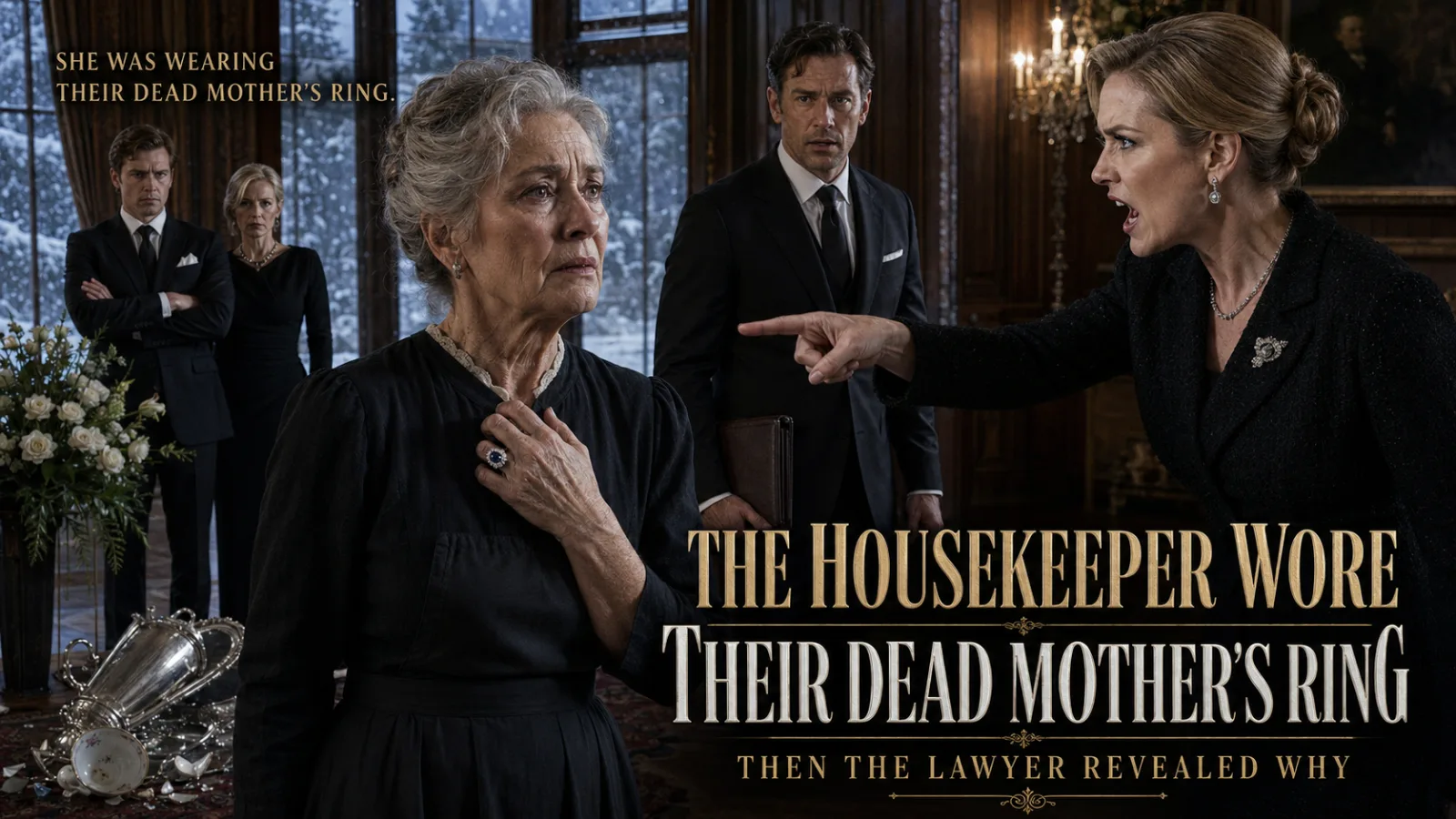
THE RING
By the time the last funeral car disappeared beyond the iron gates of Blackthorne House, snow had erased most of the tire tracks.
Victoria Sterling stood at the drawing-room windows and watched the white come down over the lower gardens, covering the stone paths, the clipped yew hedges, and the temporary canvas awning that had protected mourners from the weather two hours earlier. She had spent the day accepting condolences from people who had known her mother as Eleanor Sterling, chairwoman of Sterling Land & Timber, patron of three museums, owner of seventeen thousand acres, and one of the last women in Oregon who could make a room full of bankers wait simply by remaining silent.
Victoria had known her as Mother.
At least she had believed she had.
Behind her, Daniel Sterling opened the liquor cabinet.
“You're starting early,” their younger sister Claire said.
Daniel poured bourbon into a crystal glass. “It's four-thirty.”
“We buried our mother at noon.”
“Exactly.”
Claire looked away.
Victoria remained at the window.
Their father's portrait hung above the fireplace, painted twenty-seven years before his death. Charles Sterling had been handsome in the careful, formal way wealthy men often appeared in oil: one hand resting against a chair, the other near a stack of books he had probably never opened. Eleanor's portrait hung opposite his. The artist had painted her at fifty-eight, silver beginning at her temples, blue eyes steady enough to make viewers feel examined.
The wedding ring was visible on her left hand.
Victoria had noticed that during the reception.
She had noticed it because the actual ring was missing.
The discovery had been made the night Eleanor died. Victoria had been the first of the children to arrive at Blackthorne after Maeve called them. Eleanor had died in her bedroom after a rapid decline from pancreatic cancer, asleep before the hospice nurse could return from town. When Victoria bent to kiss her mother's forehead, she noticed the pale indentation around Eleanor's finger.
No wedding ring.
The ring had been impossible to mistake. Charles had given it to Eleanor in 1971: a square sapphire surrounded by twelve old European-cut diamonds, set in platinum. Victoria had asked for it once as a teenager and received a look from her mother that ended the conversation permanently.
“It goes where I go,” Eleanor had said.
Yet it had not.
For six weeks Victoria had asked discreet questions.
Hospice knew nothing.
The funeral home had logged no jewelry.
Claire had not taken it.
Daniel denied seeing it.
Maeve had said only that Mrs. Sterling had removed jewelry periodically during the final days because of swelling.
Victoria had not believed her.
Now inheritance had replaced grief because grief, in the Sterling family, had always been expected to work around business hours.
Julian Mercer, Eleanor's attorney for more than thirty years, was scheduled to read the preliminary estate instructions at five.
Daniel checked his watch.
“Where is Mercer?”
“He called,” Claire said. “The road from Portland is worse than expected.”
“So we're trapped here another night.”
Victoria turned from the windows. “You say that like you spent your childhood in prison.”
Daniel drank.
Claire was seated near the fireplace in the same black dress she had worn to the graveside. At thirty-eight, she was the youngest Sterling and the only one who had never worked for the family company. She ran a small architectural practice in Seattle, which Eleanor had alternately described as admirable independence and a criminal waste of an Ivy League education.
Daniel, forty-four, had spent nineteen years at Sterling Land & Timber and the last six as chief financial officer.
Victoria, forty-eight, chaired the Sterling Foundation and sat on the company board.
All three expected Eleanor's death to change the balance of power.
None knew exactly how.
That uncertainty had been making them cruel to one another since breakfast.
A soft knock came from the open doorway.
Maeve Donnelly entered carrying a silver tea service.
She had worked at Blackthorne longer than Claire had been alive. Victoria's earliest memories contained Maeve almost as reliably as they contained her parents: Maeve binding a scraped knee at seven, Maeve telling Daniel not to climb the library railing, Maeve standing quietly at the back of Christmas photographs because Charles Sterling never invited staff forward.
She was seventy-one now, slim, white-haired, and still carried a tray as if balance were a moral obligation.
“Tea,” she said.
Daniel glanced at the bourbon in his hand. “We're covered.”
Maeve ignored him.
She placed a cup near Claire first.
Then she moved toward Victoria.
The sleeve of her dark dress shifted as she tilted the silver pot.
Victoria saw the sapphire.
For several seconds, her mind refused to understand what her eyes had already recognized.
Square blue stone.
Twelve diamonds.
Platinum worn thin at the underside from fifty years against Eleanor's hand.
Victoria caught Maeve's wrist.
Tea spilled over the saucer.
Maeve inhaled sharply.
“What is that?”
Claire looked up.
Daniel lowered his glass.
Maeve glanced at her own hand.
Victoria's grip tightened.
“What is that ring?”
“Victoria—”
She struck the tray away.
Silver hit hardwood with a violent metallic crash. Cups shattered. Hot tea streaked across the Persian rug.
Claire jumped to her feet.
“Jesus, Victoria!”
Maeve stumbled backward.
Victoria pointed at the ring.
“You stole from a dead woman?”
Maeve's face changed.
Not guilt.
Pain.
That made Victoria angrier.
“My mother's ring disappeared the night she died, and you're standing in her house wearing it?”
“Let go of me.”
“Take it off.”
Maeve pulled her wrist free.
“No.”
Daniel came closer.
“Maeve.”
His voice was quieter, but the warning in it was unmistakable.
“Where did you get it?”
Maeve looked past all three of them.
Toward the doorway.
“Don't touch her.”
Julian Mercer's voice cut through the room.
The family attorney stood just inside the drawing room, snow melting on the shoulders of his black overcoat. He was sixty-three, tall, gray-haired, carrying the same brown leather document case he had carried to every Sterling board meeting for as long as Victoria could remember.
His expression stopped her.
Julian was not shocked by the ring.
He was shocked by Victoria.
“Julian,” she said. “She has Mother's wedding ring.”
“I can see that.”
“She took it.”
“No.”
Maeve lowered her eyes.
Julian removed his gloves.
“Your mother gave it to her.”
Nothing in the room moved.
Daniel recovered first.
“Why?”
Julian looked at the broken china, then at Victoria.
“Six weeks before Eleanor died, she asked Maeve and me to meet her in the west library after midnight.”
Claire's face tightened.
“Why?”
“Because she'd discovered that someone had forged her signature.”
Daniel's bourbon glass stopped halfway to his mouth.
Victoria stared.
Julian continued.
“The forged documents were designed to change who would control Sterling Land & Timber after Eleanor's death.”
Nobody spoke.
Outside, snow struck the windows in soft bursts.
Victoria felt the room changing around her.
“What documents?”
“You'll see them.”
“Who forged them?”
Julian's eyes moved across all three children.
“I know what your mother believed.”
Daniel set his glass down.
“What does that mean?”
“It means Eleanor discovered a betrayal. She wasn't prepared to accuse anyone until she could prove exactly how it had been done.”
Victoria pointed toward Maeve.
“And somehow that explains why she gave the housekeeper her wedding ring?”
Maeve's face went completely still.
Julian looked at Victoria for a long moment.
Then he said something far quieter than everything that had come before.
“Your mother asked me not to tell you the rest until all three of you were in this house together.”
Claire folded her arms across herself.
“The rest of what?”
Julian set the leather case on the table.
“Why Maeve has the ring.”
He opened the brass clasps.
“And why Eleanor trusted her more than any of you.”