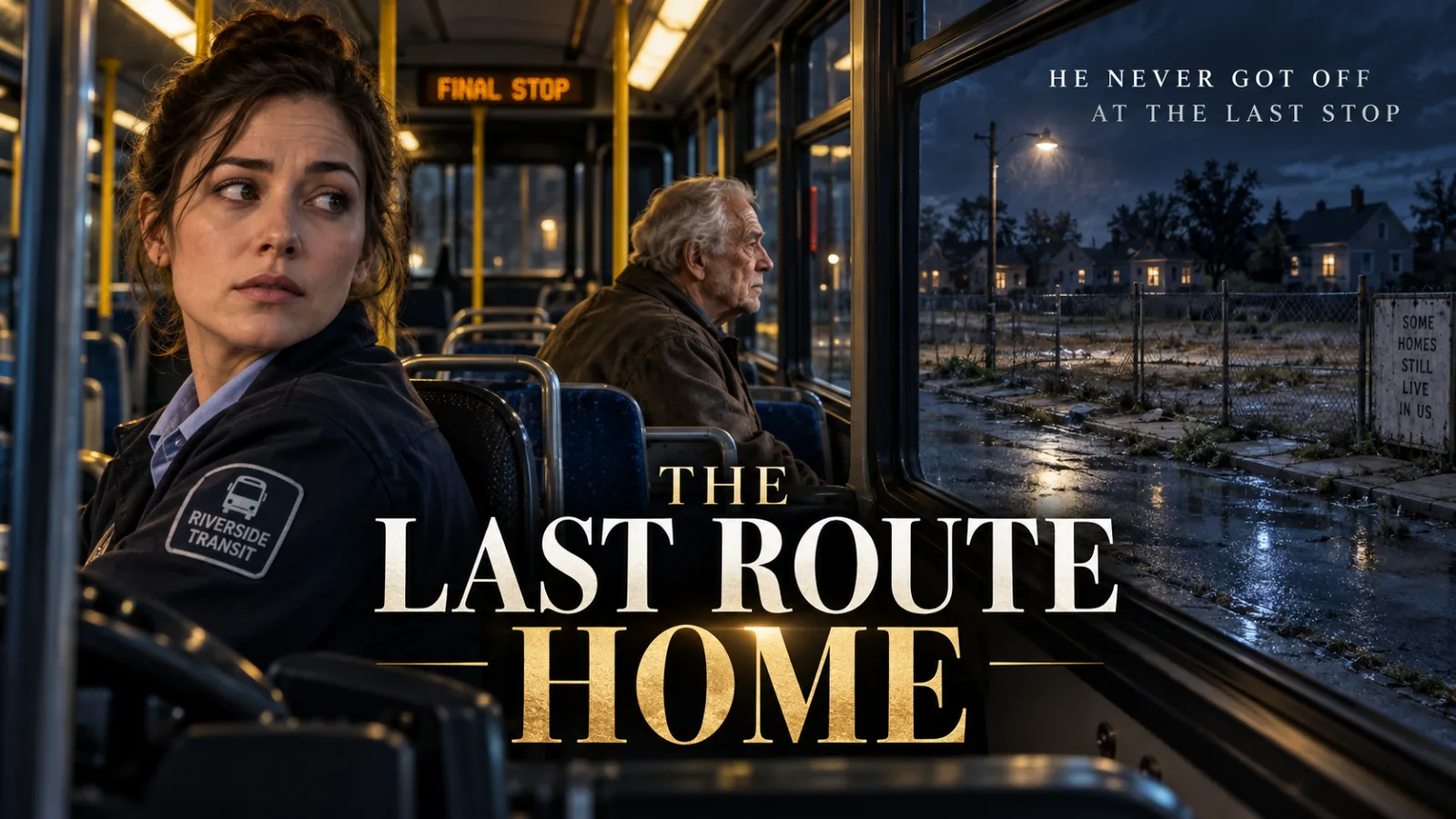
THURSDAYS
Marisol Vega first noticed the old man because he never made her late.
People who stayed aboard at the end of Route 18 usually did.
They woke confused, argued that they had not heard the stop announcement, searched under seats for missing bags, or stood in the aisle blinking at Calder Loop as if the bus company had personally deposited them at the edge of civilization.
The old man did none of those things.
Every Thursday, he boarded at 8:41 p.m. on Warren Avenue.
Not approximately 8:41. Exactly, unless traffic or weather interfered.
He wore a brown canvas coat in cold weather and a pale gray windbreaker when it was warm. He carried no shopping bags. No backpack. No cane, although the care with which he lowered himself into a seat suggested one might eventually become necessary.
He always paid with a senior transit card.
He always said, "Evening."
Then he sat three rows behind the rear door on the right side of the bus.
At first Marisol assumed he lived somewhere along the route.
Route 18 began downtown beside the courthouse, passed apartment blocks, the community college, St. Vincent's Hospital, two shopping plazas, and then crawled east through neighborhoods where houses became smaller and front yards became larger.
Calder Loop was the end.
Once, decades earlier, buses had gone farther.
Marisol knew because some of the old street signs remained. Sections of sidewalk disappeared behind chain-link fencing. Concrete steps rose from weeds to porches that no longer existed.
The city had demolished most of the old Calder district after years of flood damage, abandoned properties, and a failed industrial redevelopment plan that had somehow managed to destroy buildings without developing much of anything.
Now Route 18 circled an island of cracked asphalt beside an empty lot and headed back west.
The first Thursday Marisol noticed the old man, he was simply the last passenger aboard.
She opened both doors.
"Calder Loop," she called.
He remained seated.
Marisol checked him in the mirror.
His eyes were open.
"Sir?"
He looked toward her.
"End of the line."
"I know."
He stood, buttoned his coat, walked slowly to the front and stepped onto the pavement.
Nothing unusual about that.
Except twenty minutes later, on Marisol's return trip, he was waiting at the same stop.
He boarded.
"Evening," he said.
Marisol glanced at him.
"Forget something?"
"No."
He tapped his transit card and sat down.
The following Thursday, he did it again.
And the Thursday after that.
By November, Marisol had begun expecting him.
At 8:38 she would glance down Warren Avenue.
At 8:41 he would appear beneath the pharmacy sign, shoulders slightly rounded, walking with the deliberate patience of someone who had learned not to race his own body.
"Evening."
"Evening."
They did not become friends.
Bus drivers learned the difference between friendliness and invitation.
Marisol knew passengers who would tell a driver their divorce history because she asked whether they wanted the heat turned down.
So she kept conversations light.
Cold tonight.
Rain coming.
Construction is terrible.
The old man seemed to understand the arrangement.
His name, she eventually learned, was Arthur.
That happened only because another passenger knew him.
"Arthur Dwyer," the woman called as she got off near the medical center. "You still playing cards Tuesday?"
Arthur smiled.
"If Eddie stops cheating."
"Eddie's eighty-two."
"Old enough to know better."
It was the first joke Marisol ever heard him make.
After that, he became Arthur in her head.
Thursday Arthur.
The other drivers apparently knew him too, though not for the same reason.
One night in the break room Marisol asked Ben, who drove Route 18 mornings, whether an older man named Arthur Dwyer rode his bus.
Ben shrugged.
"Half the city is old men named Arthur."
"Brown coat. White hair. Gets on at Warren."
"No idea."
That should have ended her curiosity.
It didn't.
The strange part was not that Arthur traveled to Calder Loop every Thursday.
It was what he did when they arrived.
By December, cold weather kept Marisol from opening the doors longer than necessary. The heaters worked badly when both doors stayed open, and drivers received complaints when the bus became too cold.
One Thursday at 9:26 p.m., she pulled into the loop.
Arthur was the only passenger left.
Marisol opened the front door.
He did not move.
She waited.
Neither did he.
"Sir?"
Arthur stared through the window.
Marisol followed his line of sight.
Across Calder Street was an empty lot silvered by frost. A streetlamp illuminated a section of broken sidewalk. Beyond it stood a low fence and the dark skeleton of a maple tree.
There was nothing to see.
"Mr. Dwyer?"
He finally turned.
"Sorry."
He stood and walked forward.
At the door, though, he stopped.
Not because of the step.
Not because he had forgotten where he was.
He turned back toward the empty lot.
Then he got off.
Marisol watched him cross the street.
He stopped at the fence.
For almost fifteen minutes he stood there.
When she came back west, he crossed toward the bus and climbed aboard again.
"Long way to come for an empty lot," Marisol said.
The words escaped before she could decide whether they were any of her business.
Arthur looked toward the fare box.
"Used to be houses there."
"I figured."
He tapped his card.
"Good night, Ms. Vega."
Marisol had no idea how he knew her name until she remembered the identification placard behind the driver's seat.
The next Thursday brought freezing rain.
The city issued advisories. Traffic slowed. A sedan spun into a curb on Malden Avenue, forcing Marisol to sit fifteen minutes behind a police cruiser.
She assumed Arthur would stay home.
At 8:56, when she finally reached Warren Avenue, he was standing beneath the pharmacy awning.
His coat was soaked across the shoulders.
Marisol opened the door.
"You've got to be kidding me."
Arthur climbed aboard.
"Evening."
"You're going all the way out there in this?"
"So are you."
"I'm being paid."
"That does make you the smarter of us."
He sat in his usual seat.
By Calder Loop the rain had become hard enough to rattle against the roof.
Marisol opened the door.
Arthur stayed where he was.
She looked at the empty lot, barely visible through the wet glass.
"Mr. Dwyer."
He lifted his head.
"This is the last stop."
"I know."
He did not move.
Marisol watched him for another second.
"What are you looking at?"
Arthur turned back toward the window.
When he answered, his voice was quiet enough that she almost missed it beneath the rain.
"Her house used to be right there."
Marisol looked through the windshield.
"Whose house?"
Arthur's mouth tightened.
For several seconds he said nothing.
Then he stood.
"My daughter's."
He walked toward the front door.
Marisol looked again at the demolished block.
"Does she still live around here?"
Arthur stopped beside the fare box.
"No."
"Where does she live?"
His hand rested against the yellow rail.
"I don't know."
That was when Marisol understood that Thursday Arthur was not commuting anywhere.
He was searching.
And somehow, after all those rides, the only place he knew to look was a street that no longer existed.