NOT MY PROBLEM
Leo had been interested in the pickleball bag for exactly eleven seconds.
That was long enough.
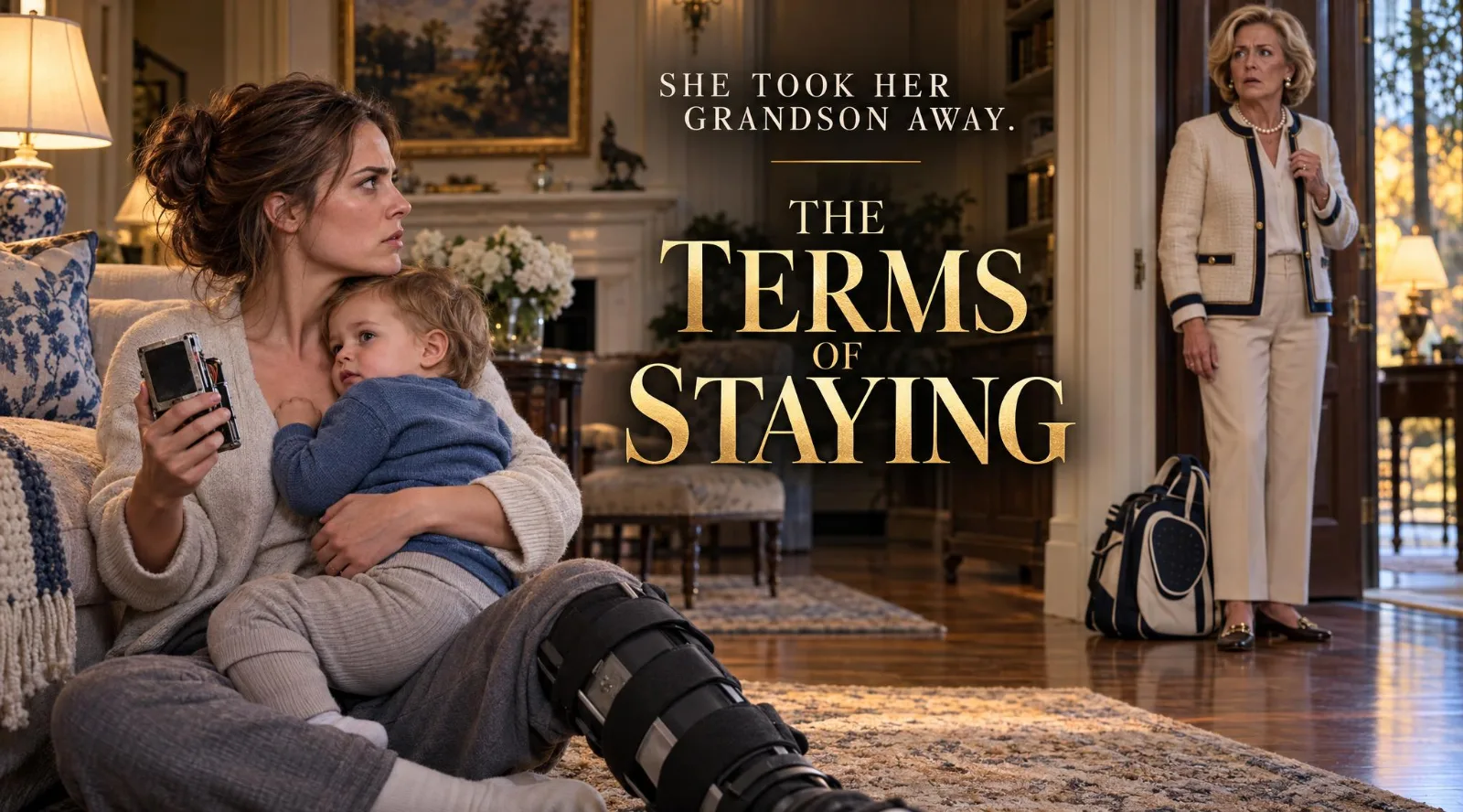
It stood beside the sofa in the west drawing room of Alder House, white leather with green piping, one of Diane Mercer's newest hobbies announced by equipment expensive enough to suggest seriousness and abandoned frequently enough to suggest otherwise.
Leo crawled toward it because he was thirteen months old and therefore believed every zippered object in the world existed for his inspection.
Elena saw him from the chaise near the windows.
She also saw her mother looking down.
"Leo," Elena called.
Her son turned toward her, grinned, then planted one hand on the bag.
Diane sighed.
"Move."
Leo did not speak enough English to appreciate contempt.
He smiled up at his grandmother.
Diane moved her foot.
It was not a kick.
Elena would remember that distinction later because other people kept trying to make it important.
Diane put the side of her white sneaker against the child's upper arm and shoved him away from her bag.
Leo lost his balance.
The carpet took most of the fall.
The coffee table took the rest.
The side of his head struck its padded edge with a dull sound.
For perhaps half a second he made no noise.
Then he screamed.
Elena was already moving.
Her right leg remained locked from thigh to ankle inside a hinged medical brace. Eleven weeks after the crash, she could walk short distances with a cane if she was careful and if the muscles around her reconstructed knee had not already been exhausted by physical therapy.
There was no cane beside the chaise.
She tried to stand anyway.
Pain shot upward.
Her leg refused the angle.
Elena dropped to one knee, caught herself with both hands, and began moving across the carpet.
Not gracefully.
Not quickly enough.
She dragged the braced leg behind her and heard Diane say, with irritation rather than alarm, "Oh, for God's sake."
Elena reached Leo.
He threw himself against her.
She gathered him into her chest, one hand immediately moving over the side of his head.
No blood.
No swelling yet.
His crying was strong.
That helped.
"It's okay. Mama's here."
Diane picked up her pickleball bag.
Elena looked up.
"What did you just do?"
"He was pulling on my things."
"He's one."
"I didn't hurt him."
"He hit the table."
"Because he fell."
Elena stared at her.
There were moments in which a relationship ended before either person had the administrative convenience of admitting it.
Elena had imagined hers with Diane ending many times.
When she was sixteen and her mother read her diary aloud during an argument.
When she was twenty-three and Diane told a room full of relatives that Elena had only been admitted to Stanford because Julian Mercer had donated to the engineering school, which was untrue on both counts.
When Owen proposed and Diane spent dinner explaining what sort of husband would be "appropriate" for a Mercer.
When Leo was born and Diane visited the hospital for nineteen minutes because she had a luncheon.
But daughters are capable of extraordinary acts of reinterpretation.
Especially daughters with mothers who occasionally know exactly when to become tender.
Diane had sat beside Elena's hospital bed after the crash.
She had brushed her hair.
She had helped wash blood from underneath Elena's fingernails because Elena's left hand had been immobilized.
She had cried when the surgeon explained that Owen had died before the ambulance arrived.
For eleven weeks Elena had been telling herself that grief might make them different.
Then Diane pushed Leo with her shoe.
"He's your grandson," Elena said.
Diane adjusted the strap on her bag.
"Not my problem."
She turned toward the door.
Something inside Elena became extraordinarily quiet.
Her phone was on the carpet beside the chaise.
Too far.
Her handbag, however, had fallen from the chair when Elena lunged for Leo.
It lay within reach.
She pulled it closer.
Diane glanced back.
"What are you doing?"
Elena found the phone.
Called Marcus Hale.
He answered on the third ring.
"Elena?"
"Cut her off."
Silence.
Marcus had been the Mercer family's attorney for twenty-two years. At sixty-three, he had become very good at not reacting before he knew what reaction would cost.
"I'm sorry?"
"Every discretionary payment. The car. The club account. The household staff I'm paying for. Everything."
Diane turned around fully.
"Don't be ridiculous."
Elena kept Leo against her shoulder.
Marcus said, "We should probably discuss this when you're—"
"No."
Diane took one step toward her.
"Elena."
"Today, Marcus."
The lawyer breathed out.
"All right."
"Everything."
Another pause.
"The house too?"
Diane stopped moving.
Elena saw it.
A tiny loss of color.
Not outrage.
Fear.
Alder House had belonged to Julian Mercer.
After his death, the property moved into the Mercer Family Trust.
Diane had remained there under an occupancy arrangement Elena had never bothered reading closely because Owen handled most of the estate administration and because asking her recently widowed mother to justify where she lived had seemed grotesque.
After Elena married Owen, she had moved out.
After Julian died, Diane stayed.
Elena inherited control of the trust.
At least, she had always believed she had.
"Yes," Elena said.
Marcus did not answer.
"Marcus?"
"There are procedures."
"Then start them."
"Elena, the house is more complicated than the allowance."
Diane's face had become rigid.
Interesting.
Elena shifted Leo in her arms.
"What aren't you telling me?"
"This isn't a conversation we should have by telephone."
"You're already on the telephone."
"Not like this."
Diane walked toward the door.
Elena remembered the object in her handbag.
She had placed it there that morning because she planned to ask Marcus about it eventually.
Eventually had just moved forward.
"Mom."
Diane kept walking.
Elena reached into the bag.
"Before you go."
Diane looked back.
Elena removed the device.
Six inches long.
Brushed aluminum.
Heavy for its size.
A narrow black screen ran across the upper face.
The rear casing had been unscrewed, exposing part of a wiring harness and a small green circuit board beneath it.
The effect on Diane was immediate.
Her hand fell away from the doorknob.
Elena had not seen her mother look frightened often.
She had never seen this.
"You told me Dad destroyed this."
Diane stared at the object.
For several seconds she did not speak.
Then:
"Where did you get that?"
Marcus's voice came through the phone.
"What does she have?"
Elena watched her mother.
"The Mercer token."
Marcus stopped breathing.
Or perhaps Elena only imagined it.
She looked down at the device.
"I found it behind Owen's safe."
When Marcus finally spoke, his tone had changed.
Every word now seemed selected for legal durability.
"Elena, don't plug it into anything."
Diane moved toward her.
"Give me that."
Elena tightened one arm around Leo.
"No."
"You don't understand what it is."
"Dad's authorization token."
"You were twelve the last time you saw it."
"And somehow I remember."
Diane's eyes flicked toward the device again.
"Your father destroyed it."
Elena almost smiled.
"Apparently not."
Marcus spoke.
"Elena."
"Yes?"
"There are documents we need to discuss."
"What documents?"
Another pause.
"The occupancy agreement."
Diane closed her eyes.
"And," Marcus added carefully, "a loan secured against Alder House."
Elena looked up at her mother.
"What loan?"
Diane said nothing.
"How much?"
Marcus answered.
"Originally four million eight hundred thousand."
Leo had stopped crying.
The house became so quiet Elena could hear the old clock in the hall.
She looked around the room.
At Julian Mercer's walls.
At Diane's furniture.
At the woman who had shoved her grandson because his hand touched a sports bag.
Then back at the device Owen had hidden from everyone.
"Marcus."
"Yes?"
"I think you'd better come here."