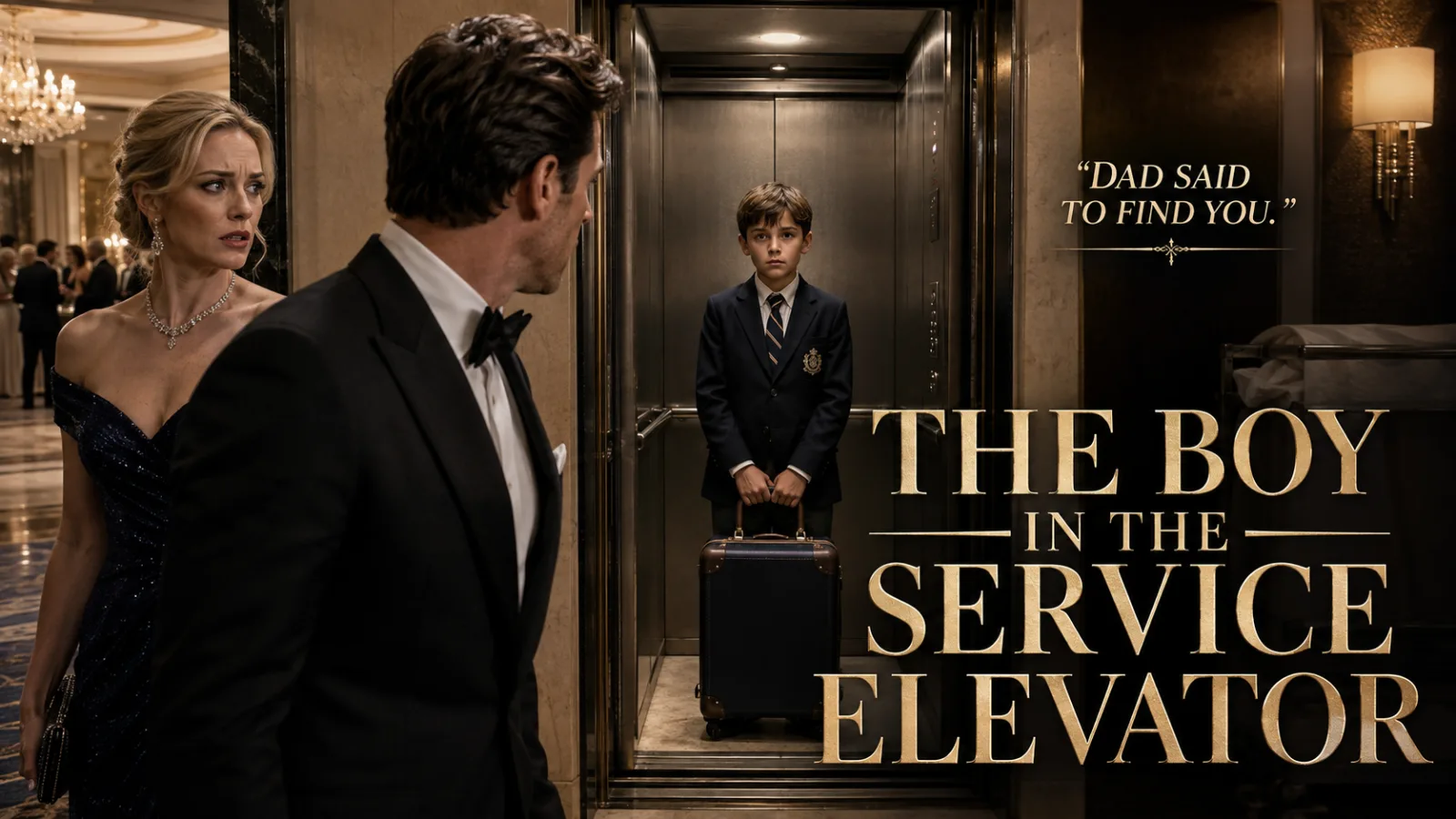
THE ELEVATOR
Sebastian Thorne had spent most of his adult life learning how to leave a room without appearing to escape it.
At charity dinners, he knew when to loosen his jaw into something warmer than a boardroom smile. At investor summits, he knew how long to let a laugh hang before pulling the conversation back to numbers. At hotel galas like the one hosted that night at the Marlowe Grand, he knew how to stand beneath twelve crystal chandeliers while strangers praised him for generosity that had already been itemized into tax strategy and brand equity by three different teams.
What he did not know how to do was watch the service-elevator doors open and see his dead brother’s eyes staring back at him from the face of a child.
He had just finished posing for photographs beside his wife at the end of the ballroom receiving line. The orchestra was transitioning into something softer. Waiters glided past carrying champagne. Behind them, a wall of floor-to-ceiling mirrors threw warm light across the marble corridor outside the ballroom. Sebastian was halfway through telling Vivienne he intended to leave before the final round of speeches when the service elevator at the far end gave a quiet mechanical chime.
The doors slid open.
A boy stood alone inside.
He was maybe ten years old, slight for his age, dressed in a dark private-school blazer with a white shirt and striped tie. One hand gripped the extended handle of a small navy suitcase. The other hung tense at his side. He should not have been there. Even before anything happened, the image felt wrong enough to rearrange the air around it.
Vivienne stopped walking so abruptly that Sebastian felt the tug through her arm.
Her face lost color.
“Security,” she said, sharp and low. “Get him out of here.”
Two hotel security men who had been lingering discreetly near the ballroom entrance turned at once. Sebastian looked at his wife, then back at the boy. The child did not glance at the security guards. He looked only at Sebastian, and there was something in that look—fear, urgency, recognition—that made Sebastian step forward before he understood why.
The boy spoke first.
“Dad said if something happened to him, I should find you.”
The words were clear and memorized, the way children recited instructions meant to survive panic.
Sebastian stopped two strides from the elevator. Behind him, the orchestra seemed to recede into another country.
“Who was your father?” he asked.
The boy swallowed. His chin trembled once, then steadied. He reached into his blazer pocket and pulled out an old silver watch attached to a worn leather strap. The metal caught the corridor light as he opened his palm.
Sebastian knew that watch.
He had given it to Adrian on his twenty-fifth birthday after their father died. The family jeweler had replaced the cracked crystal twice because Adrian refused to stop wearing it. The back was engraved with three words Sebastian had chosen himself during a year when he still believed money could translate into intimacy.
When You’re Ready.
Sebastian felt the blood drain from his face.
“Adrian?” he whispered.
The nearest security guard had reached the elevator by then, but Sebastian held up one hand without looking at him.
“No,” he said. “Nobody touches him.”
Vivienne moved closer, recovering herself by degrees. To most people, her composure looked natural. Sebastian had once admired that quality in her. Tonight it felt practiced.
“This is not the place,” she said. “Sebastian, you’re being manipulated.”
The boy flinched at her voice.
That flinch decided everything.
Sebastian crouched slightly so he was more level with the child. “What’s your name?”
“Oliver.”
“How did you get here, Oliver?”
“Mr. Vega brought me to the city.” The boy’s fingers tightened around the watch. “He said if anyone stopped us, I had to go to the hotel. He wrote the name down.”
“Where is Mr. Vega now?”
Oliver’s eyes filled but did not spill. “I don’t know.”
Vivienne took a breath that sounded almost like patience. “Sebastian, please. Anyone could have given him that watch.”
“No,” Sebastian said quietly. “Not anyone.”
He stood and turned to the security guards. “Take us to the private executive suite on forty-two. Nobody else comes up without my permission.” Then, after the briefest pause, he added, “Not even family.”
It was a small sentence. Vivienne heard the accusation inside it immediately.
Her expression sharpened. “You are seriously bringing this child upstairs based on a prop?”
Sebastian looked at her fully for the first time since the elevator opened. “You told security to remove him before he said two complete sentences.”
Vivienne’s jaw tightened, but she did not answer.
Oliver left the elevator only after Sebastian extended a hand and said, “You’re safe with me.” The boy hesitated, glanced once at Vivienne, and then set the suitcase rolling behind him.
The private executive suite overlooked the river and most of the city beyond it. Under ordinary circumstances, Sebastian used the space for discreet negotiations and exhausted midnight conference calls. That night it became an interrogation room made strange by velvet furniture and a tray of untouched petits fours.
Oliver perched on the edge of a cream sofa, back straight, suitcase at his feet, watch still clenched in one hand. Up close, Sebastian could see that the boy’s blazer sleeve had been repaired at the cuff by someone careful but not professional. There was a fading bruise near his wrist, the kind children acquired when adults grabbed too hard and later claimed they were helping.
Sebastian dismissed the hotel staff after ordering tea, water and something simple from the kitchen. When the door closed, he took the chair opposite Oliver instead of the sofa beside him. He remembered enough about frightened children to know proximity could feel like pressure.
Vivienne remained standing near the bar, one hand resting on the marble countertop as if the room itself needed anchoring.
“Start at the beginning,” Sebastian said gently. “Tell me about your father.”
Oliver looked down at the watch. “My dad’s name was Adrian Thorne.”
The room went silent in a different way than before—less shock now, more consequence.
“How old are you?” Sebastian asked.
“Ten.”
Sebastian did the math automatically. Six years since Adrian’s death. The timeline was possible. So possible, in fact, that the possibility hurt.
“Did your father tell you who I was?”
Oliver nodded. “He said you were his brother. He said if he ever couldn’t come back, I should find you. Mr. Vega said I wasn’t allowed before now.”
Sebastian’s throat tightened. “Why not?”
Oliver lifted one shoulder helplessly. “He said it wasn’t safe.”
Vivienne laughed once under her breath, too controlled to sound nervous and too cold to sound amused.
Sebastian turned toward her. “Do you know something I don’t?”
“I know this is a disaster waiting to happen,” she said. “A child arrives at our gala with a story no one can verify, and suddenly you’re treating him like a legal heir. Think for one second.”
“He knew where to find me. He had Adrian’s watch.”
“Both of which could be arranged.”
Oliver looked from one adult to the other, shrinking without moving. Sebastian noticed and lowered his voice.
“We are not doing this in front of him.”
Vivienne crossed her arms. “You are already doing much worse in front of him.”
Before Sebastian could answer, there was a soft knock. The kitchen had sent up a tray. Oliver startled visibly at the sound, and Sebastian filed that reaction away too.
He waited until the tray was set down and the server left again before sliding a glass of water across the table.
“Oliver,” he said, “who is Mr. Vega?”
“He took care of me.”
“For how long?”
“Always.”
“Was he family?”
Oliver shook his head. “He was my dad’s friend.”
“And tonight? What happened tonight?”
The boy stared at his lap for several seconds, as though selecting which fear could safely be shared.
“Mr. Vega said we were going on a trip,” he said at last. “Then a black car was outside the school. He saw it and got upset. We didn’t go home. We went to a bus station and then to another car. In the city, he said if anything happened I had to go to the service entrance because too many people would be watching the front. He gave me a card with the hotel name and your name on it.” Oliver paused. “Then he left me with a woman downstairs.”
“What woman?”
“A housekeeper. She said she knew my dad.”
Sebastian looked toward the suite phone at once. “I want security footage from every service entrance, every freight and staff elevator, and a list of all housekeeping staff on shift tonight.”
Vivienne’s face changed almost imperceptibly at that.
Sebastian saw it.
“Why does that bother you?” he asked.
“It doesn’t bother me. It concerns me.”
“Those are not the same thing.”
She exhaled sharply. “Fine. Do you want the truth? Yes, I knew Adrian was involved with someone he kept hidden from the family. I suspected there may have been a child. I never had confirmation.”
Sebastian stared at her.
“You what?”
Vivienne met his eyes. “He came to me once, not long before his death. He asked what would happen to his shares if he acknowledged a child publicly while the board was negotiating the Belgrave acquisition. I told him it would create chaos. He accused me of caring more about optics than blood.”
The room tilted.
“You knew this for six years,” Sebastian said.
“I knew Adrian might have gotten a woman pregnant.”
“You said nothing.”
“I had nothing concrete to say.”
Oliver was watching them, frightened again. Sebastian stood, walked to the window, and forced himself not to put a fist through the glass.
When he turned back, his gaze went to the watch still in Oliver’s hand.
“May I see it?”
Oliver hesitated, then nodded and passed it over.
Sebastian ran his thumb across the scratched crystal and the familiar weight of the case. On instinct more than reason, he turned it over and opened the leather strap. Adrian used to tuck receipts and matchbook fragments under the lining when he was afraid he’d lose them.
Tonight, beneath the worn leather fold, something small and metallic clicked against Sebastian’s finger.
A key.
Not decorative. Not random. A miniature safety-deposit key taped carefully into the underside of the strap.
Sebastian looked up slowly.
Vivienne had gone perfectly still.