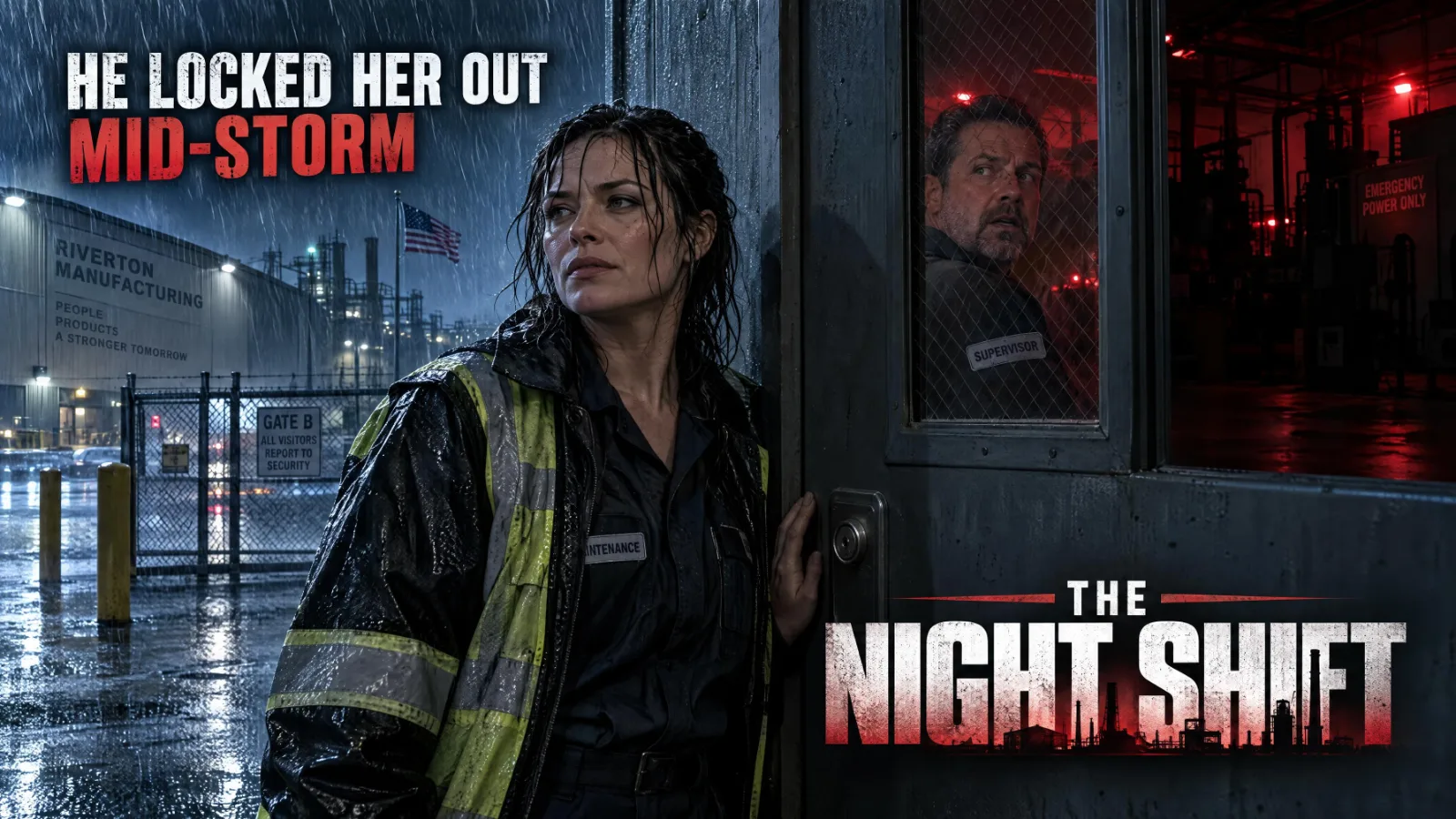
THE DOOR
At 11:43 on a Thursday night, Dale Haskins took Nora Finch's keycard out of her hand.
He did it carefully.
That was what Nora remembered later—not the rain hammering the metal roof over the employee entrance, not the thunder rolling somewhere beyond the loading docks, not even the expression on Dale's face.
She remembered how carefully he took the card.
Two fingers against the plastic. A small tug. Almost polite.
“I'm still on shift,” Nora said.
Dale slipped the card into the breast pocket of his supervisor's shirt.
“You were on shift.”
Behind them, through the wired-glass security door, the east production floor stretched beneath rows of fluorescent lights. Presses, winding stations, pallet conveyors, and inspection tables ran in long parallel lines across the building. The place produced molded components for heavy-equipment manufacturers, the sort of parts no customer ever thought about unless one arrived late.
At night the plant had its own climate. Warm machinery. Cool concrete. Hydraulic oil, dust, burnt coffee. The steady layered noise of motors and compressed air.
Nora had worked in that noise for eleven years.
Dale had supervised it for eleven months.
“Give me the card,” she said.
Rain blew beneath the entrance canopy and darkened the shoulders of her maintenance jacket.
Dale smiled in a way he had learned to use without technically smiling.
“You can go home.”
“My truck is on the other side of the building.”
“Walk around.”
“In this?”
He looked toward the storm.
“You wanted fresh air.”
Nora stared at him.
The argument had begun twenty minutes earlier at Line Four.
One of the cooling pumps had begun cycling irregularly again. Nora had heard it before the control panel told her anything was wrong. She had put a hand against the pipe, listened, checked the gauges, and told the operator to slow the line while she inspected it.
Dale had arrived three minutes later.
Why are we down?
We're not down.
Then why are they slowing?
Because something isn't right.
Those four words had become dangerous around Dale.
Something isn't right meant maintenance wanted time.
Time meant missed hourly numbers.
Missed numbers meant explaining himself in the morning production meeting.
Dale regarded maintenance as an unfortunate profession built around finding reasons production should stop.
Nora regarded production as the reason maintenance existed.
They had been moving toward collision for months.
“We can deal with that pump at six,” Dale had said.
“It may not wait until six.”
“That's not what the panel says.”
“The panel tells you what the sensor sees.”
“And what do you see?”
Nora had looked at him.
“A pump that's about to become your problem.”
Dale hated being corrected in front of operators.
That was the real issue.
Not downtime.
Not pumps.
Not numbers.
Witnesses.
He had ordered Line Four back to normal speed.
Nora had refused to clear the maintenance warning.
Dale had cleared it himself.
Then he told her they needed to talk outside.
Now they were standing beneath the employee entrance canopy while rain blew sideways across the parking lot.
Nora extended her hand.
“My card.”
“No.”
“You don't have authority to confiscate it.”
“I have authority to send you home.”
“Then document it.”
His jaw tightened.
“Not everything needs paperwork, Nora.”
“Funny. You usually love paperwork when you're writing somebody up.”
There it was.
She saw the change immediately.
Dale's face barely moved, but whatever restraint had brought him outside disappeared.
He opened the security door.
For half a second Nora assumed he meant to let her back inside.
Instead he stepped through first.
She caught the door with one hand.
“Dale.”
He looked at her across the threshold.
“If you come back tomorrow ready to act like part of the team, we'll talk.”
“I am part of the team.”
“You act like you're running it.”
“No. I act like machines don't care about your production target.”
The door started closing.
Nora kept her palm against it.
Dale pushed from the other side.
She could have pushed harder.
She didn't.
Something in her suddenly became very tired.
Not frightened.
Not defeated.
Simply tired.
Eleven months of being called difficult after preventing failures.
Eleven months of Dale asking male operators what Nora had just explained to him.
Eleven months of maintenance requests mysteriously moving to the bottom of the schedule if they required shutting down one of his lines.
Three written warnings, each careful enough to sound professional.
Communication style.
Failure to demonstrate operational flexibility.
Adversarial response to supervisory direction.
Nora released the door.
Dale held it open another inch.
“Maybe now you'll learn who runs this shift.”
Then he let it slam.
The magnetic lock engaged with a heavy click.
Through the glass, Dale watched her.
Nora hit the door once with the flat of her hand.
Not because she thought he would open it.
Because she wanted him to know exactly what he had done.
He turned away.
Nora stepped back beneath the canopy.
Rain rushed across the parking lot in silver sheets.
She pulled out her phone, intending to call security.
A fluorescent light above the employee entrance blinked.
Once.
Twice.
Nora looked up.
Inside the plant, one entire row of ceiling lights went dark.
Then came back.
Then everything disappeared.
The compressors stopped first.
Their absence seemed almost louder than their operation.
The production floor vanished behind Dale.
A second later the emergency lighting came on, throwing strips of red along the walls.
Dale turned.
Nora forgot about the argument.
Her eyes moved automatically toward the section of darkness where Line Four sat.
“No,” she whispered.
The storm had taken utility power before. That alone wasn't unusual.
The plant's critical systems were supposed to transfer.
Most of them probably had.
But Nora knew something Dale did not.
Because three months earlier, at 2:17 in the morning, she and an electrician named Wes Barlow had spent almost four hours tracing an intermittent fault in one of the backup circuits serving the cooling system.
They had found it.
They had also found the temporary manual recovery procedure the plant would need if that fault returned before the replacement work was completed.
Nora had filed the repair request the next morning.
The repair required a planned shutdown.
Dale had opposed the shutdown.
Production couldn't spare six hours that month, he said.
Then the next month.
Then the next.
Nora looked through the glass.
Dale was staring into the plant.
The calm superiority had left his face.
On the wall beside Nora was an exterior security call box.
She pressed the button.
Inside, a buzzer sounded.
Dale looked toward the door.
Nora pressed again.
Eventually he crossed the entrance and hit the intercom.
“What?”
His voice came through the metal speaker.
“Is Line Four's cooling loop running?”
“What?”
“Go look.”
“We've lost power.”
“I can see that.”
“We're on emergency.”
“Not the whole plant.”
Dale's face moved closer to the glass.
“What are you talking about?”
Nora looked at the man who had spent months telling her she made things complicated.
Then she looked beyond him into the dark.
“You locked out the only person on this shift who knows where the manual reset is.”