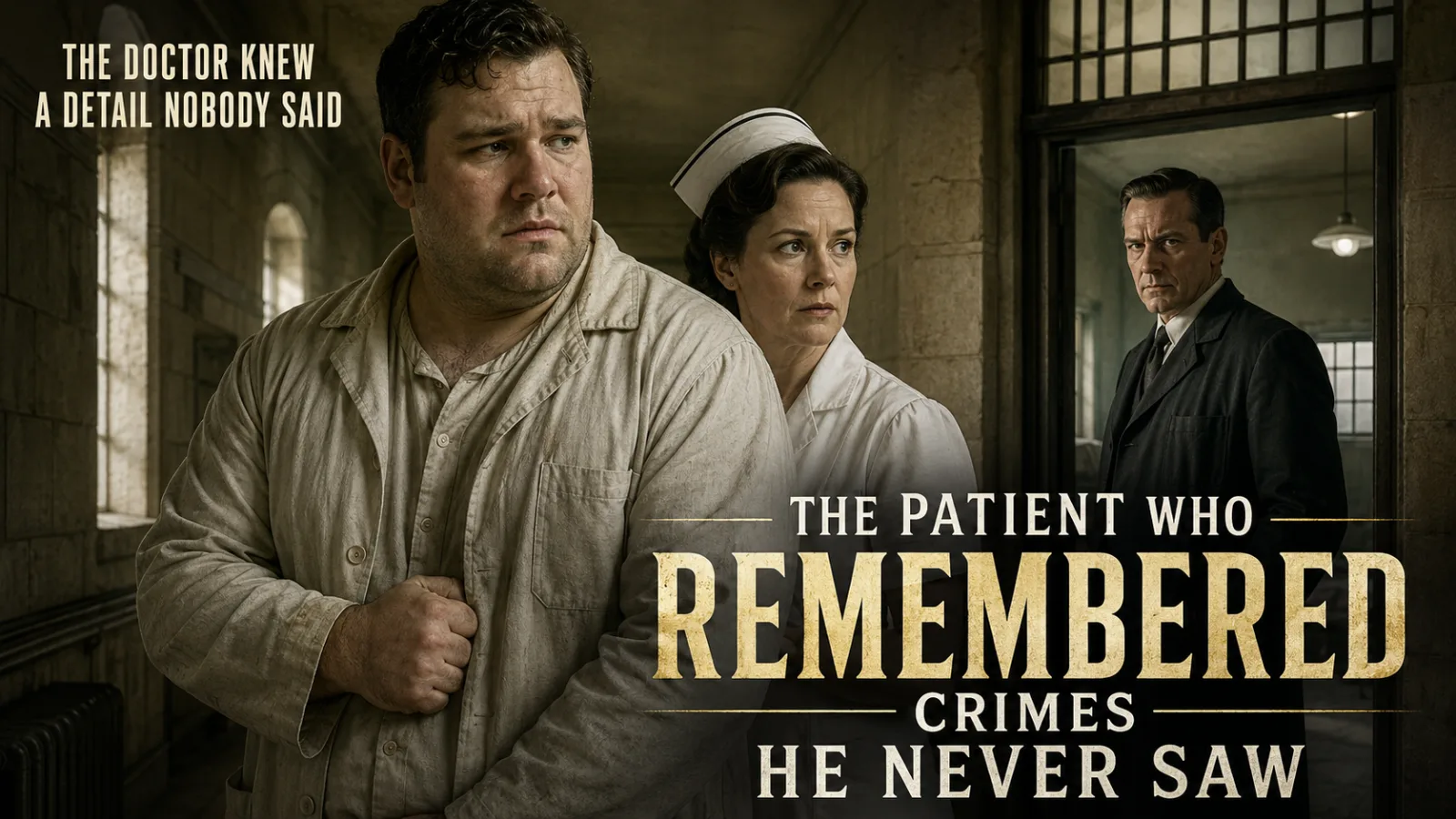
THE MAN WHO HEARD YESTERDAY
Clara Rourke had spent fifteen years learning the noises of Marrow Creek State Hospital, and by 1938 she could tell almost anything about the western wing without leaving the nurses’ station. A tray dropped differently from a chair. A frightened patient kicked a door with the heel; an angry one used the whole foot. Orderlies who needed help called a nurse’s name. Orderlies who had already lost control shouted nothing useful at all.
The newest patient arrived during the quietest part of a Wednesday afternoon, which was why Clara heard the transportation van before anyone came through the doors.
Two state officers escorted him into Cedar Hall. He was the largest man Clara had ever seen brought through the admission corridor, tall enough that the officer behind him seemed to vanish whenever they crossed in front of a window. The newspapers had always emphasized his size. They had called him the Quarry Giant, the Culvert Butcher, the Monster of Wren Road.
The man himself stopped just inside the ward because a patient named Mrs. Avery had wandered into his path.
One of the transport officers pushed her aside.
“Move.”
Jonah Vale reached toward the woman automatically, then stopped himself before touching her. His hands were cuffed at the waist. He lowered them as Mrs. Avery shuffled away.
“Don’t shove her,” he said.
The officer laughed. “You worried somebody might get hurt?”
Clara looked up from the admission papers.
“Officer.”
The man glanced at her.
“If you intend to remain on my ward long enough to insult my patients, I’ll find you paperwork to justify the space you’re occupying. Otherwise, bring Mr. Vale to Room Nine.”
The officer decided the second option was preferable.
Jonah’s case had been famous six years earlier. Thomas Wren, eleven, and his brother Eli, nine, had vanished while walking home from a harvest fair outside the town of Bellweather. A search party found them after midnight near an old drainage culvert three miles away. Jonah was kneeling in the mud beside Thomas. Eli lay several yards farther down the road. Both boys were dead.
Jonah had blood on his hands and shirt. He could not explain where he had been during the two hours before the discovery. Worse, he told deputies that he had seen “pieces” of what happened after touching Thomas’s coat.
He described rain when the evening had been dry.
A car horn.
A woman’s glove.
Someone laughing.
A smell like peppermint and hot metal.
Prosecutors called it lunatic invention. The jury called it guilt.
The conviction had been unusually swift. Harlan Sloan, then district attorney for the county, built his political reputation on it and became a state judge two years later.
Jonah spent six years in prison before deteriorating badly enough that doctors petitioned for transfer to Marrow Creek. The official diagnosis was delusional disorder with violent potential. The state medical commission had authorized an evaluation for prefrontal surgery if Dr. Everett Sloan concluded Jonah could not be safely managed.
Clara had read that final name twice.
Everett Sloan was Harlan Sloan’s son.
He was also the youngest physician at Marrow Creek ever to receive authority over an entire secure ward. He was competent when he wanted to be, polished whenever administrators were watching, and protected enough to make ordinary complaints die somewhere between the nursing office and the director’s desk.
Everett entered Cedar Hall before Clara finished the intake.
He looked Jonah over without introducing himself.
“So this is him.”
Jonah studied his face.
Something in the patient’s posture changed.
It was slight, but Clara saw it. His shoulders pulled inward, not like a man preparing to attack but like someone bracing against a loud noise.
Everett noticed too.
“You recognize me?”
Jonah shook his head.
“Then stop staring.”
Jonah looked away.
Everett turned to Clara. “Room Nine. No communal meals for the first week. No yard privileges. No unnecessary contact.”
“On what behavioral basis?”
“His record.”
“He has been in this building eight minutes.”
“And managed to commit two murders before ever arriving.”
The transport officer smirked.
Clara signed the receipt anyway. Fighting Everett in front of a new patient accomplished little beyond giving Everett a reason to prove he could win.
Jonah walked toward Room Nine.
As he passed the nurses’ desk, Ben Hale’s pocket watch slipped from the top of an open drawer and struck the floor.
Jonah stepped on the chain before the watch could slide under the desk.
Ben bent to retrieve it.
Jonah did too.
Their fingers touched.
Jonah recoiled as if he had been burned.
The reaction was so violent that one transport officer grabbed his shoulder.
“Easy.”
Jonah did not appear to hear him.
He stared at Ben.
“Lake water.”
Ben stopped reaching for the watch.
Jonah’s breathing had changed. “Cold. Your brother is yelling at you to stay on the dock.”
The corridor seemed to shrink around them.
Ben’s hand remained suspended halfway to the floor.
Jonah squeezed his eyes shut.
“There’s a green boat upside down. He thinks turning it over will help. It doesn’t.”
“Enough,” Ben whispered.
Clara looked at him.
Ben was fifty-eight and had worked at Marrow Creek for nearly eleven years. In all that time he had spoken about one brother, Arthur, who ran a feed store in Ohio.
Clara had never heard about another.
Jonah swallowed hard and turned his face toward the wall.
“I’m sorry.”
Ben picked up the watch.
His fingers shook.
Everett gave a short contemptuous laugh. “Parlor tricks impress prisoners too, Hale. I expected better of you.”
Ben did not answer.
After the transport officers left, Clara followed him into the medication room.
“What was that?”
He closed the door.
“My brother Samuel drowned when I was thirteen.”
Clara waited.
Ben stared at the watch in his palm. “That belonged to him.”
“Was there a green boat?”
Ben looked at her.
“No one here knows that.”
“Your family?”
“Dead or three states away.”
Clara leaned against the counter.
“What exactly happened?”
Ben sat down slowly.
“We were fishing. Samuel stood up, the boat rolled, and he panicked. I made it to the dock. He tried turning the boat over because he thought he could climb on top.” Ben rubbed a thumb across the watch crystal. “He drowned before my father reached us.”
Clara felt the first uncomfortable movement of doubt.
“Could Jonah have read about it?”
“In the Bellweather Gazette in 1893?”
“I’m asking.”
“So am I.”
They said nothing for a moment.
From the corridor came the metallic sound of Room Nine being locked.
That evening Clara reviewed Jonah’s prison file more carefully.
His record was not what she expected. No assaults. No attempts to escape. No disciplinary reports for violence. There were several incidents in which he refused to touch another inmate, one in which he became hysterical after handling a dead man’s shirt, and repeated statements from prison physicians describing “sensory delusions triggered by physical contact.”
A guard had written that Jonah sometimes told prisoners things about their childhoods.
Another called him a fraud.
A third asked to be transferred after Jonah described a barn fire the guard had survived as a boy.
Clara closed the folder near midnight.
When she made rounds, Jonah was sitting on the floor beside his bed.
“You should sleep.”
“I will.”
She remained at the door.
“What happened with Mr. Hale?”
Jonah rubbed his palms against his trousers.
“His watch was full.”
“Full of what?”
“Yesterday.”
Clara almost dismissed him.
Then she thought of the overturned green boat.
“You think objects remember things?”
“No.” Jonah considered the question. “I think people leave things in them sometimes.”
“What things?”
“Fear. Hurt. Love. The stuff that gets too big.”
“And you can see it.”
“Not like seeing.”
“Then how?”
He looked frustrated by language.
“Like remembering something that never happened to me.”
Clara studied him through the bars.
“What did you remember from the Wren boys?”
His expression changed at once.
“I don’t want to.”
“Two children died, Jonah.”
“I know.”
“You went to prison because you couldn’t explain what happened.”
“I tried.”
“You told deputies about rain on a dry evening and a woman’s glove.”
“Because that’s what was there.”
“In the memory?”
He nodded.
“Whose?”
Jonah stared at his hands.
“I didn’t know.”
Clara waited, but he had retreated somewhere she could not follow.
When she turned away, he spoke again.
“The doctor hurts to stand near.”
She looked back.
“Dr. Sloan?”
“Yes.”
“Did you touch him?”
“No.”
“Then how would you know?”
Jonah gave her an exhausted look.
“Some things don’t stay inside very well.”
Clara continued her rounds.
At the far end of Cedar Hall, Everett stood outside Room Seven talking to an orderly. He was laughing at something.
Nothing about him looked afraid.
Nothing about Jonah looked convincing enough to overturn six years of public certainty.
Yet as Clara returned to the nurses’ station, she found Ben’s watch still sitting in the center of his palm.
For the first time since reading Jonah Vale’s name in the newspapers, she wondered whether the strangest part of his story was not what he claimed to remember.
It was how quickly everyone else had decided he was lying.