THE DOOR OPENED AT EIGHT
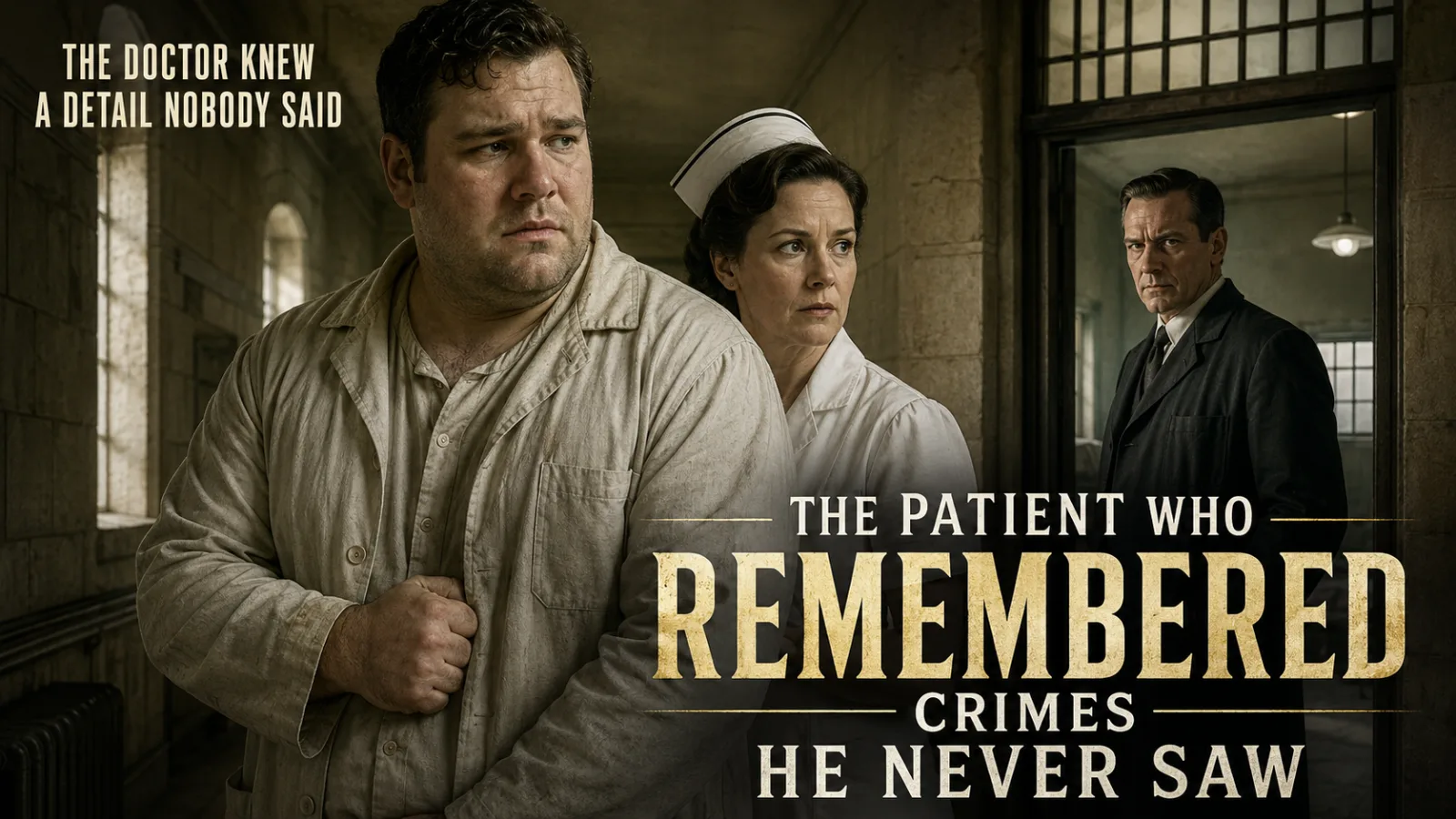
At 7:32 on Friday morning, two attendants came for Jonah.
At 7:34, Clara refused to release him.
Commissioner Crain arrived at 7:38 carrying the operative order.
“You are obstructing an authorized medical procedure.”
Clara stood outside Room Nine with Ben on one side and Luis on the other.
“I am maintaining custody of a patient whose underlying criminal conviction is subject to an emergency evidentiary hearing.”
“The conviction has not been vacated.”
“The evidence used to characterize him as violently delusional is now compromised.”
“That is for a court to determine.”
“Correct.”
“The court has not determined it.”
“Also correct.”
“Then open the door.”
“No.”
Crain stared at her.
“Mrs. Rourke, you will be dismissed.”
“That may happen.”
“You may be charged.”
“That may happen too.”
Everett appeared behind him.
He looked exhausted. His collar was open, and the polish he normally carried had cracked around the edges.
“My father has been arrested.”
No one answered.
Everett looked at Clara.
“You happy?”
“No.”
“You should be. You wanted the truth.”
“I wanted Jonah out of this room.”
“He killed two children.”
“Leon confessed.”
“Leon is insane.”
“Edwin Pike’s ledger isn’t.”
Everett stepped toward her.
“My father built courts in this county. He put murderers away. He funded hospitals. He kept half these people employed.”
“And two boys?”
Everett’s jaw tightened.
“You think one night cancels a life?”
Clara looked at him for a long moment.
“No. I think one night reveals what a man is willing to do when his life is threatened.”
Everett laughed once.
“You know nothing about him.”
“Then tell me.”
Crain intervened.
“This is not a courtroom.”
“No,” Clara said. “In a courtroom people are supposed to wait for evidence before destroying someone.”
The commissioner ordered the attendants forward.
Ben blocked them.
Luis did not move.
For several seconds the hospital seemed balanced on a ridiculous question: whether three nurses and orderlies could physically prevent the state from taking one patient down a corridor.
Then the telephone rang at the nurses’ station.
Tessa answered.
Everyone watched her face.
“Yes, sir.”
She covered the receiver.
“Clara.”
Clara picked it up.
The voice belonged to Judge Amos Cartwright, speaking from the county courthouse.
“I’ve reviewed the emergency affidavit.”
Clara gripped the receiver.
“And?”
“I’m issuing a temporary restraining order against any irreversible neurological procedure until this matter is heard.”
She closed her eyes.
“When?”
“Effective immediately.”
“Can you send it?”
“My clerk already has.”
Clara looked at the clock.
7:47.
“Thank you.”
She replaced the receiver.
Crain demanded confirmation and spent six furious minutes on another line.
At 7:56 he returned.
“The procedure is stayed.”
Nobody celebrated.
The relief was too large for that.
Ben sat down.
Luis covered his face with both hands.
Inside Room Nine, Jonah leaned his forehead against the wall.
Clara unlocked the door.
For the first time since his arrival, there was no institutional reason to keep it closed before the hearing.
Jonah stared at the open doorway.
“You can come out.”
He stepped into Cedar Hall.
Everett stood ten feet away.
Their eyes met.
Jonah did not accuse him.
He did not strike him.
He did not forgive him.
He simply walked past.
That hurt Everett more than anything Clara could have said.
The hearing lasted two days.
Samuel Greer testified.
Edwin Pike produced his original repair ledger.
The state police authenticated Thomas Wren’s academy button through photographs and manufacturing records.
Leon repeated his confession under counsel, accepting responsibility for moving the boys and participating in the cover-up.
A former clerk from Harlan Sloan’s district attorney office identified the handwriting on the notation removing Greer’s statement.
Most damaging of all was Harlan’s own archive. State investigators found correspondence between him and the county bank discussing Greer’s father less than forty-eight hours after the boy reported seeing the Packard.
The court did not attempt to determine whether Jonah truly received memories through touch.
It did not need to.
The evidence demonstrated that the original prosecution had concealed an alternate account, suppressed a witness and failed to disclose facts implicating other men.
Jonah’s conviction was vacated pending retrial.
No retrial came.
The county prosecutor dismissed the charges three weeks later.
Harlan Sloan resigned from the bench before the state legislature could remove him. He was later convicted of obstruction, evidence suppression and conspiracy arising from the cover-up. Age and influence softened his sentence, but not his reputation. The courthouse portrait that had hung for four years disappeared before the trial was over.
Leon Voss pleaded guilty to conspiracy, obstruction and unlawful treatment of the injured boys after the collision. Prosecutors could not prove which act caused Eli’s death. Leon spent the rest of the decade in state custody.
Everett’s case was more complicated.
He had not driven the car. He had not moved the boys. At twenty-five, he had initially urged his father to seek help.
Those facts mattered.
So did everything he did afterward.
He knew Jonah had been wrongfully convicted. He concealed Leon’s connection to the case when Leon arrived at Marrow Creek. He attempted to remove incriminating property. He falsified portions of Jonah’s behavioral record to accelerate surgery after Jonah began revealing details of the crash.
The medical board revoked his license.
A jury later convicted him of evidence tampering and conspiracy.
Clara attended sentencing.
Everett looked older than thirty-one.
Before the bailiff led him away, he asked to speak to her.
She almost refused.
Then she crossed the courtroom.
“You got what you wanted,” he said.
“No.”
“What else is there?”
“Six years.”
His expression tightened.
“I can’t give him those back.”
“That’s the first true thing I’ve heard you say.”
Everett looked down.
For a moment Clara saw the twenty-five-year-old Leon had described—the frightened son beside a road, wanting to call a doctor before his father explained what honesty would cost.
That man had existed.
Then he had made another choice.
And another.
And another.
Clara left him there.
Jonah remained at Marrow Creek for nearly three months after his release because he had nowhere else to go.
The irony was not lost on anyone.
The state could unlock his door but could not manufacture a home, family or profession to replace the life it had taken.
Halbrook gave him a room in the staff cottage rather than the secure ward and found paid work for him in the greenhouse.
Jonah liked plants because they did not leave memories in his hands.
He rarely touched patients.
When someone needed comfort, he learned to sit close without making contact.
Clara eventually asked whether he regretted staying the night before the hearing.
“Sometimes.”
“That is not the heroic answer.”
“I’m not heroic.”
“Good.”
He smiled.
“Sometimes I think I should’ve gone with you. Then I think about running for the rest of my life every time somebody recognized my face.”
“You wouldn’t have had to run forever.”
“Maybe.”
“What made you stay?”
Jonah considered the question more carefully than he had that night.
“I wanted one thing to happen while I was standing still.”
Clara understood.
His entire life had been defined by other people’s interpretation of him: prosecutors, newspapers, prison doctors, juries, physicians.
Staying had been the first decision no one could rewrite for him.
In the spring of 1939, Jonah left Marrow Creek.
Not dramatically.
No reporters waited at the gate.
Ben drove him to a railway station with one suitcase and a paper bag containing sandwiches Tessa insisted he would forget to buy.
Jonah had accepted a job at a nursery outside Erie owned by Ben’s widowed sister, Margaret.
Clara walked him to the car.
He stopped before getting in.
“Can I shake your hand?”
She looked at him.
“You’re asking me?”
“I usually don’t.”
Clara held out her hand.
Jonah took it.
For several seconds he said nothing.
Then he laughed softly.
“What?”
“You remember me stealing your coffee.”
“You did steal my coffee.”
“First week.”
“You said you thought it belonged to Ben.”
“I lied.”
“That may be the most ordinary thing you’ve ever confessed.”
He released her hand.
Whatever memories he felt from Clara, he kept them to himself.
That restraint mattered more to her than any demonstration of his ability.
She watched Ben drive him away.
Years passed.
The Wren case became one of those scandals institutions later described as belonging to another era, as though calendars rather than people corrected injustice.
Marrow Creek changed directors.
Cedar Hall was renovated.
The old treatment room became storage.
Clara remained a nurse until arthritis finally convinced her that experience did not make her stronger than her knees.
Jonah wrote twice a year.
His letters were short and practical. He learned grafting, complained about aphids, bought a small house, and eventually married Margaret’s cousin Ruth, a woman who knew his history before accepting his first invitation to supper.
They had no children.
They raised roses.
Jonah never became famous.
That was intentional.
A journalist once offered him enough money to buy another house if he would demonstrate his “gift” for a national magazine.
He refused.
In one letter he explained why.
People think knowing everything would make them kinder. Mostly it makes them nosier.
Clara kept that one.
In 1968, thirty years after Jonah arrived at Marrow Creek, Clara returned to the hospital for its seventy-fifth anniversary.
She was retired by then.
The superintendent giving the tour was young enough to call the old locked wards “historic spaces.”
He led former staff through Cedar Hall.
Room Nine no longer had bars.
The door had been painted pale green.
Someone had turned it into an office for occupational therapy.
Clara stood in the doorway while the tour moved ahead.
She remembered Jonah sitting on the floor telling her that objects became full of yesterday.
She remembered Everett’s syringe.
Nobody said black.
She remembered the Packard ledger, Samuel Greer’s shame, Nora Wren’s box of clippings, Leon finally admitting what he had helped do.
Most of all she remembered the morning the door opened at 7:47 and Jonah stepped through it without knowing whether the world outside had any place for him.
A woman behind Clara said her name.
She turned.
Jonah stood at the end of the corridor.
He was sixty-four now, gray at the temples, still enormous, though age had softened his shoulders. Ruth stood beside him.
“You came,” Clara said.
“Ruth made me.”
Ruth smiled. “He has been blaming me for sensible decisions since 1941.”
Jonah looked at Room Nine.
“Smaller than I remember.”
“Most prisons are after you leave them.”
He laughed.
They walked slowly through the corridor.
Near the old nurses’ station, Jonah rested his hand on the wooden counter.
Clara watched his expression.
For a moment he went very still.
She almost asked what he saw.
Then she stopped herself.
Jonah looked at her.
“You were going to ask.”
“I changed my mind.”
“Good.”
“What did you remember?”
He smiled.
“Still asking.”
Clara smiled back.
“Old habits.”
He lifted his hand from the counter.
“Mostly people.”
“Bad?”
“Some.”
“Good?”
“Some.”
They continued toward the exit.
Outside, the hospital lawn had filled with former employees, families and administrators posing for anniversary photographs.
Jonah paused before the front steps.
“Do you know what I used to think?”
Clara waited.
“I thought all the hurt people left behind was the truest thing about them.”
“And now?”
He looked at Ruth, who was arguing with Ben’s granddaughter about where they had parked.
“Now I think people leave other things too. You just have to live long enough to notice.”
Clara considered telling him that sounded suspiciously wise.
Instead she offered her arm because the steps were uneven.
He took it.
Neither of them treated the gesture like a miracle.
They walked down together.
The official history of Marrow Creek would eventually devote three paragraphs to Jonah Vale. It described his wrongful conviction, the Wren Road conspiracy and the reforms that followed. It named commissioners, judges and statutes. It explained how evidence procedures changed.
It did not mention that the truth began with a frightened man touching somebody else’s wrist.
It did not mention Ben Hale’s drowned brother, or the rain that fell outside Bellweather while the town itself stayed dry.
It did not mention Clara standing between a syringe and a patient while a respected doctor supplied one word too many.
Histories liked clean causes.
Real change was messier.
Sometimes it began because an institution finally listened to the person it had spent years calling insane.
Sometimes it began because a mechanic kept a ledger.
Sometimes because a witness decided shame had lasted long enough.
And sometimes because one man who had been running from other people’s memories all his life chose, for a single terrible night, to remain exactly where everyone could see him.
The door opened the next morning.
This time, the truth walked out with him.
Chapters · 6 of 6
Don't stop now.
Choose another Veyra story and keep reading.
More Secrets & Lies
One ending should lead naturally into another beginning.