THE LOAF HE LEFT BEHIND
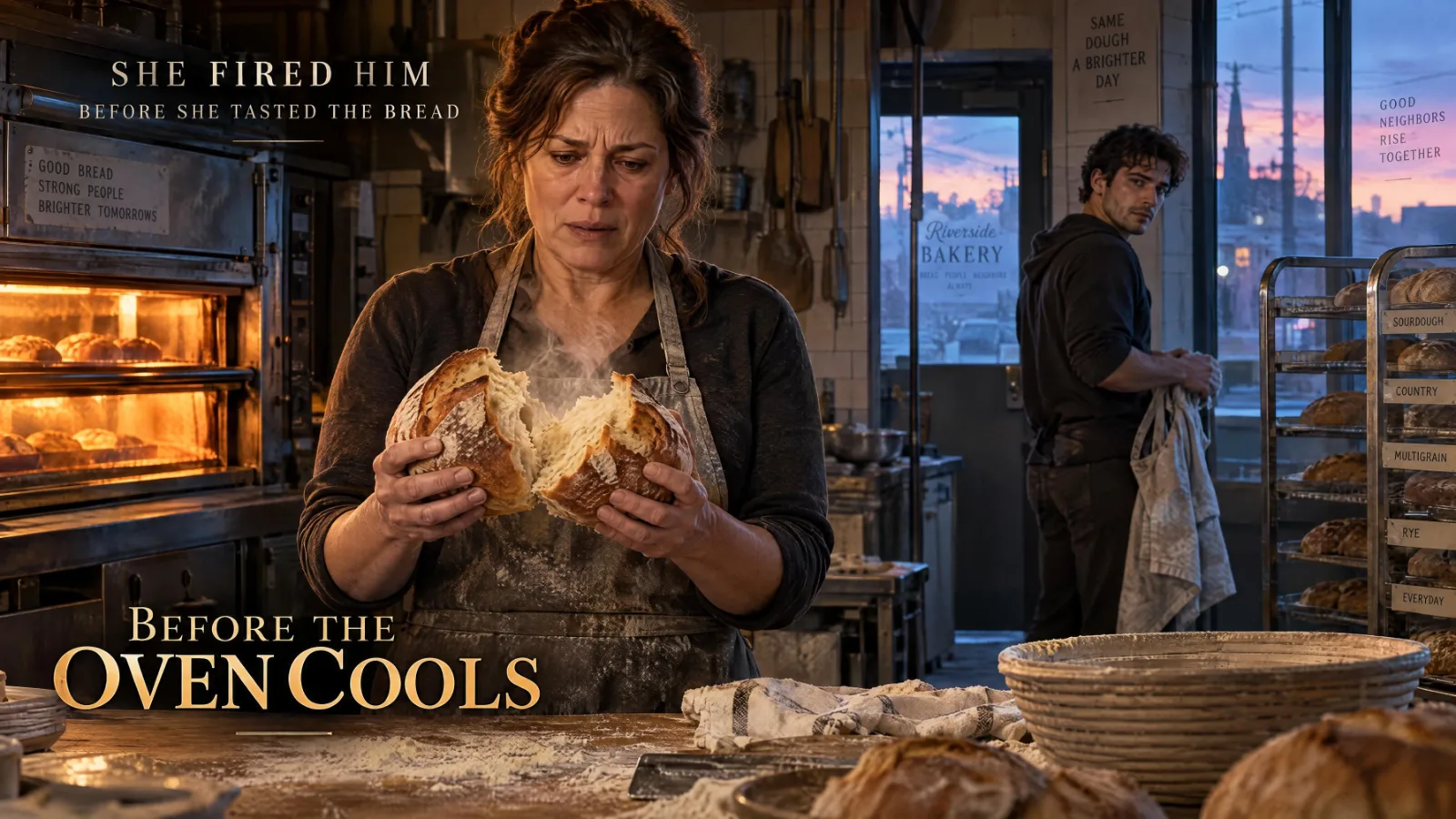
Mara Keene fired Theo Navarro at four forty in the morning.
She did it beside the mixer, which was still rotating slowly because Theo had forgotten to switch it off after pulling the last batch of dough.
“You changed the hydration again.”
Theo leaned against the flour bin.
“I adjusted it.”
“You changed it.”
“The flour came in dry.”
“The flour came in exactly the way flour comes in November.”
Theo looked toward the mixer.
“That batch would've been tight.”
“You've worked here nine nights.”
“And every night you've told me you hired me because I know bread.”
“I hired you because Denise quit three days before Thanksgiving.”
“That too.”
Mara reached across him and shut off the machine.
Silence settled briefly over the production room.
Not true silence.
Keene's Bakery had not been truly silent since Mara was a child.
Refrigerator compressors hummed along the back wall. The proofing cabinet clicked. Water moved inside old pipes. The deck ovens gave off the faint metallic expansion sounds that came whenever stone and steel cooled at different speeds.
Theo rubbed flour from his forearms.
Mara had liked him during the interview.
That was irritating in retrospect.
Twenty-seven years old. Seven years in commercial bakeries. No culinary-school performance. No speech about “elevating” bread. He had arrived wearing ordinary work boots and had asked more questions about the ovens than the menu.
He worked fast.
He kept his station clean.
He also treated instructions as interesting suggestions.
“You changed the fold too,” Mara said.
Theo glanced at the cooling rack.
“The dough needed strength.”
“We don't fold that loaf.”
“Maybe that's the problem.”
Mara stared at him.
Theo apparently realized, several seconds too late, that this had been the wrong sentence.
“This bakery has been making Keene country bread for fifty-three years.”
“I know.”
“My father developed that formula.”
“I know.”
“And you decided in your first week that he didn't understand his own bread?”
“I didn't say that.”
“You didn't have to.”
Theo exhaled through his nose.
He looked tired.
So did Mara.
Night baking did ugly things to people who argued before coffee.
“I followed the formula,” he said. “I just handled the dough differently.”
“You were told not to.”
“Yes.”
“And then you did it anyway.”
“Yes.”
At least he didn't lie.
Mara almost respected that enough to become angrier.
“Take your apron off.”
Theo's expression changed.
Not much.
Just enough.
“You're serious?”
“Yes.”
“Mara.”
“No.”
“One batch.”
“Three.”
“The first two sold.”
“That is not the point.”
“What is the point?”
She stepped closer to the worktable.
“That when I tell somebody how production works in my bakery, I don't spend the rest of the night wondering which instruction they decided was optional.”
Theo studied her for a moment.
Then he nodded.
“Okay.”
That was worse than another argument.
He untied his apron, pulled it over his head, folded it once, then apparently reconsidered the courtesy and dropped it onto the worktable instead.
“I'll pick up my last check later.”
“Tuesday.”
He walked toward the rear door.
Mara immediately began putting his station back into order.
Bench knife.
Scale.
Dough tub.
Linen.
He had left a loaf on the table.
Of course he had.
The country loaf was still too warm to bag. Deep brown crust. Slightly darker at the ears. Theo had scored it differently too.
Mara picked it up to move it onto the rack.
The crust gave softly beneath her thumb.
Something about the resistance bothered her.
She turned the loaf.
Theo had shaped it tighter than their standard production.
Mara tore the loaf open.
Steam rose into her face.
The crumb separated in long, irregular layers.
She stopped.
No.
She pulled the loaf farther apart.
There it was again.
A subtle spiral through the interior caused by folding the outer edge inward, turning the dough, then pressing with the heel of the hand before the gluten fully relaxed.
Her father had never written it down.
Mara had asked him why once.
Arthur Keene had shrugged and said there were things you wrote for people and things you showed them.
Mara tore off a piece.
She tasted it.
The bakery disappeared for half a second.
She was eleven years old again, sitting beneath the worktable because Arthur had refused to let her near the ovens after she burned her wrist.
He had handed her the heel of the first loaf out of the deck oven.
Same pull.
Same chew.
Same faint sweetness from fermentation pushed slightly longer than the production sheet allowed.
Mara turned.
Theo had one hand on the rear door.
“Wait.”
He stopped.
Mara walked toward him carrying the torn loaf.
“Who showed you how to fold dough like that?”
Theo did not answer immediately.
He looked at the bread.
Then at her.
“Arthur Keene.”
Mara felt something in her chest close.
“That's my father.”
“I know.”
The compressors seemed suddenly too loud.
Mara stared at him.
“My father died six years ago.”
Theo nodded.
“I know that too.”
“How?”
“I knew him before.”
“From where?”
Theo looked toward the clock.
Almost five.
Delivery drivers would begin arriving soon.
The front baker would be in within twenty minutes.
“Linden Street,” he said.
Mara's fingers tightened around the loaf.
“What about Linden Street?”
“The family center.”
She knew the building.
Everybody in the neighborhood had.
A brick former nursing home three neighborhoods south that became temporary housing after the recession and closed years later when the city sold the property.
“What does that have to do with my father?”
Theo looked surprised by the question.
“He baked there.”
Mara almost laughed.
“No, he didn't.”
Theo said nothing.
“My father was here six nights a week.”
“Not all night.”
“You're mistaken.”
“I'm not.”
“When?”
Theo hesitated.
“Two thousand nine. Some of two thousand ten.”
The loaf became heavier in Mara's hands.
Those dates belonged to a period her family rarely named.
Her mother called it Arthur's bad year.
Mara had always called it something less charitable.
That was the year flour disappeared from inventory.
The year her father stopped coming home two nights a week.
The year her parents nearly separated.
“You need to leave,” Mara said.
Theo's eyebrows lifted.
“You already fired me.”
“I know.”
He looked at her for another moment, then pushed the door open.
Cold predawn air entered the bakery.
Mara spoke before she could stop herself.
“Theo.”
He turned.
“How old were you?”
“When?”
“When you knew him.”
“Twelve.”
That answer made even less sense.
Theo stepped outside.
The door closed behind him.
Mara remained in the production room holding a loaf she suddenly could not bring herself to throw away.