ROOM SEVEN
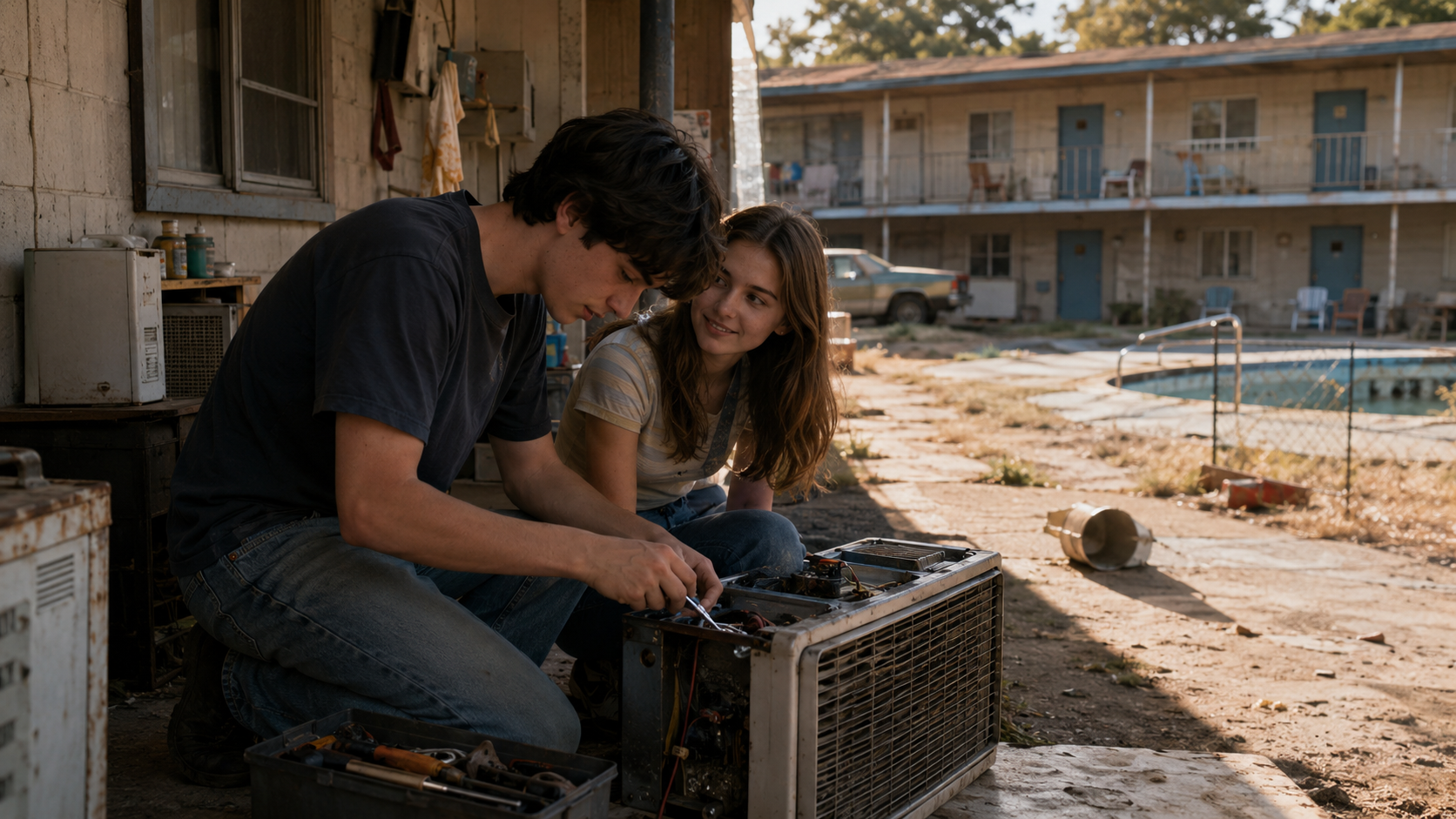
I grew up in a motel my mother could barely afford to own.
The Hale Motor Court sat beside Highway 41 in eastern Tennessee, fourteen rooms arranged in an L around a cracked swimming pool that had not held water since I was six. My mother, Ruth, bought the place with money from my grandfather's life-insurance policy and a bank loan whose monthly payment she could recite down to the penny.
Room Seven was directly behind the office.
That was ours.
Guests got beds with matching covers.
We got whatever linen had survived too many washings to be rented.
I never considered us poor until other children explained it to me.
What bothered them more than the motel was my voice.
I stuttered badly as a child. Not occasionally. Not only when I was nervous. Words seemed to reach a locked door somewhere behind my teeth and pile up there until my face tightened from the effort of getting them through.
Children are efficient in their cruelty.
By second grade, I had been called Broken Record, Engine Knock, and Morse Code.
Teachers told me to slow down.
My mother told them to stop finishing my sentences.
That distinction probably saved me.
“If he needs thirty seconds,” she told my third-grade teacher, “then the class has thirty seconds.”
Ruth Hale was five feet three inches tall and had no measurable fear of anyone with a clipboard.
Elise Carter moved into Room Eleven with her father when we were nine.
Her father installed commercial refrigeration systems and followed contracts from town to town. They were supposed to stay six weeks.
They stayed eleven years.
Elise never asked me to repeat myself unless she genuinely hadn't heard.
The first afternoon we met, she found me behind the laundry room taking apart a discarded window air conditioner.
“What are you doing?”
“T-trying to see why it rattles.”
“Does it work?”
“Yes.”
“Then why does it matter?”
I remember looking at her and realizing I had never been asked that question.
“Because it shouldn't rattle.”
She sat beside me.
That was Elise.
She rarely needed a grand reason.
If something mattered to you, she treated that as sufficient evidence that it mattered.
The air conditioner had a bent fan blade.
I straightened it.
The rattle stopped.
By fourteen, I repaired televisions, vending machines, ice makers and almost every air-conditioning unit at the motel. I couldn't always explain what was wrong without fighting my own mouth, but machines were generous that way. They didn't require explanations.
You listened.
You watched.
You found the part doing something it wasn't supposed to do.
Then you decided whether it could be fixed.
Elise believed that applied to people too.
She was wrong, but it took both of us years to understand how wrong.
When I was sixteen, three boys from school followed me behind the vocational building after class.
One of them had spent the semester imitating my stutter.
I usually ignored him.
That afternoon he took the wooden toolbox my mother had given me for Christmas and threw it into a drainage ditch.
Something in me changed.
I didn't hit him.
I couldn't.
There were three of them.
Instead I climbed into the ditch and recovered the box while they laughed.
The latch was broken.
Two sockets were gone.
I carried it home.
Elise found me repairing the hinge.
“You should tell someone.”
“What would they do?”
“Something.”
I shook my head.
She sat beside me.
“You always fix the thing they break.”
It sounded like admiration.
I heard accusation.
“What else should I do?”
“Sometimes,” she said, “you should let people know they broke it.”
I remembered that sentence many years later.
At seventeen, the school district's only diesel mechanic quit two days before the state vocational competition.
Our instructor entered my name without telling me.
I protested for nearly ten minutes.
Mostly unsuccessfully.
The competition required us to diagnose six engine faults in forty-five minutes.
I finished in twenty-eight.
The judge asked how I had identified a failing injector so quickly.
“I heard it.”
He stared at me.
“You heard it?”
“Yes.”
That afternoon, a representative from Cumberland Technical Institute offered me a scholarship.
My mother cried in the motel office.
Elise kissed me beside the dead swimming pool.
Then she pulled back and said, “Don't make that face.”
“What face?”
“The one where you're surprised something good happened to you.”
I didn't know then how much of my life I would spend trying to make that face disappear.