THE PROMISE ON THE DOCK
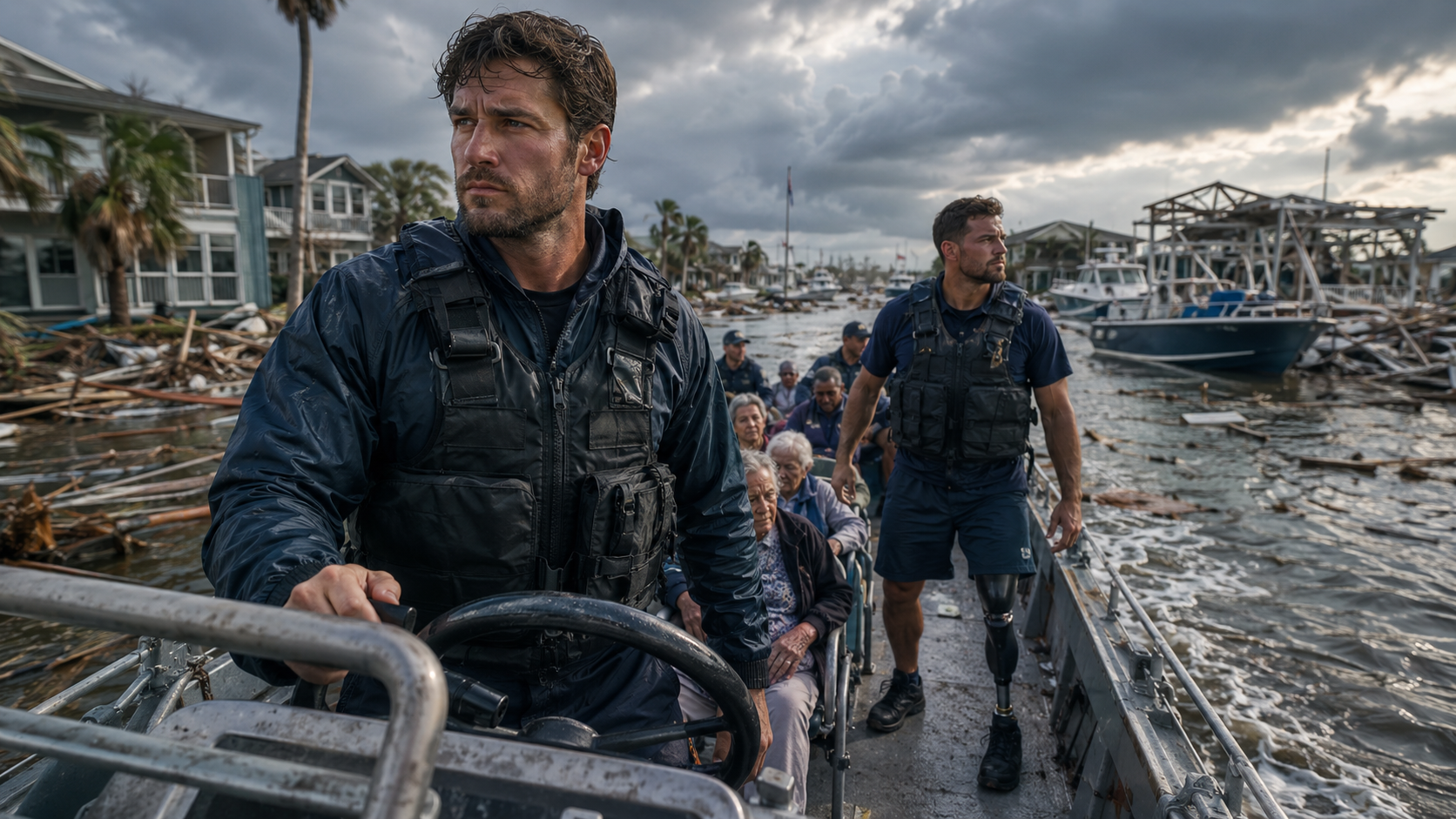
Grant lost his left leg below the knee.
Luis lost everything.
The official investigation eventually concluded that our crew had saved six civilian lives under conditions that should have forced us to withdraw.
People called us heroes.
I hated the word.
Heroes were supposed to feel as if they'd done something heroic.
I mostly felt late.
Too slow reaching Luis.
Too slow understanding what the surge would do.
Too slow to trade places.
Grant hated the word for different reasons.
He woke after surgery and asked where Luis was.
I told him.
Then he looked toward the blanket where his left leg ended and turned his face toward the wall.
For months, he barely spoke to me.
When he did, it was usually to ask why I hadn't left him there.
“You should've gotten Luis.”
“I tried.”
“You came for me first.”
“You were closer.”
“That doesn't make it better.”
Nothing I said did.
After rehabilitation, I received a Coast Guard commendation in Washington.
My mother attended.
Elise attended.
Luis's mother sat beside us holding a photograph of her son at nineteen.
The medal felt too heavy for its size.
Afterward, Mrs. Ortega asked me to walk with her.
We ended up beside the reflecting pool.
“You and Luis had plans.”
I knew immediately what she meant.
“He talked too much.”
“He always did.”
She smiled.
“Harborlight.”
That was the name Luis had chosen.
I had forgotten it.
Or tried to.
“He wanted to paint it on the first boat.”
I stared at the water.
“I can't.”
“Why?”
“Because it was his.”
Mrs. Ortega looked at me for a long time.
“No. It was yours together.”
“I don't know how to run a company.”
“You know how to fix boats.”
“That's not the same thing.”
“Then find someone who knows the other part.”
She placed Luis's battered notebook in my hands.
He had carried it on deployments.
The cover was swollen from water.
Inside were sketches, supplier names, lists of equipment and page after page of ideas.
On the final written page, beneath a terrible drawing of a flat-bottomed rescue boat, Luis had written:
HALE + ORTEGA HARBORLIGHT BUILD THE BOAT YOU WISH WAS COMING FOR YOU.
I read it three times.
Mrs. Ortega touched my arm.
“You don't owe my son a company.”
I looked at her.
“Then why give me this?”
“Because you owe yourself the choice.”
Two months later I left active service.
Elise thought I was coming home.
Instead I went to Louisiana and bought a forty-year-old utility boat with a cracked transom and an engine that smoked at idle.
She stood on the dock staring at it.
“This is the plan?”
“No.”
“Good.”
“This is all I can afford.”
She laughed despite herself.
For the next year, Harborlight lost money with almost professional consistency.
We hauled disabled fishing boats.
Recovered damaged marina equipment.
Transported repair crews.
I slept in the wheelhouse because rent seemed irresponsible.
Elise took freelance photography assignments and visited when she could.
Grant did not.
He lived alone in Florida, drank too much and returned almost none of my calls.
Then my mother became sick.
The diagnosis was pancreatic cancer.
Everything suddenly became measured in months.
I returned to Tennessee.
Ruth listened while I explained that Harborlight was failing.
She smiled.
“What?”
“You sound happy.”
“I'm losing money.”
“You've lost money before.”
“No, I haven't.”
“You owned a motel with me.”
Fair.
She reached for my hand.
“Is it worth fixing?”
I knew she wasn't talking about the boat.
“Yes.”
“Then don't confuse difficult with broken.”
My mother died four months later in Room Seven.
The room where she'd raised me.
The room whose key I had carried away years before.
After the funeral, Elise found me sitting beside the empty motel pool.
“I can stay,” she said.
I wanted her to.
That was exactly why I said, “You have the assignment in Seattle.”
“Mason.”
“Go.”
“You don't have to prove you can survive everything alone.”
“I know.”
She touched my face.
We both knew I was lying.