THE RULE HE BROKE
Prison stripped glamour from crime faster than guilt ever had.
Caleb had spent years watching men enter restaurants through kitchens, skip waiting lists, settle debts with a nod, and walk through doors that opened because somebody knew Gideon Rourke. Inside prison, everybody waited. They waited for counts, food, mail, telephone access, doors, medical appointments, lawyers, and decisions made by people they could not charm.
Nothing moved because Caleb knew Gideon.
At first he hated the powerlessness. Then he began identifying the smaller systems inside the larger one.
That was what Gideon had trained him to do.
Contraband circulated through the prison in ways Caleb never needed to understand completely to profit from. He connected people, remembered debts, arranged favors, and eventually became involved in the illegal trade of prescription medication.
Leah wanted nothing to do with it. For months she refused to participate in any part of Caleb’s prison economy, but financial desperation gradually eroded the boundary. A trusted visitor carried small quantities through a chain Caleb deliberately kept vague when speaking to Leah.
The money kept the mortgage current and paid legal expenses.
Every compromise came with the same private sentence.
Just until.
Just until Caleb came home.
Just until the house was safe.
Just until Gideon made good on everything Caleb had sacrificed.
Caleb was released after four years and eight months.
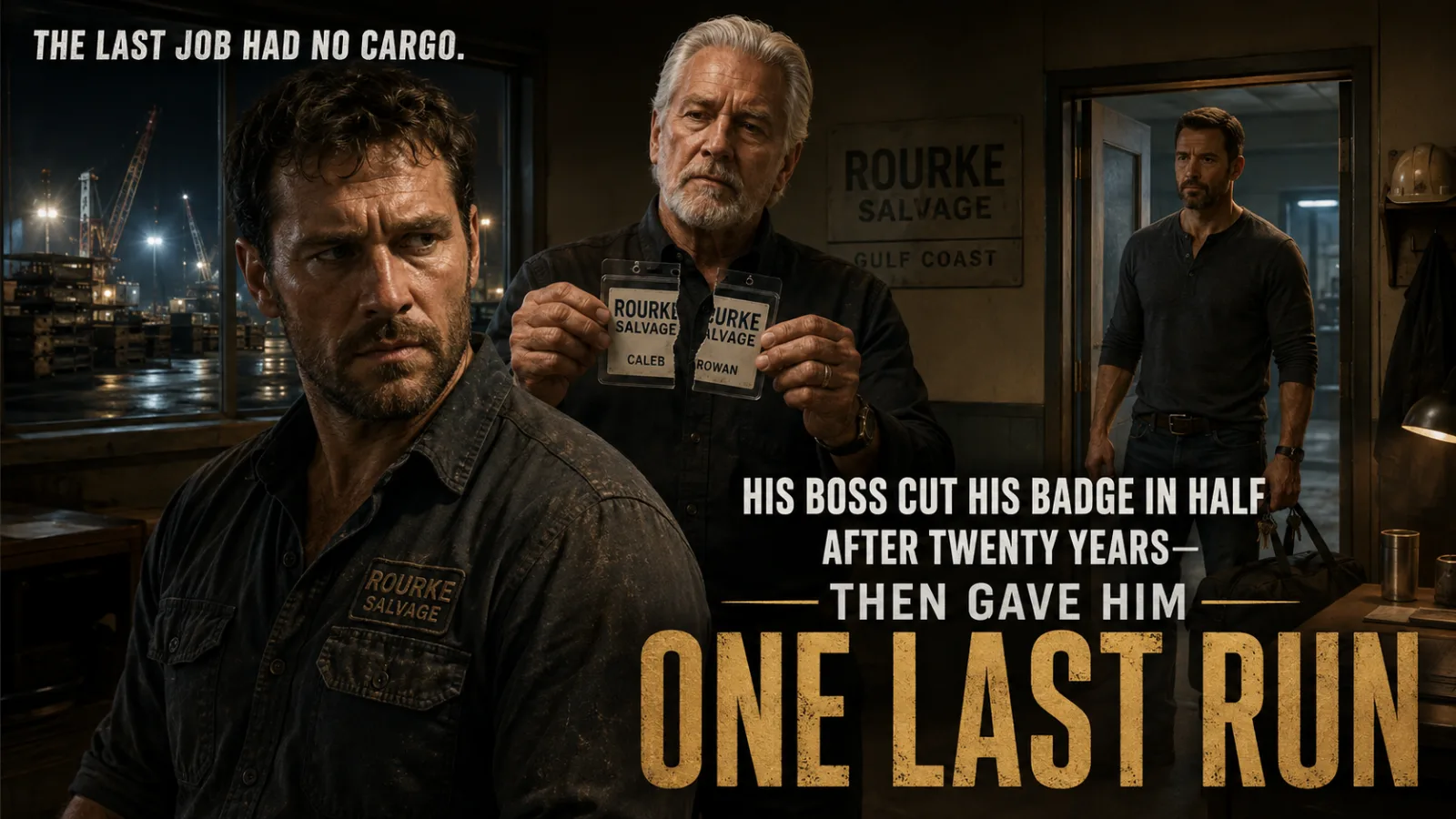
Gideon asked him to come to the salvage yard before he went home. The old man had more silver in his hair and less patience around his eyes. He embraced Caleb once, then walked him through the rebuilt offices as if presenting a company Caleb had helped create but no longer fully belonged to.
At the end of the tour, Gideon shut the door.
“I heard what you were doing inside.”
Caleb said nothing.
“No pills. No powder. No street business through my yard.”
“I kept my family afloat.”
“I kept your family afloat.”
Something old and grateful inside Caleb turned bitter. “You paid enough to stop Leah selling the house.”
“That is what afloat means.”
“I lost five years.”
“You lost them because you got caught.”
It was the first time Caleb heard Gideon speak to him without the paternal varnish.
Gideon leaned forward. “Cargo is paperwork. Contracts are relationships. Drugs make people stupid, frightened, and visible. You want back in here, you leave that behind.”
Caleb agreed.
Within six months he broke the rule.
Partly it was money. Mostly it was resentment.
Caleb had gone to prison while Gideon’s company grew. Miles had emerged from his own sentence with a new house and equity in a towing subsidiary. Theo had become recovery manager. Caleb returned to find younger men sitting at desks he once controlled.
The illegal pill business made him important again. Miles joined because Miles would join almost anything profitable if he believed enough distance existed between himself and the risk. Theo wanted in as well, but Miles refused him.
Theo resented the exclusion for months.
At the same time, Gideon’s legitimate empire reached its peak. Severe storms flooded coastal warehouses, leaving insurers and public agencies with enormous amounts of damaged or disputed property. Rourke Marine won contracts to move, inventory, auction, and dispose of much of it.
Miles saw an opportunity.
The scheme became larger than anything they had attempted before. Through false inventory, corrupt access, cooperating brokers, and manipulated auctions, high-value consignments effectively disappeared between official custody and private resale. Luxury watches, marine electronics, industrial components, and collectible jewelry entered a chain of shell transactions and emerged with cleaner histories.
Caleb never knew the exact total.
Miles claimed twelve million dollars.
Gideon insisted he knew nothing about it, which Caleb had learned was Gideon’s preferred way of knowing dangerous things.
For three weeks everybody behaved.
Then one driver arrived at the yard in a bright red imported truck that cost more than his house.
Miles watched it from the office window. “I told him nothing new for a year.”
Caleb shrugged. “It’s a truck.”
“It’s an affidavit with tires.”
Another crew member purchased a waterfront condominium in his girlfriend’s name. A third paid cash for a racing boat and began filling it with people he met at casinos.
Miles changed.
The humor disappeared first. Then the sleep. He began calling Caleb at odd hours to ask whether certain men had contacted him. A warehouse clerk vanished after telling coworkers he planned to leave Louisiana. The driver with the red truck later died during a boating incident police initially treated as suspicious.
Caleb asked Miles whether he was cleaning up the crew.
Miles smiled without warmth. “You don’t want answers to questions like that.”
For the first time, Caleb realized he was afraid of the man who had once handed him a pressure washer instead of throwing him out.
Theo never realized he should have been afraid too.
He had spent years complaining that Gideon treated him like hired muscle while Caleb and Miles received the profitable work. When Gideon invited him to a private meeting at an old dry dock outside Port Mercy, Theo arrived wearing a new white shirt and told Caleb he was finally being made a regional partner.
“About damn time,” Theo said.
Caleb tried to be happy for him, but something about Gideon’s expression that afternoon bothered him.
Theo never came home.
The truth emerged in pieces. Ellis Dane’s older brother had spent years pressuring officials, unions, and contractors to isolate Rourke Marine. Gideon had quietly negotiated a truce to protect a major port concession.
Theo was the price.
Miles learned the same day Caleb did and threw a chair through a glass dispatch partition.
“You gave him up?” he shouted.
Gideon did not flinch. “Theo killed a man.”
“We all carried that.”
“No. We all carried Theo.”
The distinction silenced the room.
Caleb understood then that Gideon’s version of family had always been conditional. Protection lasted only while protection cost less than sacrifice.
After Theo disappeared, Caleb began using more of the medication he sold. Leah recognized the change before he admitted it. He slept at strange hours, checked the street from windows, moved too quickly, and hid cash in places he later forgot.
One night she found him dismantling a kitchen vent because he thought someone had hidden surveillance equipment inside it.
She stood in the doorway in her robe.
“Look at yourself.”
“I’m fine.”
“You’re taking the kitchen apart at two in the morning.”
“I heard something.”
“You hear things because you haven’t slept.”
Caleb pressed both hands against the counter. “I need one more run. Then I’m done.”
Leah laughed, but there was no humor in it. “You have been one more run away from becoming a decent man since I met you.”
The next arrest came before Caleb could prove her wrong.
Federal narcotics agents and financial investigators had been building a case around his side business. They took him at a warehouse outside Lafayette and released him on bond while attorneys fought over charges and evidence.
When Caleb returned home, Leah had destroyed the stash he had hidden inside the house and burned a notebook containing cash records because she believed agents might return with a broader warrant.
“You did what?”
“I saved us.”
“You burned everything.”
“I saved us.”
“That was our money.”
“That was poison in a kitchen with our son sleeping upstairs.”
Caleb checked the cabinet where he kept emergency cash.
Empty.
Leah had used most of it to pay retainers, overdue taxes, and debts Caleb had hidden from her.
By morning the life he had spent twenty years building had shrunk to a mortgaged house, frozen accounts, pending charges, and whatever value Gideon Rourke still believed Caleb possessed.
At nine seventeen, the salvage yard called.
Gideon wanted to see him alone.