THE CUT BADGE
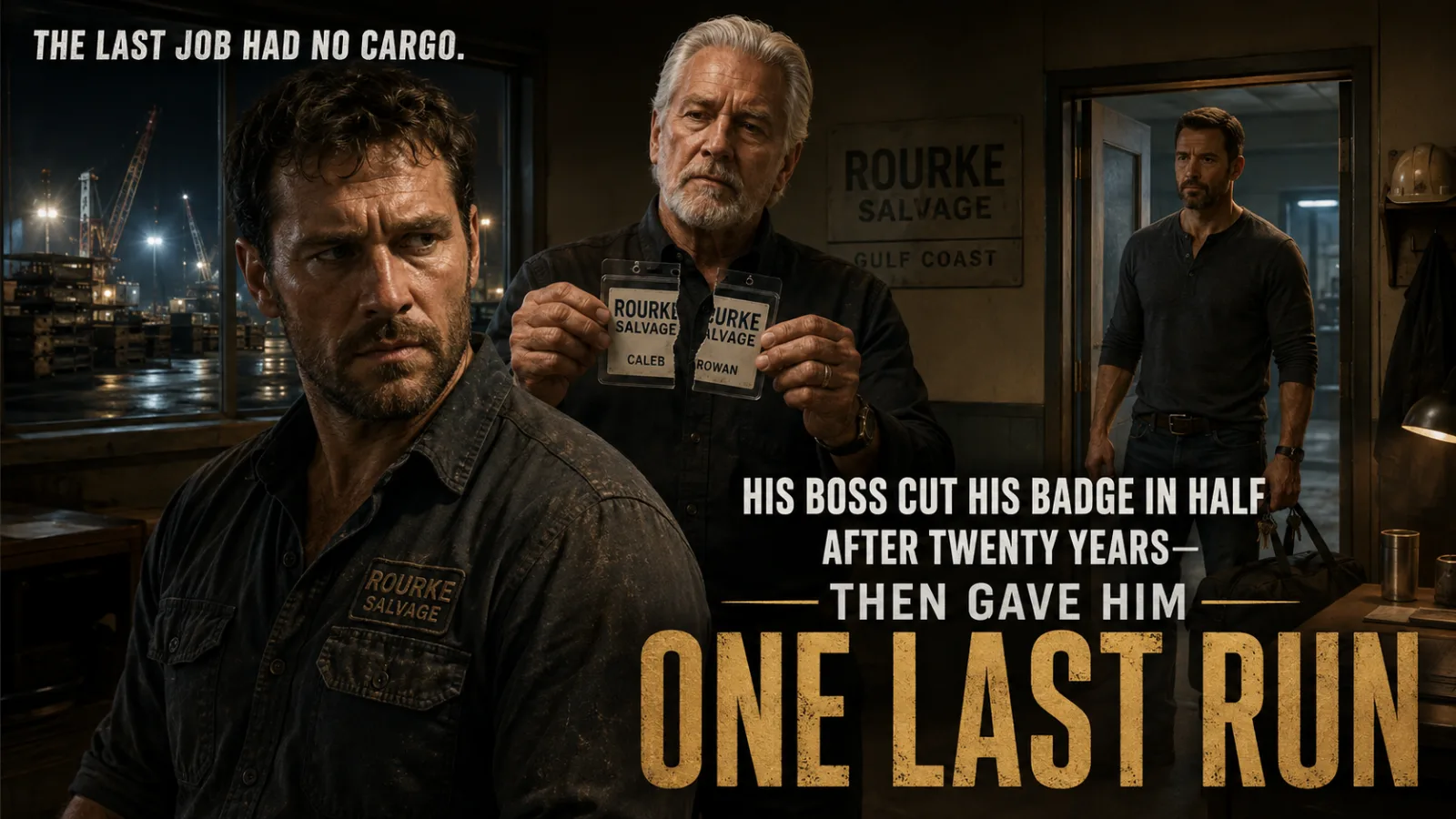
Leah told Caleb not to go.
They stood in the kitchen where she had burned the notebook the night before. A dark scorch mark remained inside the stainless-steel sink. Julian had already left for school with Leah’s sister, making the house feel larger and more exposed than usual.
“Gideon doesn’t ask,” Caleb said. “If he says come in, I go in.”
Leah folded her arms. “Listen to yourself.”
“He can help.”
“He can bury you.”
Caleb looked at her.
Leah’s mouth tightened. “I didn’t mean that literally.”
Neither of them believed her.
Before leaving, Caleb wrote the name of his attorney and the salvage-yard address on a piece of paper and placed it beside Leah’s keys. If he did not call her within an hour, he told her, she should contact the lawyer and explain exactly where he had gone.
“You think they’ll hurt you?”
Caleb stood with his hand on the back door. “I think I’ve spent too long assuming they won’t.”
It was the first fully honest answer he had given her in days.
Rourke Marine looked ordinary when he arrived. Forklifts moved between sheds. Welders worked beside a damaged barge cradle. A crew rinsed mud from a flatbed near the wash rack. Two mechanics waved at Caleb as he crossed the yard.
He had always imagined that real danger would change the atmosphere around it.
Instead, work continued.
Gideon waited in the old office behind the machine shop.
Miles was there too.
That frightened Caleb more than finding Gideon alone would have.
A black duffel rested beside Miles’s boot.
Gideon gestured toward the chair.
“Sit.”
“I’m fine.”
Gideon studied him, then opened a desk drawer and removed Caleb’s laminated yard-access badge.
“How’d you get that?”
“Your access was suspended when the agents picked you up.”
Gideon took heavy scissors from the desk and cut directly through the photograph.
The sound was small.
Caleb felt it anyway.
Gideon placed both halves on the workbench and pushed a small envelope containing four thousand dollars toward him.
“You were family until you made us visible.”
Caleb looked at the envelope but left it where it was.
“Twenty years buys four grand?”
“Twenty years bought you twenty years.”
Miles stepped forward and set a ring of truck keys beside the money.
“Breaker Point. Black truck. You go alone.”
Breaker Point was an abandoned ship-breaking property almost forty miles downriver. Rourke Marine occasionally stored damaged machinery there, but Caleb could not remember a single legitimate reason to send a man under federal scrutiny there without a dispatcher, manifest, or work order.
“What am I hauling?”
Miles pushed the black duffel toward him. “Everything you need.”
Caleb unzipped it.
Industrial gloves.
Disposable coveralls.
A folded plastic tarp.
No manifest.
No equipment list.
No cargo.
He straightened slowly.
“Where’s the shipment?”
Miles reached for the duffel before answering.
Caleb caught the truck keys first and closed his fist around them.
Miles stopped.
For the first time, Gideon’s expression tightened.
Caleb looked from Miles to the old man. He had spent twenty years translating Rourke silences, unfinished instructions, missing paperwork, and sentences whose real meaning lived in what nobody said.
Now the language suddenly seemed childish.
“There is no shipment.”
Miles said, “Don’t make this dramatic.”
“If I take that truck to Breaker Point, what am I supposed to do?”
“Drive.”
“And then?”
Miles said nothing.
Caleb looked at Gideon. “Do I come back?”
Nobody answered.
That was answer enough.
Caleb returned the keys to the bench but kept his hand beside them.
Miles shifted forward.
Gideon spoke quietly.
“Let him go.”
Miles turned toward him. “Gideon—”
“I said let him go.”
Caleb understood the calculation immediately. There were employees fifty yards away. Federal investigators had already searched the yard. Leah knew exactly where Caleb was. Whatever Miles had intended for Breaker Point, creating a disappearance inside the main yard would produce the visibility Gideon claimed to hate.
Caleb walked toward the door.
Behind him Gideon said, “You leave now, there is no coming back.”
Caleb stopped with his hand on the knob.
For most of his adult life, that sentence would have terrified him.
He looked over his shoulder.
“That’s the first kind thing you’ve said to me today.”
He left.
Caleb did not run across the yard. He walked at an ordinary pace, passed the wash rack, climbed into his pickup, and drove until the Rourke sign disappeared from his mirror.
Only then did his hands begin shaking.
He called his attorney from a crowded gas station thirty miles away.
By evening Caleb was sitting inside a federal building with two investigators, an assistant U.S. attorney, and a paper cup of coffee he never touched.
Nobody treated him like a hero.
That helped.
“What are you offering?” the prosecutor asked.
“Everything I can prove.”
“Not everything you know?”
Caleb looked at her.
“Knowing is cheap,” she said. “We need corroboration.”
For the first time in twenty years, somebody explained power to Caleb in language Gideon had not taught him.
He began with the salvage invoices. He described friendly brokers, manipulated contracts, diverted consignments, and the side business Miles had built around them. He admitted his own participation. He disclosed the prescription operation and explained the storm-recovery theft scheme, including the parts he had personally managed.
Then the prosecutor asked about missing people.
Caleb’s mouth went dry.
He told them about Ellis Dane.
The supper.
Theo.
The tug.
The second concealment.
Nobody congratulated him.
One agent simply closed her notebook. “That changes this.”
Over the following months investigators corroborated more than Caleb expected. Financial records connected shell companies to Rourke personnel. Former employees began talking when they learned Caleb had cooperated. Agents reconstructed Ellis Dane’s final known movements and located records proving the tug had been moved during the period Caleb described.
The Breaker Point meeting acquired meaning too.
A former yard employee eventually told investigators that Miles had ordered him to deliver another vehicle to the abandoned property on the morning Caleb was supposed to make his run and then leave the site before Caleb arrived. No legitimate cargo had ever been scheduled for the black truck.
The government could not prove precisely what Miles planned to do at Breaker Point, and Caleb never claimed he knew.
He no longer needed certainty to understand why Gideon had wanted him isolated.
Gideon was eventually charged with racketeering, fraud, conspiracy, and obstruction. Miles faced additional charges associated with the cargo operation and several acts of violence. Caleb pleaded guilty to his own crimes under a cooperation agreement.
The courtroom was the first place Gideon ever looked at Caleb without pretending disappointment was the same thing as love.
During one recess they passed within ten feet of each other.
Gideon spoke quietly.
“I made you.”
Caleb stopped.
His attorney touched his elbow, encouraging him to keep moving.
Caleb looked at the man who had once given him a brass key and convinced him that belonging was the same thing as being owned.
“No,” Caleb said. “You found me hungry.”
He walked away before Gideon could answer.
Caleb’s cooperation did not restore his old life. Assets were forfeited. His parents had to be relocated quietly. Leah and Julian entered a protection arrangement while the trials proceeded. Port Mercy became somewhere they could remember but could not safely return to.
Miles was convicted after a separate trial.
Gideon followed.
Caleb received a reduced sentence because of his assistance, but not freedom. At sentencing, the judge reminded him that telling the truth after twenty years of benefiting from lies did not erase what he had done.
Caleb agreed.
For once, he did not ask anyone to make the consequence disappear.