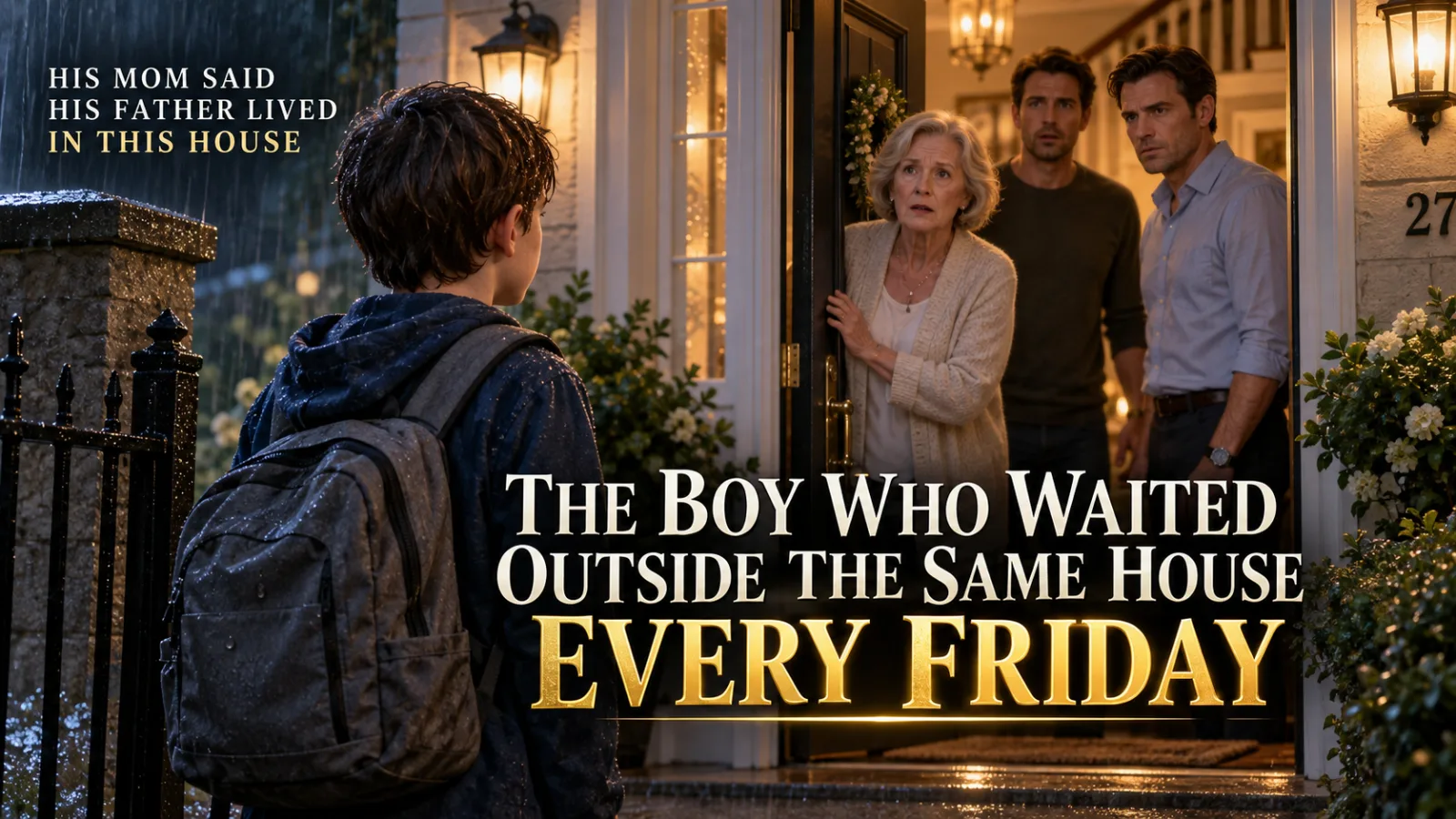
THE BOY AT THE GATE
By the sixth Friday, Eleanor Mercer had stopped pretending the boy was waiting for someone else.
He always appeared just before six, when the light over Briarwood Avenue went gold and the commuters began turning into the neighborhood. He wore the same gray backpack, though sometimes a different sweatshirt, and he never came closer than the brick mailbox at the edge of Eleanor’s drive. He would stand there for ten minutes, sometimes twenty, looking past the maple tree toward the house as if he were trying to memorize who came through the front door.
The first week Eleanor assumed he belonged to a neighbor. The second, she wondered whether he was waiting for a ride. By the third, she noticed he only came on Fridays, the one night both of her sons were reliably home.
Daniel arrived first most weeks, his white work truck coughing into the drive at five-thirty. Marcus usually followed fifteen minutes later in the blue sedan he used for school. They were grown men, thirty-nine and thirty-seven, but after their father died the previous year both had drifted back toward the house for different reasons. Daniel’s divorce had left him with a rented apartment he hated, so Eleanor offered him the finished rooms above the garage. Marcus had stayed during Walter’s illness and never quite moved out afterward. On Fridays they ate together because Eleanor had discovered that grief could dismantle a family faster than anger if nobody gave it a schedule.
The boy knew the schedule too.
That was what bothered her.
On the sixth Friday, rain had been falling since noon. The boy stood under the bare branches of the maple with his hood pulled tight, shoes dark with water. He was not carrying an umbrella.
Eleanor watched him from the kitchen window while Daniel opened a bottle of beer and Marcus argued with him about whether the roast needed another twenty minutes.
“Your stalker’s back,” Daniel said.
Eleanor glanced over her shoulder. “He’s eleven, not a stalker.”
“Then your tiny surveillance officer is back.”
Marcus looked through the window. “You should ask if he needs something.”
“I have asked with my eyes six times.”
“Very effective.”
Daniel smirked.
Eleanor took off her apron.
“Fine.”
She opened the front door before either son could follow.
The rain had sharpened, cold enough to sting. The boy saw her and immediately straightened. For one second he looked ready to run.
“Hey,” Eleanor called. “You don’t have to stand in the rain.”
“I’m okay.”
“You’re soaked.”
“I’m still okay.”
She walked down the porch steps but stopped well before the sidewalk. She did not want to frighten him.
“My name is Eleanor. I live here.”
“I know.”
The answer made her pause.
“What’s your name?”
“Eli.”
“Eli what?”
“Bennett.”
Something moved at the edge of Eleanor’s memory.
Bennett.
Not enough to become a thought.
Just enough to make her ask the next question more carefully.
“Eli Bennett, why have you been standing outside my house every Friday?”
He looked toward the doorway behind her.
Daniel had stepped into the hall. Marcus was a few feet behind him.
Eli saw them.
His face changed in a way Eleanor did not understand at first. It was not fear. It was concentration.
He was comparing them.
Then the boy looked back at Eleanor.
“My mom says my father lives here.”
The rain seemed suddenly louder.
Eleanor stared at him.
Eli swallowed.
“She just won’t tell me which man he is.”
Behind Eleanor, glass shattered.
She spun around.
Marcus stood frozen in the hall, staring at the floor where his water glass had slipped from his hand. Daniel did not look at the glass at all.
He looked at Eli.
For several seconds nobody moved.
Eleanor felt the old name finally arrive in her memory.
Bennett.
Lila Bennett.
She had not said that name aloud in twelve years.
Daniel’s face had gone white.
Marcus looked worse.
Eleanor turned back to the boy.
“How old are you?”
“Eleven.”
“When’s your birthday?”
“March second.”
Daniel made a sound behind her. Not a word. More like someone had punched the air out of him.
Eleanor looked from one son to the other.
“What the hell is this?”
“Mom,” Daniel said.
“No. Don’t ‘Mom’ me.”
Eli flinched.
Eleanor saw it and forced her voice down.
She went to the hall closet, grabbed a towel, and returned to the porch.
“Eli, come inside before you get sick.”
His eyes widened.
“My mom said I’m not supposed to.”
“Your mother knows you’re here?”
“No.”
That answer was immediate.
Daniel rubbed both hands over his face.
Marcus stepped forward. “Where is she?”
Eli looked at him.
“Who?”
“Your mother.”
“Work.”
“What does she do?”
“Emergency dispatch.”
“Marcus,” Eleanor snapped. “Stop interrogating him.”
“I’m not.”
“You sound like a cop.”
“I coach eighth-grade basketball.”
“You sound like a cop who coaches basketball.”
Daniel walked past them, picked up the broken pieces of glass, then seemed to realize he had no idea what he was doing and set them on the entry table.
Eli remained outside.
Eleanor held out the towel.
“Just the porch, then. You don’t have to come into the house.”
After a moment, Eli stepped under the roof.
Up close he looked younger than he had from the kitchen window. Freckles across the bridge of his nose. Brown hair flattened by rain. A small healed scar under his chin.
Eleanor’s eyes went involuntarily toward Daniel.
Daniel saw her do it.
“Don’t,” he said.
“What?”
“Don’t start deciding from his face.”
Marcus laughed once, but there was nothing amused in it.
“That would be convenient.”
Daniel turned on him. “What is that supposed to mean?”
“You know exactly what it means.”
Eleanor stepped between their lines of sight.
“Not in front of him.”
Eli looked at each brother.
“You both knew my mom?”
Neither man answered quickly enough.
The boy’s mouth tightened.
“Great.”
Eleanor knelt slightly so she was closer to his height without crowding him.
“Eli, I need you to call your mother.”
His hand went to his backpack strap.
“She’ll be mad.”
“She should be. You’ve been standing outside a stranger’s house in the rain.”
“You’re not strangers.”
That landed harder than Eleanor expected.
“To you, we are.”
He looked toward Daniel and Marcus again.
“Maybe not.”
Marcus closed his eyes.
Daniel walked into the kitchen and came back with his phone.
“I’ll call her.”
Eli shook his head instantly. “No.”
“Why?”
“Because I don’t know which one you are.”
Daniel stopped.
Eleanor felt something inside her tear open.
Not because the boy was being dramatic.
Because he was being literal.
He had spent six Fridays staring at two men, trying to solve a question the adults around him had been too frightened or too selfish to answer.
Eleanor handed him her phone.
“Then you call.”
Eli entered the number from memory.
It rang twice.
A woman answered.
“Eli?”
The boy’s expression crumpled almost imperceptibly.
“Mom.”
“Where are you?”
He looked at Eleanor.
“At the house.”
Silence came through the speaker so complete that everyone on the porch heard it.
Then Lila Bennett said, very softly, “What house?”
Eli’s eyes filled.
“You know.”
Another silence.
“Eli, put an adult on the phone.”
Eleanor took it.
“Lila?”
The breath on the other end stopped.
Eleanor had not heard her voice in twelve years, but she recognized it.
“Mrs. Mercer.”
“Eleanor.”
“Is he inside?”
“He’s on the porch.”
“Do not let either of them take him anywhere.”
Eleanor looked at her sons.
Daniel’s jaw clenched.
Marcus stared at the floor.
“I’m not letting anyone take him anywhere.”
“I’m coming.”
“Lila.”
“What?”
Eleanor looked at Eli, then lowered her voice.
“Is one of my sons his father?”
Lila did not answer.
“Lila.”
“I’ll be there in twenty minutes.”
The line went dead.
Eleanor handed the phone back to Eli.
Daniel moved toward the kitchen.
Marcus caught his arm.
“What are you doing?”
“Getting a drink.”
“No.”
Daniel jerked free. “Don’t touch me.”
“You don’t get drunk before she gets here.”
“I’m having one beer.”
“You’ve already had one.”
Eleanor’s voice cut across both of them.
“Enough.”
They stopped.
She looked at Daniel first, then Marcus.
“Did either of you know she had a child?”
Daniel shook his head.
Marcus did the same.
“Did either of you know she was pregnant?”
This time the silence was different.
Daniel looked at Marcus.
Marcus looked at Daniel.
Eleanor felt cold despite the warm air spilling through the doorway.
“Oh, my God.”
Eli watched them.
“You did know.”
Daniel stepped toward him.
“No. Not like this.”
“What does that mean?”
“It means—”
A car turned hard onto Briarwood Avenue.
Headlights swept across the rain.
A dark hatchback stopped crooked at the curb.
The driver’s door flew open before the engine shut off.
Lila Bennett ran through the rain.
Eleanor recognized her immediately despite the years. The same dark hair, now shorter. The same narrow face. The same way she moved when angry, as if every step had already been argued with.
She reached the porch, grabbed Eli by both shoulders and pulled him against her.
“What were you thinking?”
“I just wanted to see him.”
“You promised me.”
“You wouldn’t tell me.”
Lila closed her eyes.
Then she looked over his head.
Daniel and Marcus stood in the doorway.
For a moment the twelve years between them vanished.
Daniel whispered, “Lila.”
Her face hardened.
Marcus said nothing.
Lila moved Eli behind her.
“You stay away from him.”
Daniel stared at her.
“You told us the baby was gone.”
Lila froze.
Eleanor looked sharply at him.
“What did you just say?”
Daniel’s voice cracked.
“Dad said she lost it.”
Lila’s eyes went wide.
Marcus stepped forward.
“That’s what he told me too.”
Lila stared at both of them.
Then she laughed once, a broken, furious sound.
“I didn’t lose anything.”
Nobody spoke.
She pointed at Eli without taking her eyes off the brothers.
“He is what you were told I lost.”
Eleanor felt the porch tilt beneath her.
Lila’s hand began to shake.
“I wrote to both of you.”
Daniel shook his head. “No.”
“Yes.”
“I never got a letter.”
Marcus said, “Neither did I.”
Lila’s fury faltered.
For the first time she looked confused.
Then frightened.
Eleanor thought of Walter.
Her husband had handled the mail.
The bills.
The family business.
Problems.
Always the problems.
She turned toward the hallway where his old desk still sat behind a closed study door.
For the first time since Walter Mercer died, Eleanor wondered how many things in her marriage had been peaceful only because he had decided what everyone else was allowed to know.