THE FRIDAY HE WALKED INSIDE
One year after Eleanor first saw Eli Bennett standing at the edge of her driveway, Friday looked ordinary.
That was what made it important.
The maple tree had leaves again. The brick mailbox had been repaired after Daniel backed into it with his truck in February and denied responsibility until Eleanor produced security-camera footage. Marcus’s blue sedan was parked near the curb. Lila’s hatchback sat behind it.
Inside, Eleanor was making too much food.
Some things did not need reform.
She called the meal Friday dinner now because everyone else had given up pretending it was temporary.
The arrangement had rules.
Lila and Eli did not attend every week.
Marcus did not get offended when they had other plans.
Daniel was not allowed to turn dinner into a construction lesson unless someone asked.
Eleanor did not invite school friends, neighbors or distant relatives to “meet Eli” as though he were a newly discovered artifact.
Most importantly, nobody used the word family as leverage.
The word had to describe what they were doing, not force anyone to do it.
Marcus had learned that slowly.
He had also learned how to stand on the sideline at a soccer game without shouting instructions Eli could not hear and had not requested. He still failed sometimes.
At a tournament in April, he screamed, “Watch the near post!” so loudly the opposing goalkeeper turned around.
Eli later told him, “You are embarrassing.”
Marcus said, “That is a protected father activity.”
Eli replied, “We need laws.”
The word father had become easier between them.
Dad had not.
Marcus never asked for it.
That mattered more than Eli said.
For months, Eli called him Marcus.
On forms, he wrote father.
When teachers asked, he said my dad.
But to Marcus’s face, the name remained Marcus.
Lila noticed.
“So?” she asked one evening.
Eli was doing homework at the kitchen counter.
“So what?”
“You call him your dad when he isn’t there.”
Eli looked up suspiciously.
“Are you spying on me?”
“I have ears.”
“I don’t know.”
“You don’t have to call him anything you don’t want.”
“I know.”
“Okay.”
She returned to washing dishes.
After a minute Eli said, “It feels weird.”
“What does?”
“Dad.”
Lila turned off the water.
“Weird bad?”
“No.”
“Weird good?”
“No.”
“Very helpful.”
He frowned at his worksheet.
“It feels like the word was empty for a long time.”
Lila waited.
“And now it’s not empty, but I still remember when it was.”
She dried her hands.
“That makes sense.”
“Does it?”
“Yes.”
“How?”
“Because filling something does not erase when it was empty.”
Eli thought about that.
“Did you get that from therapy?”
“Probably.”
He smiled.
Lila had begun therapy six months earlier.
Not because Marcus insisted.
Because she realized anger had become a habit she did not want to hand to Eli as inheritance.
Marcus went too, separately.
Daniel claimed working with power tools was therapy until Eleanor threatened to enroll him herself. He eventually found a counselor after his divorce attorney, of all people, recommended one.
Eleanor joined a grief group.
Nobody became transformed overnight.
They became more difficult to fool.
That was enough.
Walter remained part of the family story.
Eleanor kept photographs of him.
Marcus sometimes defended memories of him.
Daniel sometimes could not.
Eli did not call him Grandpa.
Not at first.
“He wasn’t my grandpa,” Eli said once.
Marcus answered, “Biologically he was.”
“That’s not what I mean.”
Marcus understood.
Years later, perhaps Eli would choose another word.
Nobody hurried him.
The only person who disappeared from the story completely was the version of Walter who had been allowed to explain everyone else.
His letters remained in a fireproof box.
Not as weapons.
As evidence.
Lila had considered throwing away the forged rejection letter.
Eli asked her not to.
“Why?”
“Because one day I might think I imagined how stupid all of you were.”
Lila laughed.
“You definitely got that from me.”
The old check went into the same box.
So did the two unopened envelopes after Daniel and Marcus copied them. The originals belonged to Lila, and they returned them.
That detail mattered to Eleanor.
Walter had taken other people’s words and decided where they were allowed to go.
The family tried, whenever possible, to do the opposite.
On the anniversary Friday, Eleanor expected Eli at six.
At six-ten, he had not arrived.
Marcus checked his phone twice.
Eleanor noticed.
“Do not start.”
“I’m not starting.”
“You have refreshed the same text thread four times.”
“He said they were leaving at five-forty.”
“Traffic exists.”
Daniel walked through the kitchen.
“Maybe he found another dad.”
Marcus threw a dish towel at him.
Daniel laughed.
“Growth.”
At six-twelve, the doorbell rang.
Marcus started toward it.
Eleanor stopped him with one hand.
“My house.”
“You are territorial.”
“I am old.”
She opened the door.
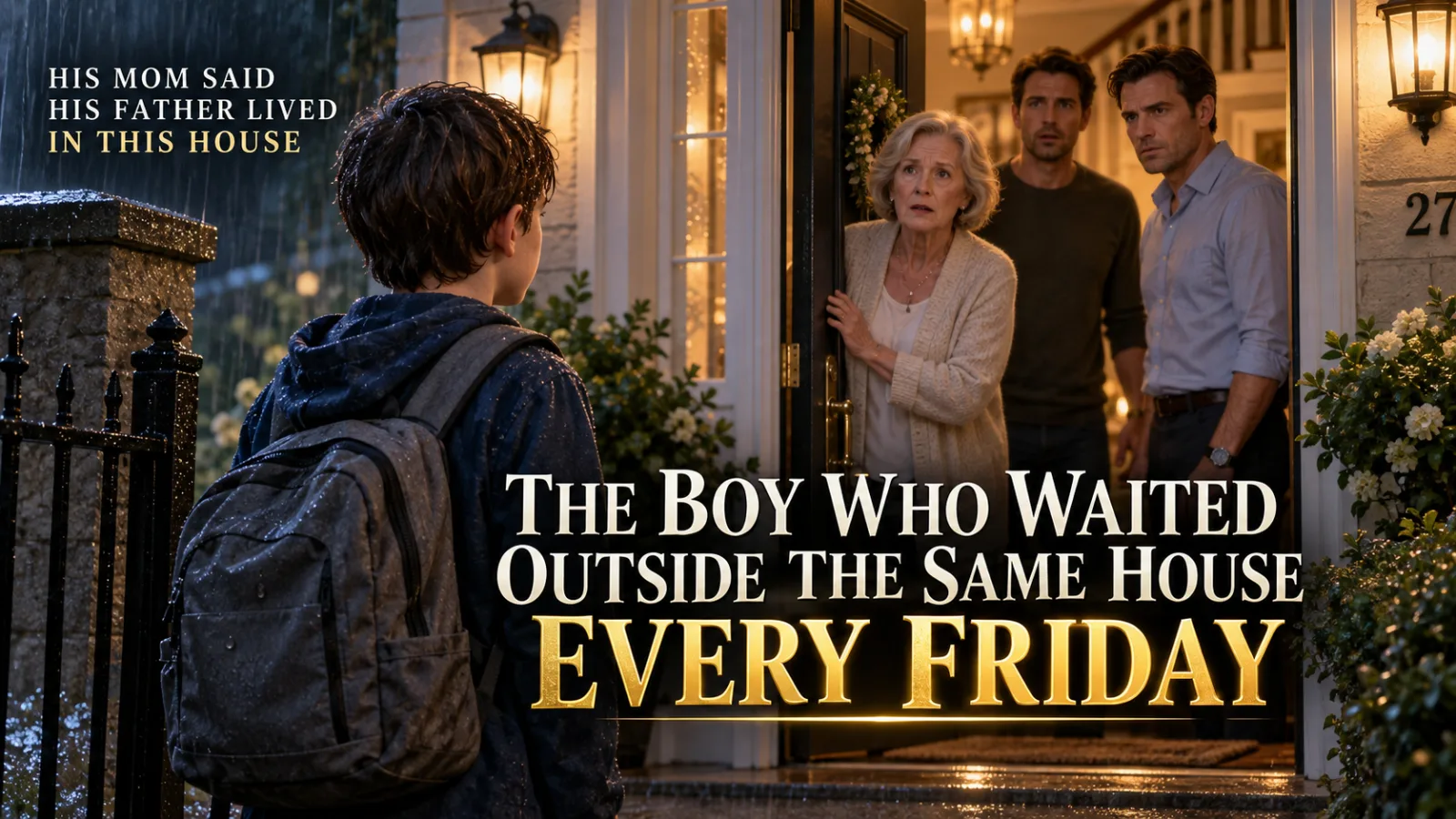
Eli stood on the porch.
He was twelve now, taller than the year before, hair longer, soccer bag hanging from one shoulder.
For one strange second Eleanor saw both versions of him.
The boy standing dry beneath the porch light.
The smaller boy soaked in rain beside the mailbox, staring at two men through a doorway and trying to identify his father from their faces.
Eleanor smiled.
“You know you can come in without ringing.”
“I know.”
“Then why are you standing out here?”
Eli glanced toward the driveway.
“Waiting.”
Eleanor’s chest tightened.
“For what?”
Before he could answer, a truck turned onto Briarwood Avenue.
Not Daniel’s white work truck.
Marcus had bought an old green pickup in March and spent months restoring it with Eli. The vehicle rolled to the curb with one headlight slightly dimmer than the other.
Marcus got out.
He looked confused when he saw Eli on the porch.
“I thought your mom was bringing you.”
“She did.”
Eli pointed down the block.
Lila’s hatchback was parked near a friend’s house. She had apparently dropped him off early and gone to pick up dessert.
Marcus walked toward the porch.
“Why didn’t you go inside?”
Eli shrugged.
“I wanted to wait for you.”
Marcus stopped.
Eleanor looked between them and suddenly knew she needed to be somewhere else.
“I have potatoes to burn.”
She went inside.
She left the door open.
On the porch, Marcus put his hands in his jacket pockets.
“Everything okay?”
“Yeah.”
“You sure?”
“Yeah.”
“Did something happen at school?”
“No.”
“Soccer?”
“No.”
“Your mom?”
“She’s fine.”
Marcus smiled.
“You are making this very suspenseful.”
Eli looked toward the street.
“Do you remember the first time I came here?”
Marcus’s smile faded.
“Yes.”
“I stood by the mailbox.”
“I know.”
“For six Fridays.”
“I know.”
“You saw me before Grandma came out?”
Marcus nodded.
“Twice.”
Eli looked at him.
“You never asked why I was there.”
The shame was immediate.
“No.”
“Why?”
“I thought you were somebody’s kid waiting for a ride.”
“That’s what Grandma thought.”
“I know.”
“Then after a while?”
Marcus looked at the brick mailbox.
“After a while I noticed you were watching the house.”
“And?”
“I still didn’t ask.”
“Why?”
Marcus could have made the answer kinder.
He did not.
“Because I was used to not asking questions when something felt uncomfortable.”
Eli nodded.
“Grandpa Walter.”
“Partly.”
“You.”
Marcus nodded again.
“Also me.”
Eli shifted the soccer bag higher.
“I was scared to knock.”
“I wish you hadn’t had to.”
“But I did.”
“Yes.”
“And then Grandma asked.”
“Yes.”
Eli smiled a little.
“She’s nosy.”
“Extremely.”
From inside Eleanor shouted, “I can hear you.”
Eli laughed.
Marcus did too.
Then Eli’s expression became serious again.
“I kept thinking if I found out which man was my father, I’d know what to do.”
Marcus waited.
“I didn’t.”
“I know.”
“It took forever.”
“A year is not forever.”
“When you’re twelve it is.”
“Fair.”
Eli looked toward the open doorway.
Daniel was setting plates on the table.
Eleanor was pretending not to watch through the kitchen.
The house glowed warm against the early evening.
“It’s weird,” Eli said.
“What is?”
“I used to stand out here because I didn’t know who I belonged to.”
Marcus’s throat tightened.
Eli continued.
“Now I know I don’t have to belong to the house.”
“No.”
“Or Grandpa’s name.”
“No.”
“Or you.”
Marcus forced himself not to react to that sentence before Eli finished.
Eli looked at him.
“But I want you.”
Marcus looked away because his eyes had filled too quickly.
The boy waited.
Marcus cleared his throat.
“That’s different.”
“Yeah.”
“Better.”
“Yeah.”
Eli rolled his eyes slightly, embarrassed by his own seriousness.
Then he said, “Come on, Dad. Grandma’s going to burn dinner.”
Marcus did not move.
Eli took two steps, noticed, and turned.
“What?”
Marcus’s face had completely broken.
“Oh, come on.”
Marcus laughed through tears.
“You cannot just say that and walk away.”
“I literally can.”
“You planned this?”
“No.”
“You waited outside for me.”
“That doesn’t mean I planned a speech.”
“It felt like a speech.”
“You’re ruining it.”
“Sorry.”
Eli stood there, trying not to smile.
Marcus stepped forward.
He did not grab him.
Did not force a hug.
He simply opened one arm.
Eli looked at it for half a second, then walked into him.
Marcus held his son.
Not the son he had been denied for eleven years.
Not proof of Walter’s wrongdoing.
Not a second chance at a life he could never reconstruct.
The boy in front of him.
That distinction had taken Marcus a year to learn.
Inside, Daniel yelled, “If you two are having a movie moment, the bread is dying.”
Eli pulled away.
“See?”
Marcus wiped his face.
“He ruins everything.”
They walked through the door together.
Lila arrived five minutes later carrying pie.
She saw Marcus’s red eyes and looked at Eli.
“What happened?”
“Nothing.”
Marcus laughed.
Lila narrowed her eyes.
Eli kissed her cheek and took the pie.
“Come inside.”
She did.
Dinner was loud.
Daniel complained about the truck.
Eleanor complained about Daniel.
Lila told Marcus he was giving Eli too much soda.
Marcus told her it was his second glass.
Eli informed them both it was his third.
For several seconds everyone argued.
Then Eleanor started laughing.
One by one, the others did too.
There was no clean version of what they had become.
Lila and Marcus were not a couple.
Daniel did not become irrelevant because a DNA test named his brother.
Eleanor did not stop loving the husband who had betrayed all of them.
Eli did not forget the years he had spent without a father.
Nothing erased anything.
The family simply stopped letting the past decide every next move.
After dinner, Eli carried plates to the sink.
Through the kitchen window he could see the brick mailbox at the edge of the property.
Once, he had stood beside it every Friday and imagined the answer was somewhere behind the front door.
He had been wrong.
The answer had never been which man lived in the house.
The answer was which people, once the truth finally reached them, would open the door and keep showing up after it did.
Eli turned away from the window.
Marcus was arguing with Daniel over dessert.
Lila was helping Eleanor stack dishes.
There was an empty chair at the table.
Eli sat in it.
He did not wait outside anymore.
Chapters · 8 of 8
Don't stop now.
Choose another Veyra story and keep reading.
More Family Drama
One ending should lead naturally into another beginning.