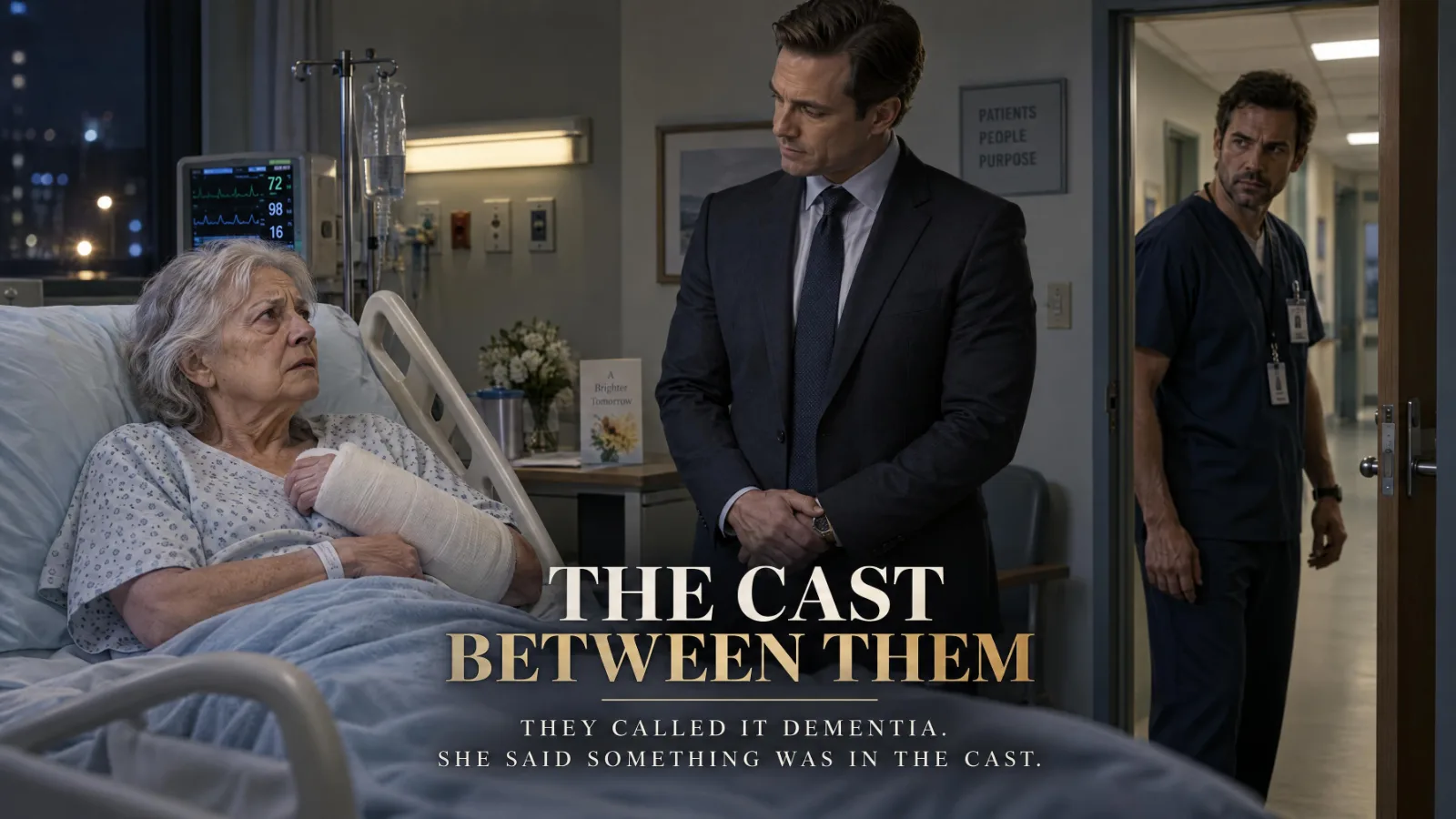
THE REPORT
By the time Eleanor Vale began screaming, Danielle had already apologized for her twice.
The first apology had gone to the emergency-room nurse when Eleanor refused to let anyone take her blood pressure on the injured arm.
The second had gone to the young orderly when Eleanor accused Marcus of standing too close to her bed.
Danielle had delivered both apologies with the same exhausted half smile she had been using for months, the one that meant Please understand. She isn't herself anymore.
Eleanor saw it every time.
That smile hurt almost as much as the arm.
“Cut it off!”
Her voice cracked through the small hospital room.
She grabbed the white fiberglass cast with her other hand and pulled at it until the bed frame shook.
“Cut this damn thing off my arm.”
The nurse stepped forward.
“Mrs. Vale, I need you to stop pulling—”
“There is something inside it.”
Eleanor was crying now, not delicately and not quietly.
“It moves. It scratches. I have been telling everybody. Please.”
Danielle closed her eyes.
“Mom.”
“Please, Danny.”
The childhood nickname should have helped.
It didn't.
Danielle stood beside the bed looking forty-seven and twelve at the same time, her handbag still hanging from one shoulder, her blond hair escaping the knot she had made in the parking garage.
“It's a cast,” she said.
Eleanor stared at her.
The room narrowed around those words.
Only a cast.
Three weeks of broken sleep.
Three weeks of waking with the sensation of something dragging against the skin below her elbow.
Three weeks of Marcus telling everyone she had begun imagining things.
Three weeks of Danielle arriving already convinced.
Marcus stood beside the IV pole.
He had taken off his raincoat but not his jacket. It was charcoal gray, fitted perfectly across the shoulders. He looked as though he had come from an office rather than from Eleanor's house, where he had been staying three nights a week because, according to him, someone needed to help Danielle manage the situation.
His hand rested lightly over his mouth.
To a stranger he looked devastated.
Eleanor knew better.
Marcus always became quieter when he was winning.
“She hasn't slept properly,” he told the nurse. “Her confusion gets much worse at night.”
“I am not confused.”
“Nobody said you were, Eleanor.”
“You just did.”
“I said you're tired.”
“You said dementia in the car.”
Danielle flinched.
Marcus did not.
He had an answer prepared for everything.
“Your geriatrician raised cognitive concerns.”
“My geriatrician asked why I was exhausted.”
“He referred you for testing.”
“Because you kept calling him.”
Danielle pressed her fingers against her forehead.
“Mom, enough.”
The word landed harder than Danielle intended.
Eleanor stopped pulling at the cast.
For several seconds she simply looked at her daughter.
Enough.
When Danielle was nine, Eleanor had once driven forty minutes through freezing rain because her daughter had telephoned from a friend's house and whispered that she wanted to come home.
When Danielle was sixteen and wrecked Eleanor's station wagon, Eleanor had arrived at the intersection before the police and wrapped her coat around her daughter without asking about the car.
When Danielle was twenty-eight and miscarried her first pregnancy, Eleanor had slept on the floor beside her bed because Danielle did not want to be touched but also did not want to be alone.
Enough.
Eleanor turned her face toward the window.
“All right,” she said.
The sudden quiet frightened the nurse more than the screaming had.
Near the doorway, Evan Mercer straightened.
He had been Eleanor's daytime caregiver for eight weeks.
Marcus had hired him through an agency after Eleanor fractured her wrist falling on the back steps. At first the arrangement had seemed temporary: help with meals, transportation, laundry, bathing safely while one arm was immobilized.
Evan was thirty-nine, broad-shouldered, soft-spoken, and so unobtrusive that Marcus had once joked he was “the first person in the house who knows how to stay out of family business.”
Evan had smiled.
He had not corrected him.
Now he stepped away from the doorway.
“Mrs. Vale.”
Eleanor looked at him.
“When you say it moves, what does that mean?”
Marcus answered before she could.
“Evan, please.”
Evan kept his attention on Eleanor.
She swallowed.
“When I turn my arm. Sometimes when I bend my elbow. It drags.”
“Sharp?”
“Sometimes.”
“Burning?”
“Yes.”
“Same place?”
“No. That's why they think I'm crazy.”
“I don't think you're crazy.”
Marcus lowered his hand.
“You're not qualified to assess dementia.”
“No.”
Evan finally looked at him.
“But I am qualified to listen when somebody reports pain.”
Danielle gave a tired laugh without humor.
“Evan, we've all been listening.”
“No,” Eleanor said.
Nobody answered.
Evan moved closer.
He did not touch the cast immediately. He crouched beside the bed so that his eyes were level with Eleanor's arm.
“Can I look?”
Eleanor nodded.
He examined the opening near her elbow.
The nurse leaned closer as well.
There was redness along the skin where the cast padding ended.
That alone meant little. Irritation around a cast edge was common.
But Evan did not look away.
“Mrs. Vale, when was this cast last checked?”
Danielle looked at Marcus.
Marcus said, “About two weeks ago.”
Eleanor said, “No.”
He gave her a wounded expression.
“You missed the appointment, remember?”
“You canceled it.”
“Because you had a fever.”
“I did not have a fever.”
“You told me you felt sick.”
“I said my arm was making me sick.”
Danielle's eyes moved between them.
For the first time that evening, she looked uncertain rather than embarrassed.
Evan lifted one hand toward the cast but stopped short of contact.
“I want orthopedics to remove this.”
Marcus exhaled.
“At midnight?”
“If they can.”
“Because she says something is crawling inside?”
“Because she says something is moving inside.”
“You understand how that sounds.”
Evan stood.
“Yes.”
Something in his tone made Marcus's expression tighten.
“You're paid to help her bathe and prepare meals.”
Evan was silent for a moment.
Then he said, “Before I did home care, I worked pediatric trauma.”
Danielle looked up.
“You were a nurse?”
“Eleven years.”
“Why didn't you tell us?”
“It wasn't relevant.”
Marcus crossed his arms.
“And now it is?”
“Yes.”
The nurse had gone very still.
Evan looked at the reddened skin again.
“I've seen kids put things down casts because they itch. Coins. Pencils. Plastic. I've seen padding bunch up and injure skin. I've seen swelling make a properly applied cast dangerous.”
He turned toward Marcus.
“And I've seen injuries people tried to explain away because the patient couldn't explain them neatly.”
Marcus's face remained composed.
Only his hands changed.
His fingers, which had been moving restlessly along his sleeve, stopped.
Evan noticed.
So did Eleanor.
The nurse reached for the wall phone.
“I'll call ortho.”
Marcus moved half a step.
“Is that really necessary?”
Evan looked at him.
“Yes.”
Danielle stared at her husband.
It was not the question itself that unsettled her.
It was the speed with which he had asked it.
The orthopedic resident arrived twenty-five minutes later.
Eleanor did not scream again.
She lay motionless while the physician inspected her fingers, checked circulation and sensation, then explained that they would remove the cast and examine the skin.
Marcus stood near the sink.
Danielle sat beside the bed.
Evan remained against the wall.
As the resident prepared the cast saw, Evan said quietly, “Before you remove anything—could you preserve the cast and the padding?”
The resident looked at him.
“Why?”
“I'd rather be wrong.”
The nurse understood first.
Her eyes went to Eleanor.
Then to Marcus.
She brought over a clean evidence bag from a cabinet normally used for patient belongings.
Danielle whispered, “Evan.”
He did not look at her.
The saw began to buzz.
Marcus's jaw tightened.
The fiberglass opened along one side.
Then the other.
The resident spread it apart carefully.
Eleanor made a small sound.
Not pain.
Recognition.
“There,” she whispered.
Something narrow and black lay beneath the inner padding along the outside of her forearm.
The resident stopped.
Nobody spoke.
He peeled the padding back.
A strip of heavy plastic, perhaps six inches long, slid against Eleanor's skin.
One edge had been cut unevenly into hard little teeth.
Beneath it, her skin was raw.
Some areas were bright red.
Others were broken.
The pattern curved around the arm in repeated shallow abrasions, exactly where the strip had shifted whenever Eleanor rotated her wrist.
Danielle stood so quickly her chair scraped backward.
“What is that?”
Eleanor did not look at the plastic.
She looked at Marcus.
“I told you.”
Marcus shook his head once.
Almost sadly.
“That could have gotten in there when they put the cast on.”
The orthopedic resident looked at him.
“No.”
Marcus blinked.
The doctor lifted the object with forceps.
“This wasn't part of the cast.”
For the first time all night, Marcus had nothing ready.
Eleanor watched her daughter turn toward him.
Not fully.
Not yet.
But enough.
And in Danielle's face, Eleanor saw the first fracture in the story Marcus had spent months teaching her to believe.