WHAT WAS UNDERNEATH
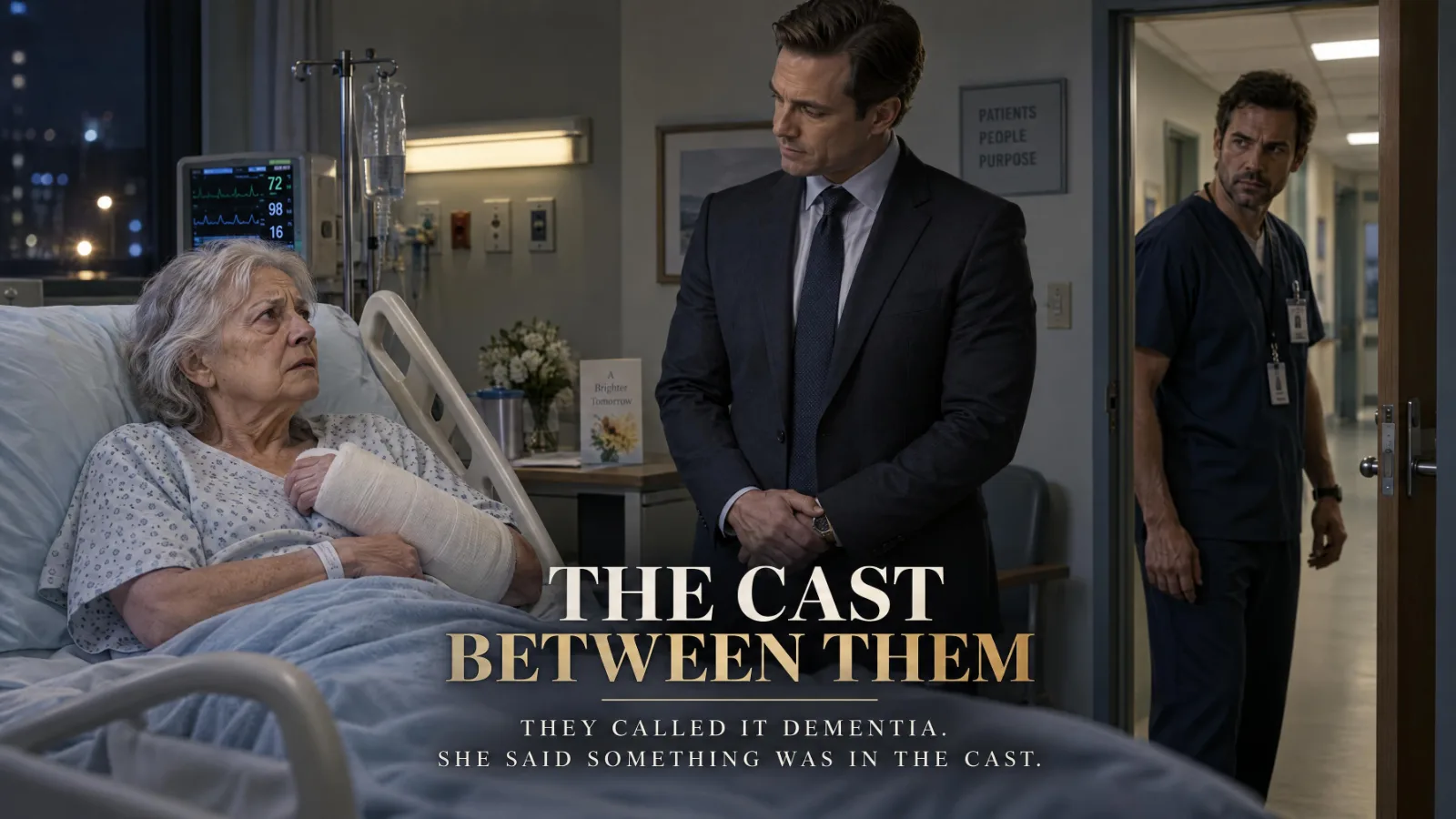
The hospital admitted Eleanor overnight.
Not because of the plastic strip alone.
The abrasions under the cast were inflamed, and one had begun to show signs of infection. Her blood work suggested dehydration. She had lost nine pounds since her wrist fracture.
None of those findings proved who had put the strip beneath the cast.
Together, however, they changed the way people listened.
Questions that had sounded irrational an hour earlier were written down.
Who had been alone with Eleanor after the cast was applied?
Who had helped her dress?
Who had taken her to follow-up appointments?
Who had canceled them?
Had she ever seen the black strip before?
Eleanor answered slowly.
“I don't know.”
The detective from the hospital's vulnerable-adult response team sat across from her shortly after sunrise.
Danielle had left the room at Eleanor's request.
Marcus had been asked to wait outside.
Evan remained only because Eleanor asked him to.
“What do you remember?” the detective said.
Eleanor looked at her bare forearm.
The cast was gone now. A removable splint lay on the blanket beside her.
Without the pressure surrounding her arm, the absence felt enormous.
She kept waiting for the scratch.
Her body had not yet understood that it could stop waiting.
“The first night was fine,” she said.
“After the cast?”
“Yes.”
“And after that?”
“The second night I felt something.”
She closed her eyes.
The kitchen came back to her.
Marcus standing at the island.
Danielle at work.
Rain against the windows.
Eleanor complaining that the padding near her elbow felt rough.
Marcus offering to fix it.
“He said the edge was catching my sweater.”
“What did he do?”
“I wasn't watching the whole time.”
“Why not?”
“He told me to look away because he didn't want fiberglass dust in my eyes.”
Evan shifted slightly beside the wall.
The detective noticed but did not interrupt.
“What did he use?”
“I don't know. Something from the junk drawer.”
“Did he remove the cast?”
“No.”
“What did he say he was doing?”
“Smoothing it.”
Eleanor rubbed her opposite thumb over the blanket.
“I remember feeling pressure. Like he pushed something down along the side.”
“Did it hurt?”
“Not then.”
The detective made a note.
“When did the scratching begin?”
“That night.”
“Did you tell him?”
“Yes.”
“What did he say?”
Eleanor laughed once.
It came out ugly.
“He said I'd probably dreamed it.”
The detective looked up.
“What happened after that?”
“I told Danielle.”
“And?”
“She asked Marcus.”
“What did he say?”
“That I'd already complained about bugs in the house.”
“Had you?”
Eleanor's mouth tightened.
“I saw ants by the sink.”
The detective waited.
“There were ants by the sink,” Eleanor said.
“All right.”
“He made it sound like I had imagined them.”
“What else?”
“The thermostat.”
“What about it?”
“I kept saying the house was cold at night. Marcus said it was seventy-two. I told him the thermostat said sixty-four.”
“Was it?”
“Yes.”
“Did anyone check?”
“Eventually Danielle did.”
“What did she find?”
Eleanor hesitated.
“She said maybe I had changed it and forgotten.”
The detective stopped writing.
Evan looked down.
Eleanor saw the change in the room.
Until that moment she had been recounting separate annoyances.
Now they sounded like a pattern.
She hated that pattern.
Not because it surprised her.
Because she had been living inside it and had still begun wondering whether Marcus was right.
That was the part she had not told anyone.
There had been nights when she lay awake scratching at the inaccessible pain beneath the cast and tried to inventory her own mind.
Her address.
Her Social Security number.
Danielle's birthday.
The name of the elementary school Danielle attended.
The year Harold died.
The combination to the small safe in the hall closet.
Some nights she could remember all of it.
Then she would forget why she had entered the kitchen.
Marcus would see.
“Another one?” he would say gently.
Not cruelly.
That would have been easier.
Gently.
As if he were standing beside her while something inevitable took her away.
The detective asked, “Has anyone discussed changing who handles your finances?”
Eleanor looked at him.
Evan's head came up.
“Yes.”
“When?”
“A month ago.”
“Who?”
“Marcus.”
“What did he propose?”
“He said Danielle should help.”
“Did you agree?”
“I said Danielle already helps when I ask her.”
“That wasn't the question.”
Eleanor smiled faintly.
“No. I did not agree.”
“What exactly did Marcus want?”
Eleanor stared at the window.
“He said we should get paperwork in place before I got worse.”
The phrase sounded different now.
Before I got worse.
At the time she had been offended.
Now she felt cold.
“What paperwork?”
“I don't know.”
“Did you see it?”
“No.”
“Did anyone come to your house about documents?”
Eleanor's eyes narrowed.
“A woman did.”
“When?”
“Last week.”
“What kind of woman?”
“About Danielle's age. Navy coat. Leather folder.”
“What did she say?”
“She said she was a notary.”
Evan swore quietly.
The detective glanced at him.
Eleanor continued.
“Marcus said she was there so I could sign something that would make things easier.”
“Did you sign?”
“No.”
“Why not?”
“Because he wouldn't tell me what page three meant.”
“What was on page three?”
“I couldn't read the print well enough without my glasses.”
“Where were your glasses?”
Eleanor looked toward the door.
“Marcus said he couldn't find them.”
For several seconds the detective did not write anything.
Then he asked, “Did the notary proceed?”
“No.”
“What happened?”
“I told her I wouldn't sign anything I couldn't read.”
“What did Marcus do?”
“He got angry.”
“How?”
“He didn't yell.”
That, Eleanor had learned, was what people expected anger to look like.
Marcus was too careful for yelling.
“He kept saying I was embarrassing Danielle. The notary asked him to leave the room. He wouldn't. So she packed up and left.”
“Did you get her name?”
“No.”
The detective wrote something.
“We can probably find her.”
There was a soft knock.
Danielle appeared in the doorway.
Her face had changed during the hour she had been outside.
She looked stripped of certainty.
“Mom?”
Eleanor said nothing.
Danielle stepped in.
“They're asking Marcus to leave the hospital.”
“That sounds sensible.”
“Mom.”
Eleanor turned her face away.
Danielle stopped beside the foot of the bed.
“I didn't know about the notary.”
Eleanor's throat tightened.
“That doesn't make it better.”
“I know.”
“No, Danny. You don't.”
Danielle swallowed.
“The doctor says the strip couldn't have been left there when they put the cast on.”
“I heard him.”
“And Marcus—”
“Don't.”
Danielle stopped.
Eleanor looked at her then.
“For three weeks I told you something was hurting me.”
Tears filled Danielle's eyes.
“I thought—”
“I know what you thought.”
“I thought you were scared.”
“I was.”
“I thought the fear was making things feel worse.”
“It was.”
Danielle looked confused.
Eleanor leaned back against the pillow.
“The difference is, I was afraid of the right thing.”
Danielle covered her mouth.
Across the room, Evan quietly turned toward the window.
Eleanor did not want comfort from him.
Not yet.
She wanted her daughter to remain exactly where she was and feel the weight of having chosen the easier explanation.
Danielle lowered her hand.
“What do you need me to do?”
Eleanor considered the question.
A month earlier, she would have said Believe me.
Now belief seemed too small.
“Don't tell me what Marcus says,” she replied. “Find out what he did.”