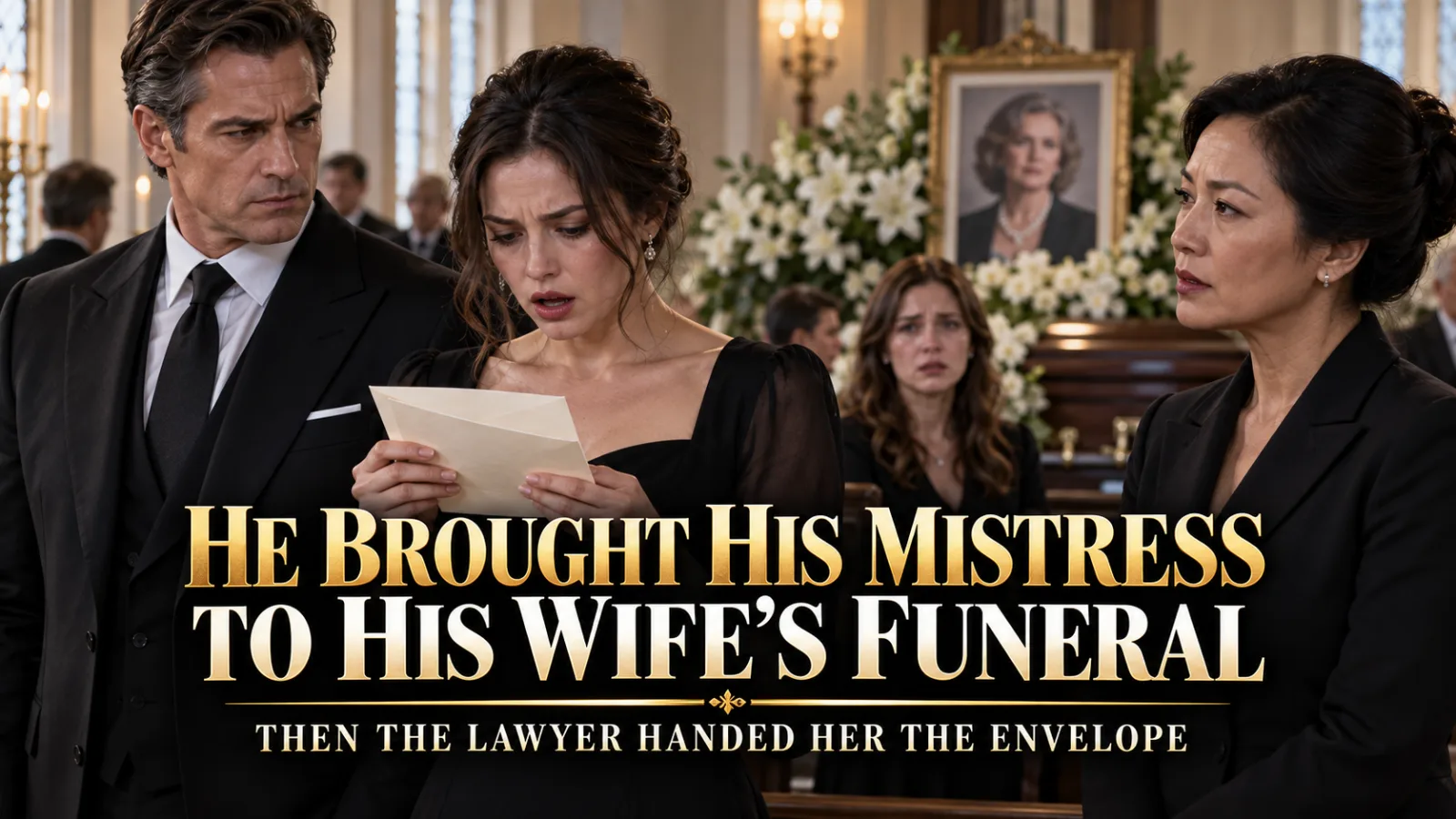
THE ENVELOPE
People had been waiting for Mara Vale to break.
They watched her from the moment she entered the chapel, though most of them were polite enough to pretend otherwise. Eleanor Mercer had been dead for four days, and grief had already become public property. Business partners wanted to know whether the Vale family would remain involved with the company. Society reporters wanted to know whether Eleanor and Grant had reconciled before the end. Employees wanted to know who would inherit her voting authority. Friends wanted to believe the last year had been gentler than it looked.
And nearly everyone knew about Sloane Avery.
Not officially. Grant Mercer had been too careful for that.
But there were photographs from restaurants where married executives did not take consultants unless they wanted to be seen. There had been late departures from the same hotel. There were conference weekends where Sloane's room was always on Grant’s floor. There were employees who had learned not to enter his office without knocking after six.
Eleanor had known too.
That was why, when Grant walked into his wife’s funeral with Sloane on his arm, every head in the chapel turned first toward Mara.
Mara sat in the first pew beside her mother.
She did not stand.
She did not shout.
She did not even look particularly surprised.
Her fingers tightened once around the folded funeral program, then relaxed.
Grant noticed.
He had expected rage.
Rage would have helped him.
Mara could almost see the version of events he had prepared: a grieving sister losing control, attacking an innocent woman, turning Eleanor’s funeral into family spectacle. Grant would remain calm. He would ask everyone to show compassion. He would guide Sloane away from the chaos with one protective hand at her back.
He had always been excellent when other people became emotional.
So Mara gave him nothing.
Grant and Sloane took seats three rows behind the family.
Sloane looked less comfortable than he did. She was thirty-two, polished enough to move naturally through rooms built for rich people, but not so experienced that she could stop herself from scanning faces. Her black dress was conservative. No jewelry except small pearl earrings. She carried a cream leather bag against her lap.
Inside that bag was the envelope.
Mara knew because Eleanor had told her.
Eleven days before she died, Eleanor had asked Mara to come to her bedroom and close the door. Cancer had taken enough weight from Eleanor that the silk robe around her shoulders seemed borrowed from someone larger, but her eyes had remained painfully alive.
“I gave Sloane something,” she had said.
Mara had thought the medication was confusing her.
“You gave who something?”
“His girlfriend.”
Mara had stood so quickly her chair scraped against the floor.
“You met her?”
“Yes.”
“What the hell, Ellie?”
Eleanor had smiled faintly. “That was roughly her reaction too.”
Mara had wanted details. Eleanor refused.
“She’ll know when to open it.”
“That sounds like something from a bad thriller.”
“I’m dying. Allow me one theatrical indulgence.”
“You’re not funny.”
“I’m still funnier than Grant.”
Then Eleanor had reached for Mara’s hand.
The humor disappeared.
“When it happens, do not give him the scene he expects from you.”
Mara had stared at her.
“What happens?”
“You’ll know.”
Now she did.
The funeral moved through hymns, readings and carefully chosen memories. Grant delivered a eulogy so polished that Mara wondered whether someone from communications had written it.
He spoke about Eleanor’s courage.
He spoke about the company they had built.
He spoke about private love.
At that, Mara finally looked back at Sloane.
The younger woman lowered her eyes.
Grant finished to restrained applause from people too well-trained to question whether applause belonged at a funeral.
Then Naomi Chen rose.
Naomi had been Eleanor’s attorney for fourteen years. She was small, silver beginning at her temples, dressed in a simple black suit that made almost everyone else’s funeral clothes look performative.
She did not approach the lectern.
Instead she turned toward the third row.
“Ms. Avery?”
The chapel became very quiet.
Sloane looked up.
Grant’s head snapped toward Naomi.
Naomi’s voice remained conversational.
“Would you please open the envelope Eleanor gave you?”
Grant went still.
That was the first real expression Mara had seen from him all morning.
Sloane’s hand moved automatically toward her bag.
Grant caught her wrist.
Not hard.
Not enough for anyone farther away to call it force.
But Mara saw.
So did Naomi.
Sloane looked at his hand.
Grant released her.
“This is inappropriate,” he said.
Naomi did not even look at him.
“Ms. Avery?”
Sloane took out the envelope.
“I don’t understand.”
“You don’t need to yet.”
Grant stood.
“Naomi.”
Now she looked at him.
“Sit down, Grant.”
Something passed across his face. Not embarrassment. Calculation.
Sloane broke the seal.
Paper sounded extraordinarily loud in a silent chapel.
She unfolded the first page.
Her eyes moved across three lines.
Then stopped.
Mara watched the blood leave her face.
“What is this?”
Grant stepped toward her.
“Sloane.”
She read farther.
Then she looked at him.
The confusion was gone.
What replaced it was worse.
“You used my company to forge her signature?”
A murmur traveled through the chapel.
Grant reached for the page.
“Sloane, give me that.”
She pulled it away from him.
“What did you make me sign?”
Naomi stepped between them without urgency.
“Do not give him the document.”
Grant stared at her.
“Have you completely lost your mind?”
“No.”
“You are making accusations at my wife’s funeral.”
Naomi’s expression did not change.
“Your wife made them.”
That finally broke the room.
People turned openly now. Someone near the aisle stood and then sat again. Grant’s chief operating officer stared at the floor. Two board members exchanged a glance that said they had understood something before the rest of the chapel did.
Sloane looked back at the page.
There were six wire-transfer numbers printed beneath Eleanor’s statement.
Her company name appeared beside all six.
Avery Strategy LLC.
Grant had encouraged her to create it eighteen months earlier.
He had told her independent consulting would protect her career.
He had sent contracts.
He had asked her to countersign approvals.
He had said they were routine.
Sloane’s voice dropped to a whisper.
“Oh my God.”
Grant moved closer.
“Whatever Eleanor told you, she was sick. She was angry. She had been on medication for months.”
Mara stood then.
Not because she had lost control.
Because that sentence required an answer.
“My sister knew exactly what she was doing.”
Grant looked toward her almost with relief.
There she was.
The angry sister.
The problem he understood.
But Mara did not raise her voice.
“She also knew you’d say that.”
Naomi extended her hand toward Sloane.
“There is a second page.”
Sloane looked down.
She had not noticed it.
Her fingers were shaking now.
She turned the sheet.
At the top was a photocopy of a document bearing Eleanor’s name.
Below it was a forensic document examiner’s preliminary finding.
SIGNATURE NOT CONSISTENT WITH KNOWN EXEMPLARS.
Sloane stared at the signature.
Then at her own initials in the witness box.
She remembered the night immediately.
Grant’s office.
Two glasses of wine.
A stack of papers.
He had kissed the back of her neck while pointing at the yellow tabs.
Just sign there.
And there.
That one too.
She had laughed and accused him of turning pillow talk into paperwork.
He had told her it was temporary restructuring because Eleanor was too ill to deal with administrative matters.
Sloane looked at him now and felt nausea rise beneath her ribs.
“You told me she signed this.”
“She did.”
“The examiner says she didn’t.”
“Preliminary examiner,” Grant snapped. “Naomi is manipulating you.”
Naomi finally allowed herself something close to disgust.
“You have had twelve years to learn that shouting a sentence does not make it legally stronger.”
Grant’s attention returned to Sloane.
“Come outside.”
“No.”
“Sloane.”
“No.”
It was the first time Mara saw Grant truly afraid.
Not exposed.
Afraid.
Naomi turned toward the mourners.
“I apologize to the family for the interruption. Eleanor instructed me very specifically about when this information was to be disclosed. That condition has now been satisfied.”
“What condition?” someone asked.
Naomi looked at Grant.
“If her husband brought Ms. Avery to her funeral.”
No one spoke.
Mara closed her eyes for half a second.
There it was.
Eleanor’s last prediction.
Grant had spent the final year of his wife’s life believing weakness belonged to the dying.
He had misunderstood the room completely.
Sloane folded the papers again, though badly, and placed them against her chest.
Grant reached toward her.
She stepped away.
That movement was small.
It ended more than the funeral.