ONE STOP NORTH
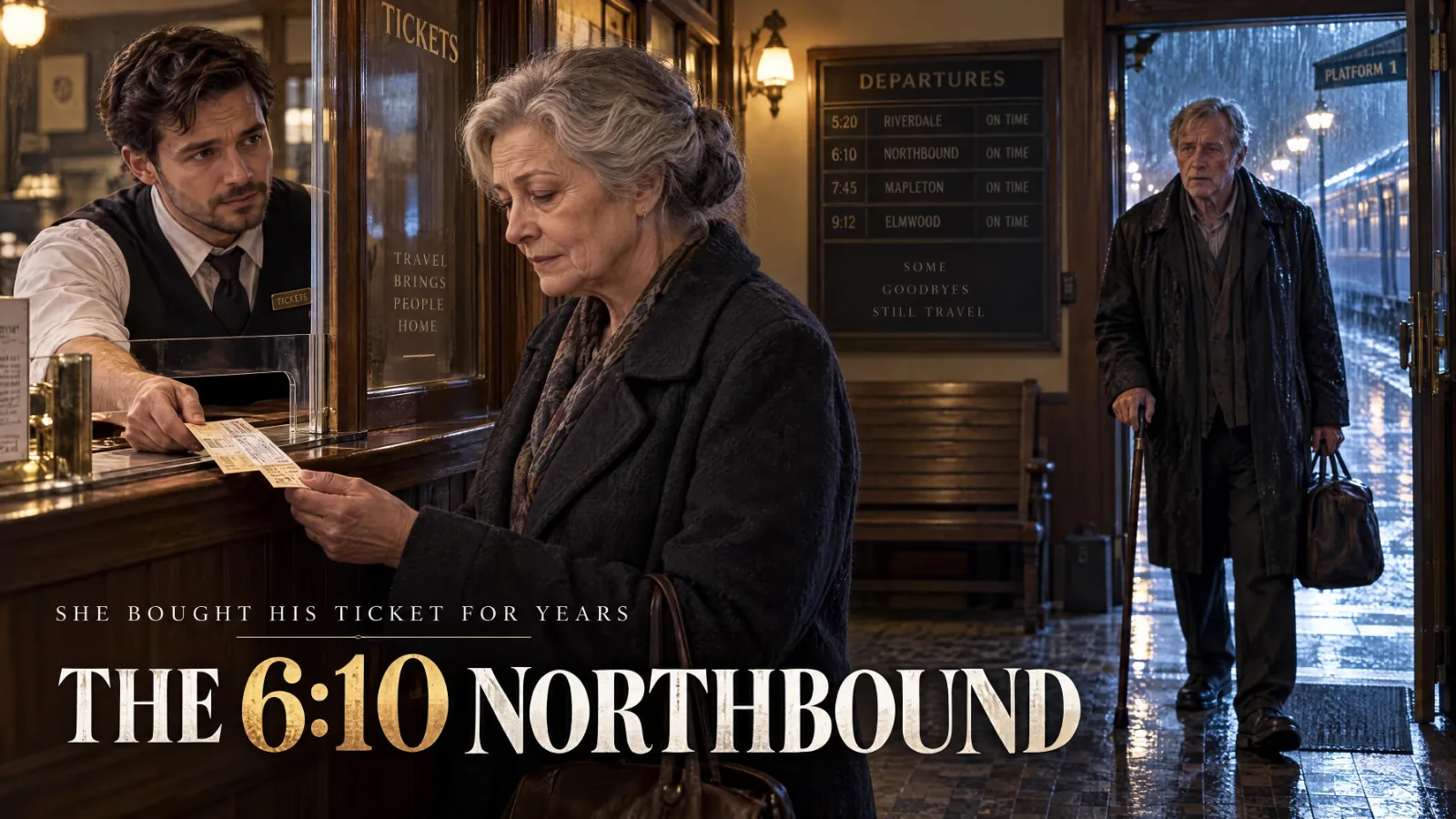
Evelyn had spent too many years imagining Frank's return to mistake reality for fantasy when it finally arrived.
Fantasy had always made him taller.
It had made him clearer.
In some versions of the reunion he apologized with perfect language. In others he had good reasons, or at least reasons dramatic enough to organize the damage. Her worst private imaginings had turned him cruel because cruelty was cleaner than weakness. A cruel man could be hated all the way through.
The man sitting across from her on the 6:10 northbound was neither cruel nor heroic. He looked tired, slightly damp, and nervous in ways no younger version of Frank Shaw had ever permitted himself to appear.
The train carried them out of Alder Creek through the darkening line of river trees and abandoned mills that marked the county's north edge. Evening reflected their faces in the glass until it was hard to distinguish memory from the present.
Evelyn kept both hands in her lap.
Frank set his cane beside the seat and waited a few seconds too long before speaking, as if he was still determining whether silence might solve anything.
It didn't.
"So," Evelyn said, "start with the truth and not the part you've rehearsed to sound decent."
Frank let out a breath that might once have become a laugh.
"All right."
He looked at the window.
"You remember the loan notices."
"I remember the final ones. Not the earlier ones you hid."
Frank nodded.
"The store was already failing before I admitted it to myself. Then I started borrowing against the idea that I could turn it around if I bought more inventory, stayed open longer, fixed the delivery truck, paid the suppliers first, paid us last." He looked at his hands. "You know the kind of intelligence that looks practical because it's busy? I had a gift for it."
Evelyn remembered more than she cared to. Shaw & Bell, Household Repair and Appliances, on Cedar Street. The business had been his father's before it was theirs. Frank could fix a washing machine blindfolded, charm a customer into patience, and spend six months marching toward disaster if the march allowed him to feel useful.
"You didn't just lose money," she said. "You lied about it."
"Yes."
"When I asked whether we were all right, you said we were tight but manageable."
"I know."
"When I asked whether the second mortgage papers were what I thought they were, you said no."
Frank's jaw moved.
"Yes."
She turned toward him fully now.
"You left me with debt, a building I had to sell, and half a town asking whether I'd known all along."
"I know."
The repetition finally irritated her.
"Stop saying that as if agreement is repentance."
Frank looked up.
"All right." He waited. "I left because after the sale, after the calls from the bank, after your brother came by and looked at me as if I'd set fire to the house on purpose, I could not bear the idea of staying and being the man everyone was correct about."
Evelyn stared at him.
"There it is," she said softly. "You still think the center of the story is what it felt like to be you."
Frank absorbed that without protest.
"Yes," he said. "At the time, definitely."
"And after that?"
"I took a maintenance job with the rail yard outside Millhaven. I told myself I'd work six months, send money, come back when I had paid enough down to stand in front of you without looking like what I was."
"You sent three checks."
"Four."
Evelyn looked at him.
Frank gave the smallest grimace. "This is not the moment to be technically correct."
"No, it isn't."
He nodded once.
"I rented a room. Worked nights. Kept thinking the next month would be the month I could come home and explain everything without sounding like a coward."
"And instead?"
"Instead it became a year. Then two. Then every additional month made the first one harder to defend."
The train rocked gently.
Evelyn looked at the darkness beyond the glass.
"I could have accepted that you were weak," she said. "What I couldn't accept was being treated like I couldn't survive the truth."
Frank's face tightened.
"You're right."
"I know I'm right."
"And I knew it then."
That made her look back at him.
Frank's eyes remained on the seat in front of him.
"I didn't lie to protect you. I lied because truth would have required me to watch your face while you understood exactly who I was."
Evelyn said nothing.
The simplicity of the sentence disturbed her more than a speech would have.
"Why the call eight years later?" she asked.
Frank rubbed the scarred edge of one thumb with the other.
"I heard from your cousin Marie that you still lived in the same house."
"Cedar Street?"
"Yes."
"Marie should have minded her own business."
"She was trying to help."
Evelyn almost smiled. "She usually was."
Frank continued. "I called because I thought if you sounded happy, I could stay away without pretending it was for your sake."
Evelyn stared at him.
"And if I sounded miserable?"
"I don't know."
"But you still didn't come."
"No."
"Why?"
Frank looked up at her finally.
"Because you sounded like yourself."
The answer arrived oddly. Not flattering. Not manipulative. Simply precise.
"What does that mean?"
"It means you didn't sound broken enough to need me and you didn't sound healed enough to absolve me. You sounded busy. Irritated. Alive." He swallowed. "I realized coming back would not be a matter of finding the correct apology. It would mean standing inside the life I'd damaged while you decided what place, if any, I could occupy in it."
The conductor came through to check tickets. Evelyn handed over both. The conductor clipped one and glanced at the second.
"Your husband joining you at Briar?"
Evelyn held the woman's gaze for a fraction too long.
"No," she said at last. "He already did."
The conductor moved on without understanding what she had witnessed.
Frank looked at the clipped edge of the second ticket.
"That line would have sounded impossible to me five hours ago."
"It sounds impossible to me now."
At Briar Junction, the train slowed. Evelyn remained seated.
"You said one stop," Frank reminded her.
"I heard you."
"And?"
"And Briar isn't a place to end a conversation badly. Too many fluorescent lights."
Frank nearly smiled.
The train pulled on toward Millhaven.
Evelyn turned back to the window.
She had boarded thinking she might allow him ten minutes and then send him away with a refusal clear enough to last the rest of both their lives. Instead she found herself sitting beside the living, diminished evidence of a truth she had spent years trying to simplify.
Frank had not stayed away because he stopped loving her.
He had stayed away because he preferred absence to being fully seen after failure.
It was a terrible reason.
It was also a human one.
And that, Evelyn suspected, was going to make everything harder.