THE LIFE THAT WENT ON
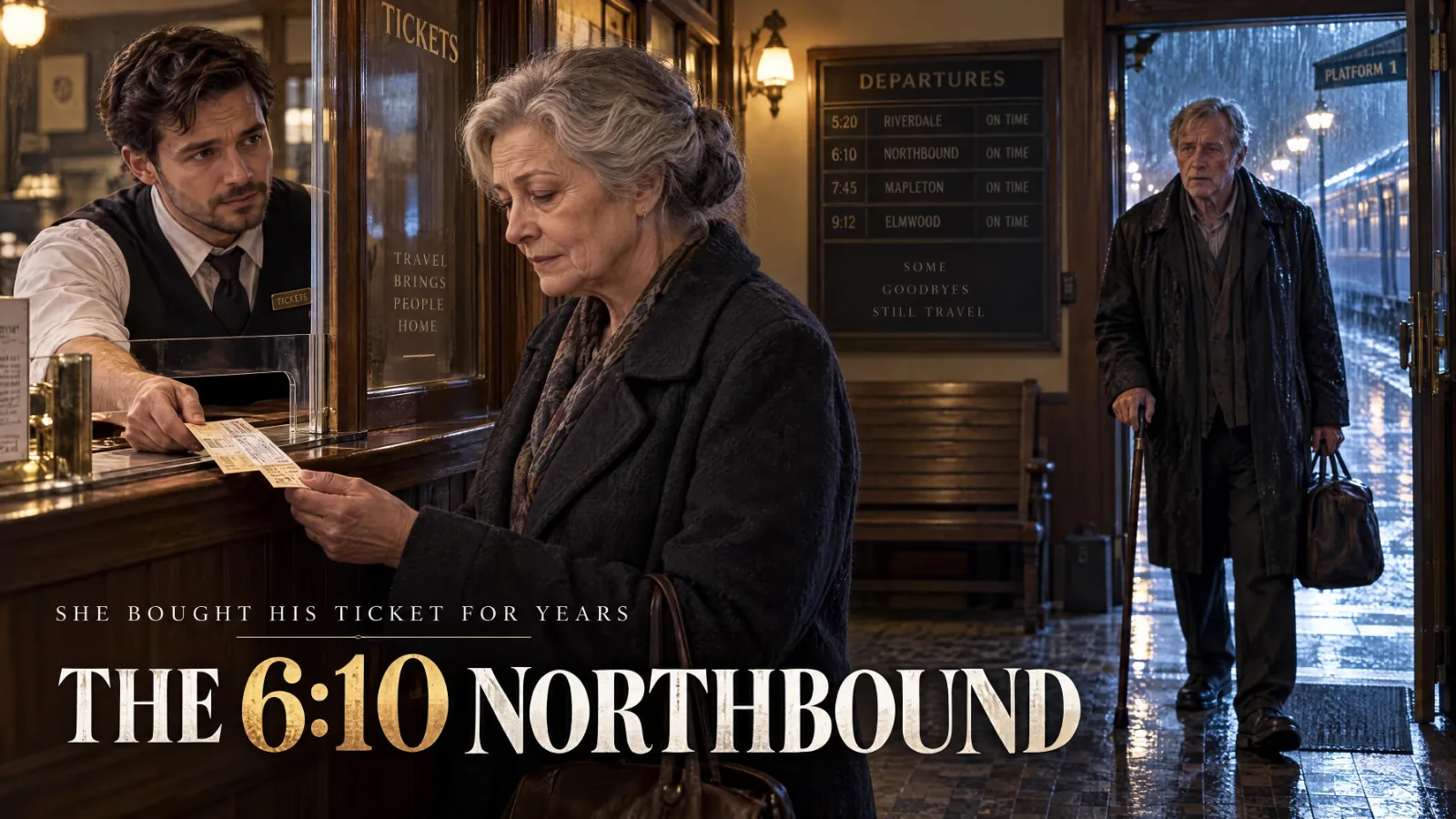
They got off in Millhaven under platform lights too white to flatter anyone.
Frank did not attempt to take her arm. Evelyn appreciated that more than if he had magically known the correct sentimental gesture. They walked side by side through the modest evening traffic of commuters and college students without speaking until Frank led her to a coffee shop across from the station.
It was not romantic.
It was warm, open late, and quiet enough for difficult honesty.
Frank bought coffee and a dry cinnamon roll neither of them really wanted. They sat in a booth by the window. Outside, the platform remained visible in intervals between passing buses.
Evelyn looked at him across the table and realized that for years she had imagined his life only as punishment or escape. Either he had suffered terribly enough to justify the delay, or he had lived lightly enough to condemn himself.
Reality, as usual, seemed less organized.
"Where do you live?" she asked.
"About ten minutes from here. Room above a locksmith's shop."
"You still work?"
"Three mornings a week at the yard. Mostly inventory now. Less climbing, fewer chances to become an inspirational safety poster."
Against her will, Evelyn let out a small laugh.
Frank's expression changed at once—not in triumph, but in relief, as if some locked mechanism had made a sound inside him.
"Don't enjoy that too much," she said.
"I wouldn't dare."
He stirred sugar into coffee he used not to take sweet.
"You mentioned the stroke," Evelyn said.
"Mild, according to people who were not experiencing it."
She waited.
"It left my right hand weaker for a while. Speech too." He tapped his mouth lightly. "I knew what I meant before the words could catch up. That was unpleasantly instructive."
"In what way?"
Frank looked down at the coffee.
"I spent a long time thinking I would come back when I could explain myself properly. Then I had several months where I couldn't explain the weather without frustration. It occurred to me that I'd been outsourcing courage to some future version of my own eloquence."
Evelyn took that in.
"So you came before language improved."
"No. I came after I realized improved language would not improve the facts."
There it was again: the older, slower Frank failing less elegantly and perhaps more honestly.
Evelyn sat back.
"You should know something," she said.
Frank looked up.
"I wasn't waiting in the way town gossip imagines."
He nodded once, cautious.
"I guessed that much."
"Did you?"
"Not entirely."
Evelyn looked out the window.
"The first year after you left, I was furious. The second year, embarrassed. The third, busy." She smiled without humor. "Turns out debt is an excellent treatment for excessive sentiment. I sold the store. Taught bookkeeping for the adult education center. Took in alterations for a while because your sister was right and my hems are neater than my temper."
Frank's mouth moved at the name.
"Rita still hates me?"
"Rita reserves special language for you."
"Fair."
Evelyn continued, "I did not sit at home preserved in amber. I worked. I paid things off. I painted the kitchen because I was tired of the yellow you loved. I threw away one of your chairs because it broke and I was in no mood to honor symbolism. I had dinner with a widower named Neil for six months and stopped because all we did was discuss weather and cholesterol as though romance were a municipal obligation."
That almost drew another smile from him.
"I am glad," Frank said.
"About Neil's cholesterol?"
"About your life."
Evelyn held his eyes for a beat, testing the answer for self-pity. It wasn't there.
"Good," she said. "Because I would like you to understand something clearly. The second ticket was not proof that my life stopped."
Frank nodded.
"What was it, then?"
She turned the two clipped stubs over on the table.
"At first it was anger. I bought two because I thought if you ever had the nerve to show up, I would not let logistics save you. Then it became habit. Then a kind of argument with myself." She looked down. "And after enough years, the argument became part of the week. People say hope is bright. Usually it isn't. Usually it looks like routine."
Frank watched her hands.
"I don't deserve that loyalty."
Evelyn gave him a flat look.
"No. You don't."
He accepted it.
For the first time that evening, she felt the conversation settle into something almost usable. Not kindness. Not repair. But the absence of theatre.
"Why tonight?" she asked again. "Specifically tonight, not generally after your educational stroke."
Frank smiled faintly at the phrasing.
"I came to Alder Creek last month."
She stared at him.
"What?"
"I drove down with every intention of coming into the station. Sat in the lot across the street like a man auditioning for a surveillance charge. I watched the 6:10 pull in. I watched people board. Then I saw you through the glass."
Evelyn's face went still.
"And?"
"You were laughing at something the clerk had said."
"Micah."
"I didn't know his name."
Frank folded his hands.
"You looked..." He searched. "Not untouched. Not waiting in ruin. Just there. In the world. And I realized I had built my courage around the possibility of meeting a woman suspended exactly where I left her. I almost drove away again because the version of you I'd have to face was the real one."
"But you didn't."
Frank shook his head.
"No. Because for once I recognized the thought as what it was. Not caution. Cowardice wearing reading glasses."
Evelyn looked at him so long that the coffee went cold between them.
Then she said, "That's the best thing you've said tonight."
Frank inclined his head slightly.
"I suspected it might be."
By the time they returned to the station for the southbound, Evelyn knew two things.
The first was that Frank Shaw had come back without enough excuses to hide behind. That mattered.
The second was that honesty arriving late still arrived late.
When the 8:05 southbound pulled in, Frank walked her to the door of the car.
"Will you come next Friday?" he asked.
"No."
The answer landed fast and clean.
Frank nodded.
"All right."
Evelyn stepped onto the train.
Then she turned back.
"But I might," she said.
He looked at her.
"And if I do, don't treat it like a miracle. Treat it like a chance."
The doors closed between them.
Frank remained on the platform as the train pulled away, one hand on the cane, his figure shrinking under the station lights.
Evelyn sat down by the window and felt, for the first time in years, that the second ticket in her purse no longer belonged to an argument with absence.
It belonged to a question.