ANOTHER FRIDAY
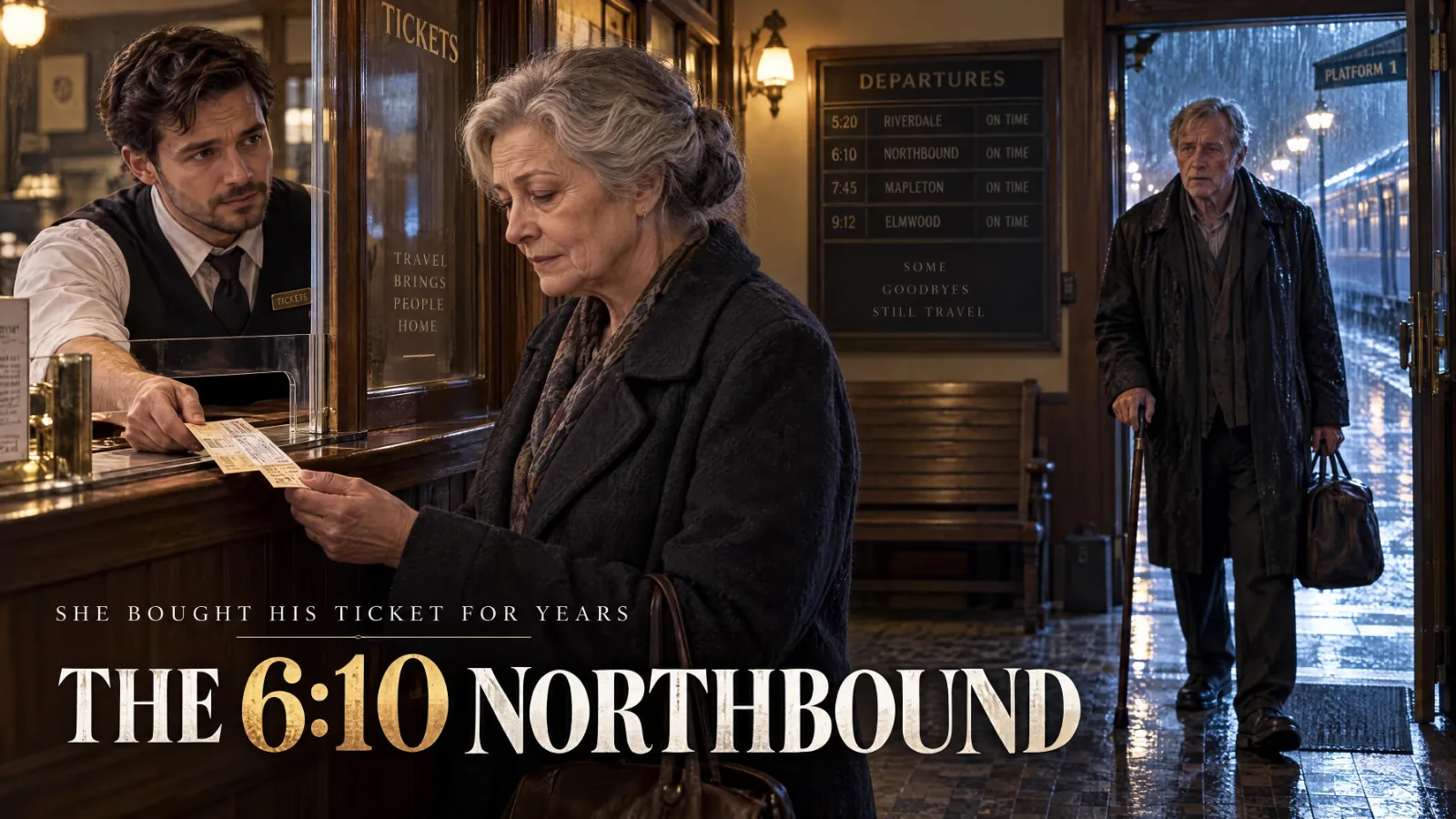
Micah was disappointed in himself for how curious he became.
He told himself he wasn't gossiping. He was following up on a customer-service event of unusual emotional consequence. The difference, morally speaking, was paper thin.
When Evelyn stepped off the southbound that first night, he stood at the counter pretending to reconcile change drawers.
She came in carrying both clipped stubs and an expression he could not read.
"You're still here," she said.
"You threatened a letter."
"I keep my promises selectively."
Micah set the drawer aside.
"Do I ask?"
"You do not."
He nodded. "Reasonable."
Evelyn put one of the used tickets on the ledge.
"For your trouble."
Micah looked at it.
"I didn't really do anything."
"No. But you witnessed."
That turned out to be the correct word. Witnessing carried less vanity than helping and more honesty than observing.
The next Friday, Micah did not expect her.
People who reunited with lost spouses on commuter lines generally did not return immediately to ritual unless they were clinically committed to symbolism.
At six o'clock, the door opened.
Evelyn walked in alone.
Micah did not comment on the fact that his chest had been unreasonably prepared for disappointment.
She came to the counter.
"Two to Millhaven."
Micah blinked.
"Right."
He printed the tickets.
As he slid them over, he saw movement behind her and nearly laughed from surprise.
Frank entered three seconds later, not from the door but from the hallway leading in from the platform restroom, clearly having arrived early enough to choose dignity over dramatic timing.
He stopped at the counter beside her.
Evelyn did not look at him as she said, "He can buy his own from now on."
Frank set exact change on the ledge.
"One to Millhaven."
Micah looked from one to the other.
"Should I charge extra for administrative reconciliation?"
Evelyn's mouth twitched.
Frank almost smiled.
"No," Evelyn said. "You have already overinvested."
"Fair."
They boarded together.
This became, over the next months, a kind of Friday grammar.
Not every week. Not dependably enough to feel sentimental. But often enough that the station began rearranging its understanding of Evelyn Shaw.
Some Fridays she arrived alone, bought two tickets, and rode without Frank because he had called ahead to say he couldn't make it or because she had not invited him into that particular week.
Some Fridays they came separately and boarded together.
Once Frank came and Evelyn did not, and Micah had to tell him she had telephoned from home to say she'd had a headache and wasn't riding north with any man, past or present.
Frank accepted the information with so little self-drama that Micah's respect for him rose against his will.
"Should I tell her anything?" Micah asked.
Frank thought about it.
"Tell her I said all right."
"That's it?"
Frank adjusted his grip on the cane.
"At my age," he said, "not making your disappointment someone else's administrative burden is a skill."
Micah watched him leave and decided the man had either learned a great deal too late or had always possessed the raw material for decency and simply misused it. Perhaps both.
In June, Evelyn came back from Millhaven later than usual and remained at the window after the last southbound passengers had cleared.
"Do you know what the annoying thing is?" she asked Micah.
He looked up from his ledger.
"There are several candidates."
"He is better at being seventy than he was at being fifty-two."
Micah sat back in the chair.
"That does sound irritating."
Evelyn folded her purse strap around one hand.
"He listens now. Really listens. He doesn't rush to solve the conversation by explaining himself. He doesn't perform remorse every five minutes like a man trying to earn a points-based reentry package."
"That's specific."
"It is observable."
Micah nodded solemnly.
"So the problem is that he's become tolerable."
"The problem," Evelyn said, "is that if he had returned smug or self-pitying, I would know exactly where to place him."
She looked toward the dark platform.
"But a person can come back altered enough to complicate your anger without repairing it. That seems unfair."
Micah considered this.
"My mother used to say forgiveness would be easier if people had the decency to remain exactly as terrible as they were at the moment they hurt you."
Evelyn glanced at him.
"Wise woman."
"She sold insurance. Same skill set."
Evelyn actually laughed then. Not loudly. Not long. But freely enough to surprise them both.
By August, Micah knew more than he meant to. Not because Evelyn or Frank overshared, but because Fridays accumulated information the way tracks accumulated rust.
Frank had rented a better apartment in Alder Creek, not because he assumed Evelyn wanted him nearby but because commuting from Millhaven three times a week had become senseless.
Evelyn had not invited him home for three months.
When she finally did, it was to fix a warped dining room drawer he had installed badly in 1998 and which she had refused on principle to let anyone else repair. Micah learned this because she arrived the next Friday carrying an expression close enough to bewilderment that he braced for impact.
"He repaired it in six minutes," she said.
"Outstanding carpentry."
"Then he stayed for tea."
Micah nodded carefully.
"Escalation."
"He washed the cup before he left."
"Reckless."
Evelyn stared at him, and for a moment Micah thought she might be offended.
Then she said, "Do not become smug about my personal life, Mr. Bell."
He placed a hand over his heart.
"I would never."
But what interested Micah most was not that Frank and Evelyn were seeing each other on some senior-citizen version of probation. It was that neither of them seemed interested in rushing past the damage.
They were not pretending to have recovered a marriage stored safely in train timetables.
They were learning, week by week, what kind of relationship could exist between two people who had once been husband and wife, had then become each other's absence, and were now something unfinished but no longer imaginary.
It was less dramatic than the town wanted.
Micah suspected that was why it might actually last.