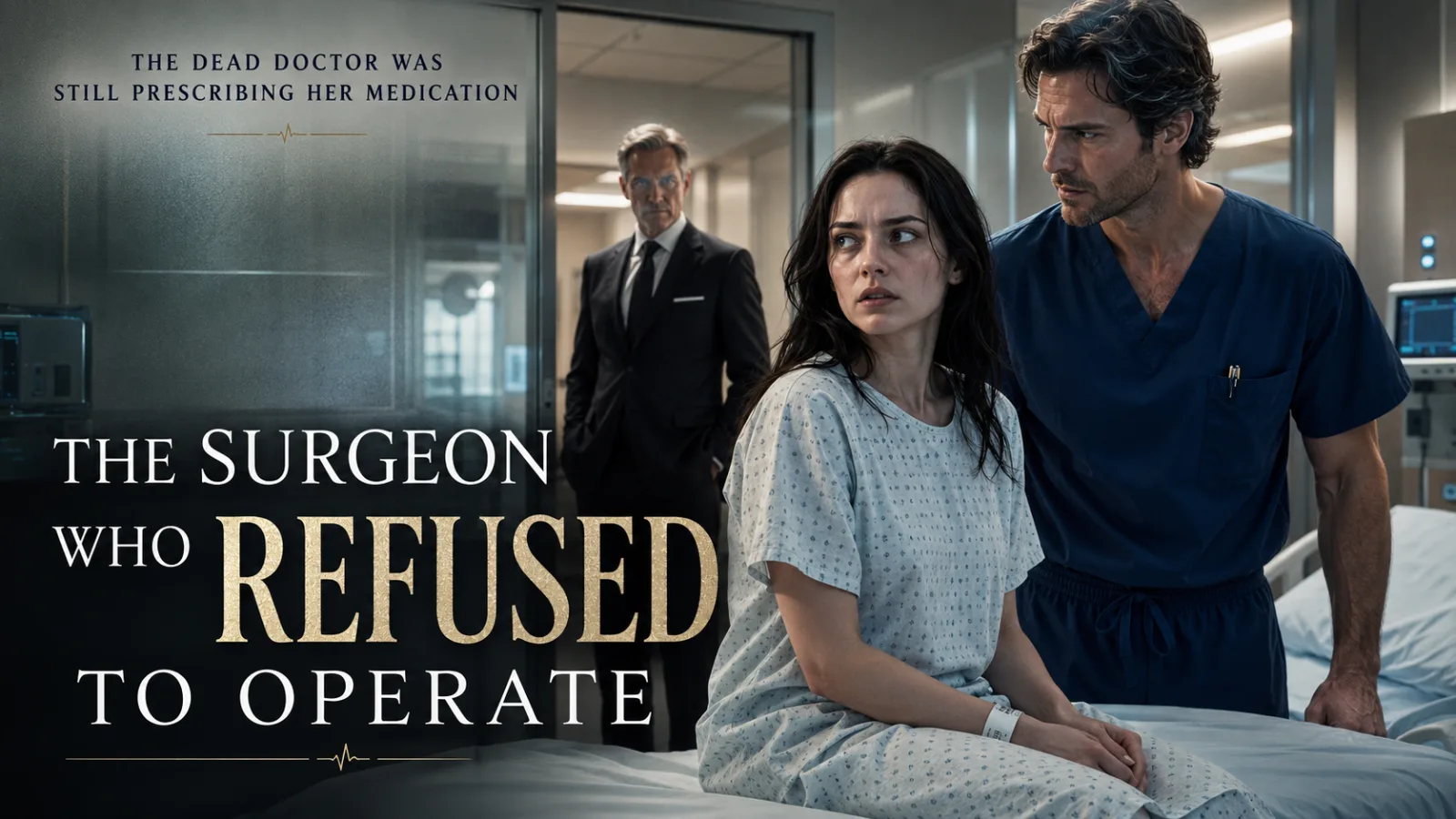
THE SURGEON WHO SAID NO
By the time Evelyn Halden reached St. Catherine Medical Center, her father had already told three people what needed to happen.
“She needs surgery.”
He said it to the paramedic before the ambulance doors opened, to the emergency physician while Evelyn was still being transferred onto a hospital bed, and again to a surgical resident whose only mistake had been asking Richard Halden to wait outside the imaging room.
Richard was accustomed to being obeyed. At fifty-eight, he ran Halden Maritime Systems, chaired two charitable foundations, and had spent enough money on St. Catherine’s new cardiac wing that his family name appeared in bronze near the elevators. He did not shout often because he had rarely needed to.
That night he shouted.
“My daughter is bleeding internally. Stop moving her from room to room and fix it.”
Evelyn heard him through the fog of pain.
She lay curled slightly on the gurney because straightening her abdomen made the pressure beneath her ribs feel unbearable. Her skin was cold, her mouth dry. Someone had placed oxygen under her nose. Another nurse was asking questions she could not concentrate on.
Medication.
Allergies.
Previous surgeries.
When was the last time she had eaten?
Evelyn tried to answer, but Richard answered first.
“She has Veylan vascular syndrome. It’s genetic. She’s been managed privately since she was seventeen.”
The nurse looked at Evelyn.
“What medications do you take?”
Richard reached into the leather bag he carried everywhere on her medical appointments and removed a typed list.
“Everything is there.”
Evelyn watched the nurse take it.
She had seen that list hundreds of times. Richard kept copies in his office, his car, the kitchen drawer beside the refrigerator and the emergency folder in Evelyn’s apartment. When she traveled—which was rarely—he made sure she carried another.
There had once been a time when Evelyn thought this was what love looked like.
Perhaps part of it was.
Her mother, Lydia, had died when Evelyn was sixteen. Richard told her the same vascular disease had caused it. Six months afterward, Evelyn began experiencing fainting spells, bruising and episodes of frightening weakness. Tests followed. Specialists followed the tests.
Eventually there was a diagnosis.
Veylan syndrome.
Extremely rare. Hereditary. Dangerous.
Richard had cried when he told her.
Evelyn remembered comforting him.
Nine years later, she still structured her life around a disease she barely understood. She avoided long flights. She stopped running. She turned down a semester in Florence because her father said the medical support there was too uncertain. She left graduate school during a prolonged flare and never returned.
People called Richard devoted.
Evelyn did too.
Until that night.
The surgeon arrived forty minutes after the ambulance.
Dr. Adrian Mercer was forty-four, broad-shouldered, dark-haired and remarkably calm for a man walking toward a woman whose father had been demanding his presence with increasing volume. He introduced himself to Evelyn first.
Not Richard.
That small detail registered.
“I’m Adrian Mercer. I’m the trauma surgeon on tonight.”
Evelyn nodded.
“We’ve looked at your scan and your blood work. You are bleeding, but I need to understand why before I take you into surgery.”
Richard stepped closer.
“She has a vascular disorder.”
Mercer continued looking at Evelyn.
“Do you know which medication you took this morning?”
She tried to remember.
“The white one and the small blue one.”
Richard said, “Her regimen is in the chart.”
Mercer’s eyes shifted toward him.
“I’m asking Evelyn.”
The room changed slightly.
Richard disliked being corrected, especially in front of strangers.
Evelyn felt the familiar impulse to repair the moment.
“My father manages the names. I get them mixed up.”
Mercer said nothing for a beat.
“Who prescribes them?”
“Dr. Armitage.”
Richard answered at the same time.
“Dr. Armitage.”
The surgeon looked at the medication list.
“When did you last see him?”
Evelyn frowned.
“It’s mostly remote now.”
Richard touched her shoulder.
“Save your strength.”
Mercer looked at Richard’s hand before returning to Evelyn.
“What does remote mean?”
“My father handles it through his office.”
Richard’s expression hardened.
“Doctor, is this really necessary right now?”
“Yes.”
“She is actively bleeding.”
“Which is exactly why I’m asking.”
Evelyn was moved upstairs shortly afterward.
The operating room looked brighter than she expected. Everything was white, silver or pale blue. Machines gave soft electronic tones. People spoke in short, practiced phrases that made Evelyn feel as though she had entered a place where panic had rules.
Richard had somehow been allowed as far as the preoperative threshold.
He remained there while Mercer reviewed the final labs.
Then the surgeon stopped.
He looked at one number.
Then another.
He asked for the medication list again.
Richard stepped forward.
“Dr. Mercer.”
Mercer did not respond.
“How long are we going to stand here?”
The surgeon looked toward the anesthesiologist.
“Hold induction.”
Richard’s voice sharpened.
“What?”
“We’re not operating yet.”
“My daughter is bleeding into her abdomen.”
“I know.”
“Then operate.”
Mercer finally turned toward him.
“If I cut into her right now with her clotting suppressed this severely, I may turn a controlled bleed into one we can’t stop.”
Richard’s face darkened.
“She has a vascular disease. Her medication affects coagulation. You should know that.”
“I know exactly what it does. What I don’t know is why she is taking this combination at all.”
Richard took another step.
“Do the surgery. Now.”
Evelyn had heard her father use that voice with executives, attorneys and once with a hotel manager who told him a ballroom was unavailable.
She had never heard him use it with someone standing between her and death.
Mercer did not flinch.
“If I operate now, she could bleed out. Who gave her this medication?”
Richard answered immediately.
“I did. Her specialist prescribed it.”
“Which specialist?”
“Dr. Samuel Armitage.”
Head nurse Talia Brooks had been adjusting equipment beside Evelyn’s table.
Her hands stopped.
She turned.
“What did you say?”
Richard looked annoyed.
“Dr. Armitage.”
Talia stared at him.
“I worked with Samuel Armitage at Baylor.”
Richard’s expression changed by almost nothing.
Talia continued.
“He died three years ago.”
The room became very quiet.
Evelyn looked at her father.
For a moment she assumed she had misunderstood.
“Dad?”
Richard recovered quickly.
“You’re mistaken.”
“I attended his memorial service.”
“He had associates working under his name.”
“No.”
“Then whoever continued his practice.”
Talia shook her head.
“His practice closed.”
Mercer took one step toward Richard.
“Where has Evelyn’s medication been coming from?”
Richard’s face flushed.
“From a licensed private pharmacy.”
“Under whose prescription?”
“I already told you.”
“You gave me the name of a dead physician.”
Evelyn tried to push herself higher.
Pain stopped her.
“Dad.”
Richard looked at her.
The expression he gave her was familiar: calm, steady, reassuring.
The expression he had used after her mother died.
The expression he used whenever Evelyn became frightened about her illness.
“Evie, don’t get worked up. There’s obviously an administrative explanation.”
Mercer stepped between them.
“Mr. Halden, I need you outside.”
“I’m staying with my daughter.”
“No.”
“You have no idea who—”
Mercer interrupted him.
“I know exactly who you are. Right now, you’re the person who says he has been personally giving my patient medication supposedly prescribed by a doctor who has been dead for three years.”
Richard went silent.
Mercer looked at Talia.
“Close the doors.”
Then he looked toward the circulating nurse.
“Call security.”
Richard’s calm broke.
“This is absurd.”
Nobody moved to comfort him.
For the first time in Evelyn’s life, a room full of adults looked at her father as if he might be the problem.
And for the first time in Evelyn’s life, she wondered the same thing.