THE SECOND REPORT
For nine months, Hannah Keene had rehearsed the moment she would give Claire Whitmore her baby.
Not Hannah’s baby.
Claire’s.
That distinction mattered to Hannah more than she knew how to explain to people who had never carried a child for someone else.
She had two children of her own, both in elementary school, both born before her marriage ended and before she discovered that the one thing her body seemed unusually good at was pregnancy. She did not romanticize surrogacy. She did not call herself an angel. She hated the language agencies used when they wanted women to forget that pregnancy involved swollen ankles, blood draws, contracts, insurance arguments, nausea, risk and nine months of strangers believing they had a right to ask what happened after delivery.
Hannah understood what she had agreed to.
The embryo had been created from Claire Whitmore’s egg and Graham Whitmore’s sperm.
That was what the contract said.
That was what the fertility clinic said.
That was what Claire believed.
And until the twenty-second week of pregnancy, Hannah had believed it too.
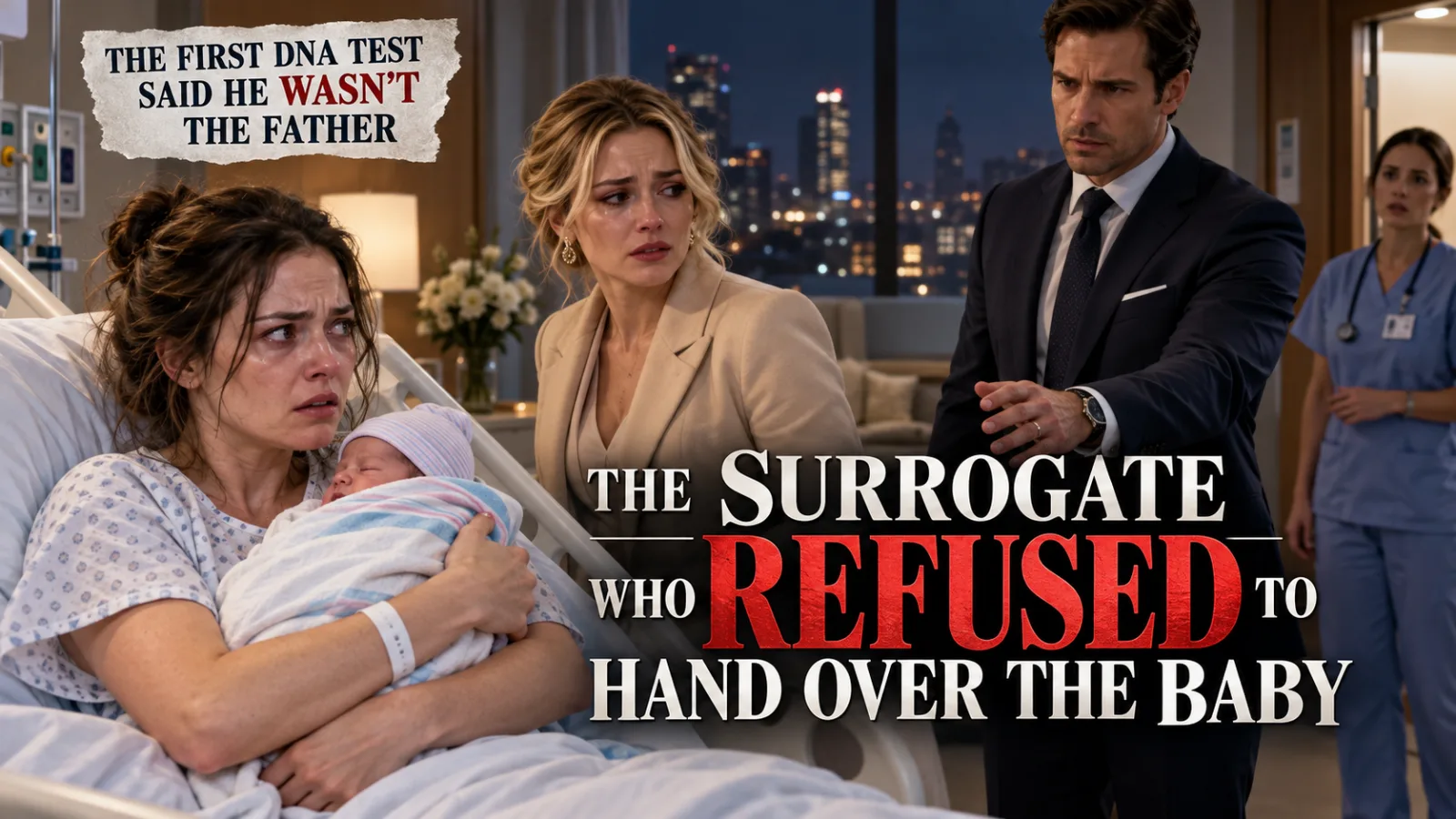
Now the baby slept against her chest in a white hospital blanket while Graham Whitmore stood three feet away, one hand extended.
“Give me my son.”
He did not say it cruelly.
That almost made it worse.
He said it as though the sentence were simply the next item in a sequence that had already been paid for.
Transfer successful.
Pregnancy maintained.
Child delivered.
Property released.
Hannah tightened her arm around the newborn.
“Not yet.”
Graham blinked.
Beside him, Claire stopped crying.
The room had been full of quiet joy seconds earlier. A nurse had adjusted Hannah’s IV. Another had taken photographs for Claire. Graham had sent a message to someone in the hallway. The baby had made one small sound and settled again.
Now every person in the room seemed to notice the same thing.
Hannah was not handing him over.
“Hannah?” Claire said.
The fear in her voice hurt.
Hannah looked at her.
Claire had been kind through almost the entire pregnancy.
She sent soup when Hannah caught the flu. She remembered Hannah’s daughter’s birthday. She never touched Hannah’s stomach without asking. She attended appointments but never treated the ultrasound screen like proof that Hannah had disappeared.
This was not about punishing Claire.
That was why Hannah had waited until the child was born.
She had needed to know that both of them were safe before detonating the truth.
“Hannah, what are you doing?”
Graham’s expression tightened.
“She’s exhausted.”
Hannah ignored him.
“Claire, before I give you this child, ask him why the DNA test came back twice.”
Silence.
Claire’s forehead creased.
“What DNA test?”
Graham moved immediately.
“She’s confused from the medication.”
Hannah had expected that.
In fact, she had written the sentence down weeks earlier because she was so certain he would say some version of it.
She shifted her gaze to Graham.
“Then why did the first report say you weren’t the father?”
Claire turned toward her husband.
The change in Graham was small.
A stranger might have missed it.
Hannah did not.
His hand lowered.
His jaw flexed.
He looked not at Claire, but toward the overnight bag beneath the chair beside Hannah’s bed.
That was where the envelope was.
The nurse nearest the door noticed the look too.
Claire whispered, “What first report?”
Graham exhaled through his nose.
“There was a lab error.”
Hannah said, “That’s what they told me.”
“Because that’s what happened.”
“Then why did they issue a second result under the same accession number?”
Graham’s eyes hardened.
“This is not the time.”
“It became the time when you reached for him.”
Claire stepped between them.
“Stop.”
Nobody spoke.
She looked at Hannah first.
“Tell me exactly what you’re talking about.”
Hannah’s hands began trembling.
Not from uncertainty.
From relief.
For twelve weeks she had carried the information alone, afraid that telling Claire too early would give Graham time to make it disappear.
“At twenty-two weeks, the clinic ordered a prenatal parentage confirmation.”
Claire frowned.
“No, they didn’t.”
“Yes.”
“I never approved that.”
“I know.”
Graham said, “It was part of the trust documentation.”
Claire turned.
“What trust documentation?”
He did not answer quickly enough.
Hannah continued.
“The lab portal listed me because I was the gestational carrier. I got the notification when the report posted.”
She could still remember sitting at her kitchen table when she opened it.
She had assumed the test was routine.
Fetal sample consistent with expected maternal contributor: Claire Whitmore.
Expected paternal contributor: Graham Whitmore.
Paternity excluded.
Hannah had read those two words again and again.
Excluded.
She called the clinic immediately.
A coordinator named Dana told her not to worry.
There had been an administrative error.
Two days later, another report appeared.
Same patient.
Same specimen collection date.
Same accession number.
Paternity probability greater than 99.99%.
The first file disappeared from the portal that afternoon.
But Hannah had already downloaded it.
“I asked Dr. Voss why the test changed,” Hannah said.
Claire knew the name.
Dr. Leonard Voss had run the fertility program that created the embryo.
“What did he say?”
“He said the lab attached the wrong paternal profile.”
Graham seized on the explanation.
“There. That’s the answer.”
Hannah looked at him.
“It would be, except the lab called me three weeks ago.”
His face changed again.
Claire saw it this time.
“Why would the lab call you?”
“Because someone in compliance found the original report during an audit.”
Graham took one step forward.
The nurse near the door moved with him.
“Mr. Whitmore,” she said quietly.
He stopped.
Hannah continued.
“The first report wasn’t attached to the wrong profile. They tested the sample labeled Graham Whitmore.”
Claire stared at her husband.
Graham said, “You have no idea how complex these tests are.”
“No,” Hannah said. “But the compliance officer does.”
She pointed toward the bag.
“There’s a signed letter in there.”
Claire moved toward it.
Graham blocked her path.
It happened so naturally that, for half a second, nobody reacted.
Then Claire stopped.
Her expression changed.
“Move.”
“Claire.”
“Move.”
“You just had a child.”
Her face hardened.
“I did not just have anything. Hannah did. Now move.”
Graham stepped aside.
Claire bent and took the envelope from Hannah’s bag.
Her hands shook as she opened it.
Hannah watched Graham instead.
For months she had wondered if she was wrong about him.
She was no longer wondering.
Claire read the first page.
Then the second.
“What does this mean?”
Graham said nothing.
Claire looked at Hannah.
“Whose DNA was it?”
“That’s the part they couldn’t tell me.”
“Why not?”
“Because the second test wasn’t just corrected.”
Hannah swallowed.
“It used a different paternal reference sample.”
Claire’s eyes moved back to Graham.
The newborn shifted gently in Hannah’s arms.
No one breathed normally.
A hospital administrator entered the room after the nurse quietly called for one.
Then security came.
Then legal counsel.
Within forty minutes, the cheerful discharge plan had become an incident review.
The hospital did not decide custody.
It did not accuse Graham of a crime.
It did something simpler.
It stopped the child from leaving while lawyers contacted the judge who had signed the pre-birth parentage order.
Graham made calls.
Claire made none.
She sat beside Hannah’s bed and stared at the sleeping child.
At four in the morning, she finally spoke.
“Is he mine?”
Hannah knew exactly what she meant.
“The first report said the maternal DNA matched you.”
Claire closed her eyes.
A tear moved down her cheek.
“So I’m his mother.”
“Yes.”
“And Graham?”
Hannah looked across the room.
Graham stood outside the glass panel speaking furiously to an attorney.
“I don’t know.”
Claire opened her eyes.
“No.”
Her voice was different now.
“I think you do.”
Hannah shook her head.
“I know he isn’t the man in the first test.”
Claire watched her husband.
“Then we find out who is.”
Neither of them knew yet that the answer had been sitting in a cryogenic storage facility for nearly six years.
Under the name Nathan Whitmore.