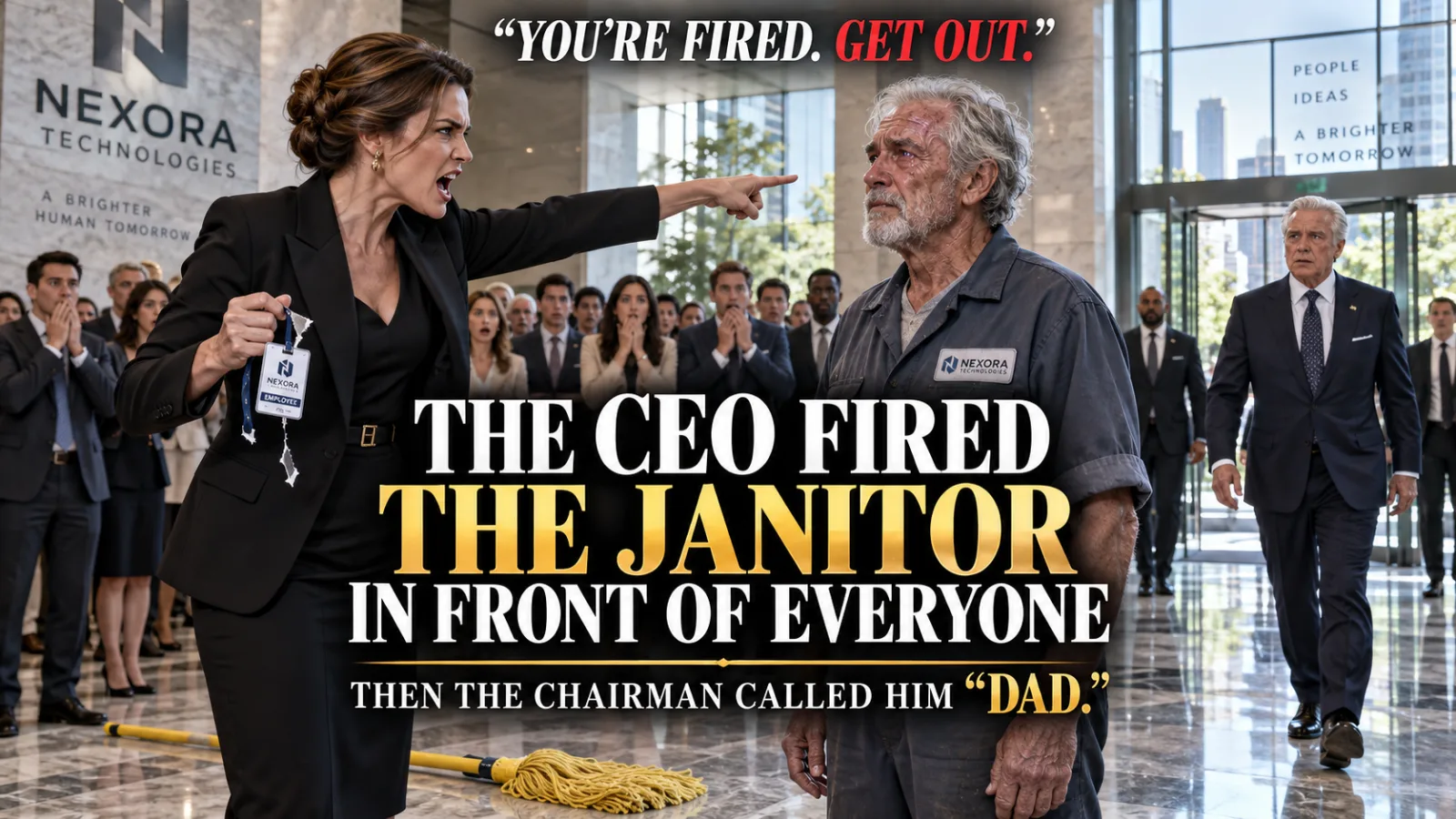
THE BADGE
Mara Keene believed public correction saved time.
At 9:47 on Monday morning, that belief had two hundred employees standing in the marble atrium of Northstar Medical Systems while she explained why “comfort” was the enemy of performance.
She was forty-three, six months into the CEO job, and wore a black suit cut so sharply that even her stillness looked intentional. Behind her, a forty-foot presentation screen displayed three words.
ACCOUNTABILITY.
SPEED.
OWNERSHIP.
Nobody looked comfortable.
Joe Bell watched from the edge of the crowd with one hand around a yellow mop handle.
He had been working the morning facilities shift for eleven weeks. Long enough to know which executives abandoned half-full coffee cups on windowsills, which engineers arrived before sunrise, which security guards quietly allowed exhausted analysts to sleep for twenty minutes in the wellness room after working through the night.
Long enough to know that the building looked most honest before the people with titles arrived.
Joe was seventy-one, broad-shouldered despite the small stoop age had begun putting into his back. His gray hair was cut close. His hands were scarred from forty years of electrical work.
His dark-blue uniform carried the stitched logo of ClearPath Facilities over one pocket.
A cheap plastic badge hung beneath it.
JOSEPH BELL.
FACILITIES - CONTRACTOR.
Most people at Northstar called him Joe.
Mara Keene had never called him anything.
She finished her speech to applause that began half a second too late.
“Remember,” Mara said, smiling now, “kindness and standards are not opposites. But protecting poor performance because a conversation feels difficult is not kindness.”
Joe saw three employees lower their eyes.
One of them was Maya Chen.
Maya was twenty-nine and worked in corporate finance. She had spent most of the previous night on the twenty-sixth floor.
Joe knew because at 2:15 that morning he had emptied the wastebasket beside her desk while she stared at a spreadsheet with both hands pressed against her temples.
Now Maya stood beside the elevators holding a thick stack of printed pages against her chest.
Mara stepped away from the stage.
Employees began dispersing.
Then she saw Maya.
“Conference room.”
Maya stopped.
“Now.”
Joe looked away.
It was none of his business.
That was the first rule of cleaning offices.
People forgot you were there.
If you respected that, they kept forgetting.
He rolled his bucket toward the west corridor.
The conference-room door closed behind Mara and Maya.
Five minutes later, something struck the glass wall inside.
Not hard enough to break it.
Hard enough that several people turned.
Joe kept mopping.
Then the door opened.
Maya came out first.
Her face was red.
A set of papers followed her.
Mara had thrown them.
The pages hit Maya’s shoulder and scattered over the polished floor.
“You do not bring that garbage to my board,” Mara said.
Maya crouched automatically.
“Mara, those are the current numbers.”
“The current numbers are whatever Finance can defend.”
“They’re the supplier numbers.”
“I know what they are.”
Maya gathered the papers with shaking hands.
The atrium was becoming quiet again, but this time nobody had been asked to listen.
Mara noticed.
Her expression hardened.
“If you cannot tell the difference between a forecast and surrender, I will find someone who can.”
Maya opened her mouth.
Nothing came out.
Joe rested his mop against the wall and bent down beside her.
Mara looked at him as though furniture had spoken.
“I didn’t ask you to do that.”
Joe picked up one sheet.
“No, ma’am.”
“Then don’t.”
Maya whispered, “It’s okay.”
Joe handed her the page.
Mara stepped closer.
“I said don’t.”
Joe straightened.
Years of industrial work had taught him the difference between anger and danger.
Anger wanted noise.
Danger wanted obedience.
Mara wanted obedience.
“She dropped her papers,” Joe said.
“I can see that.”
“Then we’re all caught up.”
Several employees looked down to hide their reactions.
Mara’s face changed.
Not much.
Joe had seen that expression before on foremen who confused being obeyed with being respected.
“What is your name?”
“Joe.”
“Joe what?”
“Bell.”
She glanced at the contractor logo.
“Who is your supervisor?”
“Luis on mornings.”
“Not anymore.”
Joe frowned.
Maya stood.
“Mara, please. He didn’t—”
“Go upstairs, Maya.”
“Mara—”
“Now.”
Maya flinched.
Joe saw it.
That was the part he could not ignore.
“You don’t have to talk to her like she’s a dog.”
The words landed in the middle of the atrium.
Someone near Security whispered, “Oh, shit.”
Mara turned toward Joe.
“What did you say?”
Joe did not raise his voice.
“You heard me.”
She walked closer until less than two feet separated them.
“You clean this building.”
“Yes.”
“You do not insert yourself into executive conversations.”
“No.”
Her eyes narrowed.
“No?”
“I said I clean the building. I didn’t say I stop being a person while I do it.”
There were perhaps sixty employees still within sight.
Joe knew because every one of them suddenly seemed afraid to move.
Mara looked at the mop beside him.
Then she swung her hand hard.
The mop flew from Joe’s grip.
It cracked against the marble.
Joe looked at it.
When he turned back, Mara had grabbed his badge.
She jerked it hard enough to snap the metal clip.
The badge came off.
She shoved it against his chest.
“You’re fired.”
Joe stared at her.
Mara pointed toward the glass entrance.
“Get the fuck out of my building.”
Nobody breathed.
Joe looked down at the badge in his hand.
His eyes burned unexpectedly.
Not because he had lost the job.
He had been fired once before, at twenty-two, from an electrical shop after refusing to work a live panel without protective equipment.
He had survived.
This was different.
There was something uniquely ugly about being stripped of dignity in front of people who were too frightened to object.
Mara mistook his silence for defeat.
“I said now.”
Joe looked toward Maya.
She was crying.
Not loudly.
She would have hated that.
Just tears she was furious with herself for having.
Joe picked up the fallen mop.
He rested it carefully against the wall.
Then he looked at Maya.
“Keep those papers.”
Mara laughed.
“Security.”
Two guards looked at one another.
Neither immediately moved.
Then the glass entrance doors opened.
A black sedan had stopped outside.
Security straightened.
A man in a charcoal suit entered carrying a leather folio.
Adam Sinclair was forty-six, tall, dark-haired, and recognizable enough that the atmosphere changed before he said anything.
Board chairman.
Northstar co-founder.
Former CEO.
The man whose photograph appeared in annual reports beside phrases such as disciplined governance and long-term stewardship.
Mara turned.
The anger disappeared from her face.
“Adam. You’re early.”
Adam did not answer.
He was looking past her.
At Joe.
The leather folio slipped slightly in his hand.
Joe felt an old, complicated dread settle into his stomach.
He had imagined this possibility for eleven weeks.
He had never imagined it happening while holding his own broken ID badge.
Adam crossed the atrium quickly.
“Joe?”
Mara looked between them.
Adam stopped in front of the older man.
His expression moved from confusion to alarm.
Then he did something nobody in the building had ever seen him do to a contractor.
He wrapped both arms around Joe and hugged him.
Joe closed his eyes.
For half a second he was no longer inside Northstar headquarters.
He was beneath an old Ford pickup teaching a skinny teenager how to replace brake pads.
He was at a kitchen table explaining compound interest.
He was in a hospital hallway telling that same boy his mother knew he loved her even though neither man knew whether she had still been conscious enough to hear it.
Adam stepped back.
His hands remained on Joe’s shoulders.
“Dad,” he said.
Half the atrium heard him.
“Why are you wearing that uniform?”
Mara Keene went white.
Maya’s mouth opened.
One security guard slowly lowered his radio.
Adam finally noticed the broken badge.
Then the mop.
Then Mara.
“What happened?”
Nobody spoke.
Adam looked at Joe.
“Dad?”
Mara recovered first.
“This is a misunderstanding.”
Joe almost smiled.
Thirty seconds earlier she had been certain enough to curse him out of the building.
Now it was a misunderstanding.
Adam looked at her.
“Why is his badge broken?”
“He interfered with a personnel matter.”
“Did you fire him?”
“He isn’t technically our employee. I instructed Facilities to remove him from the property.”
Adam’s voice became dangerously quiet.
“Did you tell my father to get the fuck out of your building?”
Mara’s jaw tightened.
Employees stared openly now.
Joe touched Adam’s arm.
“Don’t.”
Adam turned.
“Don’t what?”
“Do this here.”
“She just—”
“I know what she did.”
“Then why are you stopping me?”
Because Joe knew his son.
Adam’s anger had always been efficient.
It wanted an answer immediately and a consequence before lunch.
That instinct had helped build Northstar.
It had also kept him away from a hospital room on the final afternoon his mother had been lucid.
Joe looked at Mara.
She was frightened now.
Good.
But fear was not proof.
Joe had not spent eleven weeks watching people disappear inside this building just to let Mara become the victim of one powerful son’s rage.
He handed Adam the broken badge.
“If you fire her because I’m your father,” Joe said quietly, “she’ll spend the rest of her life saying this was about me.”
Adam stared at him.
Joe nodded toward Maya.
She was still clutching the reports Mara had thrown.
“It isn’t.”
Mara’s eyes immediately moved toward Maya.
Joe saw it.
So did Adam.
Joe picked up his mop.
“You came for a board meeting, didn’t you?”
“Yes.”
“Good.”
Joe looked at the elevators.
“Then maybe the board should finally have one.”