THE PEOPLE NO ONE SAW
The first person Joe really noticed at Northstar was Rosa Alvarez.
Not because she was loud.
Because she wasn’t.
Rosa had worked in the building for nine years, first directly for Northstar and later through ClearPath after Mara approved the outsourcing of facilities labor.
She knew where every executive hid extra coffee.
She knew which conference-room door jammed when humidity rose.
She knew how to polish stainless steel without leaving streaks.
Nobody on the twenty-ninth floor knew her last name.
Joe learned it on his second day.
“You’re doing that wrong,” she told him.
He was replacing a trash liner.
“I’ve been putting bags in trash cans since before you were born.”
Rosa looked at him.
“How old do you think I am?”
Joe reconsidered.
“That was badly phrased.”
“Very.”
She showed him the faster method anyway.
They became friends.
Rosa had two daughters, one grandson, and a mortgage she was six years from paying off.
She also had a right knee that had started hurting after ClearPath cut the morning crew from seven workers to four.
The same amount of floor still had to be cleaned.
The same bathrooms.
The same executive offices.
The same kitchens.
The difference was that employees like Rosa now pushed two carts instead of one.
On April 17, Joe heard the crash from the west service corridor.
He found Rosa on the floor beside an overturned trash cart.
She had slipped while trying to drag the second cart around a corner.
Her face was gray.
Joe crouched.
“Don’t move.”
“I’m fine.”
“You are absolutely not fine.”
“My supervisor will—”
“Your supervisor can kiss my ass.”
She laughed despite the pain.
Then Luis Ortega arrived.
Luis managed the ClearPath morning team. He was a decent man trapped inside bad incentives.
His first question was whether Rosa could stand.
His second was whether she needed an ambulance.
His third, after he checked his phone, was whether they could “handle it internally.”
Joe heard the change.
“What does internally mean?”
Luis lowered his voice.
“The site’s already over incident target.”
“So?”
“So ClearPath loses the performance bonus.”
Rosa looked away.
Joe became angry.
“Call the clinic.”
Rosa resisted.
She needed the hours.
Joe called anyway.
Rosa missed six shifts.
When she returned, she wore a brace.
Her workers’ compensation claim had somehow become disputed because ClearPath’s initial incident report described the injury as an “aggravation of a pre-existing condition.”
Joe had been there.
He knew what happened.
He filed a report through Northstar’s ethics portal.
The portal thanked him for supporting a culture of integrity.
Five days later it marked the matter CLOSED.
Nobody contacted him.
Nobody contacted Rosa.
That was when Joe bought the black notebook.
He did not think of himself as an investigator.
He thought of himself as an electrician.
Electricians did not trust a breaker that failed three times because somebody wrote NORMAL on the panel.
They traced the circuit.
Northstar had patterns.
Mara’s pattern was easiest to see because everyone behaved differently when she appeared.
Conversations stopped.
People sat straighter.
Managers began agreeing before she finished asking questions.
One afternoon Joe was emptying a bin outside Product Operations when he heard Mara tell a director named Evan Cole that an employee who challenged her in a planning meeting had “confused psychological safety with immunity from consequences.”
Three days later, the employee disappeared from the directory.
Joe wrote down the date.
Another week, he watched a young software engineer leave HR with tears running down his face.
Joe offered him a paper towel because the restroom dispensers were being replaced.
The engineer laughed weakly.
“This is humiliating.”
“What is?”
“Crying in front of the janitor.”
Joe handed him another towel.
“I cry in front of the janitor all the time.”
The engineer stared.
Joe pointed at himself.
It took a second.
Then the man laughed.
He resigned the following week.
Maya Chen lasted longer.
Joe first spoke to her at 2:15 one morning when he found her asleep upright at her desk.
He gently tapped the partition.
She woke violently.
“Oh my God.”
“Sorry.”
“What time is it?”
“Too late or too early. Pick one.”
She looked at the monitor.
“I can’t leave.”
“Building on fire?”
“No.”
“Then statistically you can.”
She smiled despite herself.
Over the next month they became familiar in the odd way people on opposite edges of an institution sometimes did.
Maya knew almost nothing about Joe.
Joe knew she drank terrible hazelnut coffee, hated bananas, called her younger brother every Thursday, and worked whenever she was frightened.
By May, she was frightened constantly.
The Atlas imaging platform was supposed to be Northstar’s biggest release in four years.
Hospitals had preordered units.
Analysts expected the launch to drive the next two quarters.
Executive bonuses were partly tied to meeting the launch and margin targets.
Then a supplier failed a regulatory qualification.
Northstar could replace the component.
It would take time.
Maya’s job was forecasting.
The delay appeared in every responsible version of the numbers.
So did the financial consequences.
One morning Joe found her in the cafeteria staring into coffee.
“You look worse than usual.”
“Thank you.”
“Professional assessment.”
She smiled weakly.
Then she began crying.
Joe sat across from her.
He did not ask why.
People often told you when you stopped making them explain themselves.
“Mara wants the supplier delay out of the board deck.”
Joe waited.
“She says it’s temporary, so showing it as a launch risk is ‘premature pessimism.’”
“Is it a launch risk?”
“Yes.”
“Then why take it out?”
Maya laughed bitterly.
“Because red boxes make people uncomfortable.”
“Who?”
“The board. Compensation committee. Investors eventually.”
Joe stirred his coffee.
“You going to take it out?”
“My boss already did once.”
“And?”
“I put it back.”
Joe nodded.
Maya stared at him.
“You don’t understand how stupid that was.”
“No.”
“She can end my career here.”
“Probably.”
“That’s not helpful.”
“You want helpful or true?”
Maya looked down.
Joe leaned back.
“I spent forty years around electricity. There’s a rule. If a gauge says the wire is hot, you don’t erase the reading because the boss wants green.”
“This isn’t electricity.”
“No. Electricity is more forgiving.”
Maya laughed again.
Then Joe said something that stayed with her.
“Keep your original.”
She stopped smiling.
“What?”
“Whatever you made before they changed it. Keep it.”
“Why?”
“So tomorrow you don’t have to argue with your own memory.”
Maya said nothing.
Two weeks later she filed an internal complaint.
It was closed as a management-performance disagreement.
Mara then placed her on an informal “executive communication improvement plan.”
Joe added that to the notebook.
Maya begged him not to mention her name if he complained.
He didn’t.
He submitted a second ethics report describing a pattern of retaliation without naming her.
That report was closed within forty-eight hours.
By then Joe understood something that frightened him.
Northstar did not have a reporting problem.
It had a listening problem.
Complaints entered the system.
The system simply redirected them toward the people being complained about.
Joe considered calling Adam.
He picked up the phone one Sunday.
Put it down.
The problem was not pride anymore.
It was evidence.
If he called his son and said the CEO was cruel, Adam would investigate.
Maybe.
Or he would think Joe’s grief had turned into obsession.
Or Mara would learn the chairman’s father had been walking around headquarters writing notes.
Everything Joe had seen would become contaminated by who he was.
So he stayed silent.
Until the Thursday before his firing.
Maya found him polishing the conference-room glass at 6:10 in the morning.
She had not slept.
“They changed the deck again.”
Joe stopped.
“Atlas?”
She nodded.
“The board sees it Monday.”
“What does it say?”
“On schedule.”
“Is it?”
“No.”
Joe looked through the glass toward the empty conference table.
“What happens if you say something?”
“I might lose my job.”
“What happens if you don’t?”
She was silent.
Joe resumed wiping the glass.
“I can’t answer that for you.”
Maya stared.
“You’ve been telling me to keep evidence for weeks.”
“I told you to keep the truth. What you do with it is yours.”
She looked angry.
“Easy for you to say.”
Joe turned.
“No, it isn’t.”
She did not know why.
Not yet.
He gestured at the empty room.
“People like Mara count on everyone believing they’re the only scared person in the building.”
Maya’s eyes filled.
Joe lowered his voice.
“You aren’t.”
Monday at 7:42 a.m., Maya sent her original Atlas forecast, the revised versions, and five emails to Priya Shah’s audit-committee address.
At 9:47, Mara gave her speech about accountability.
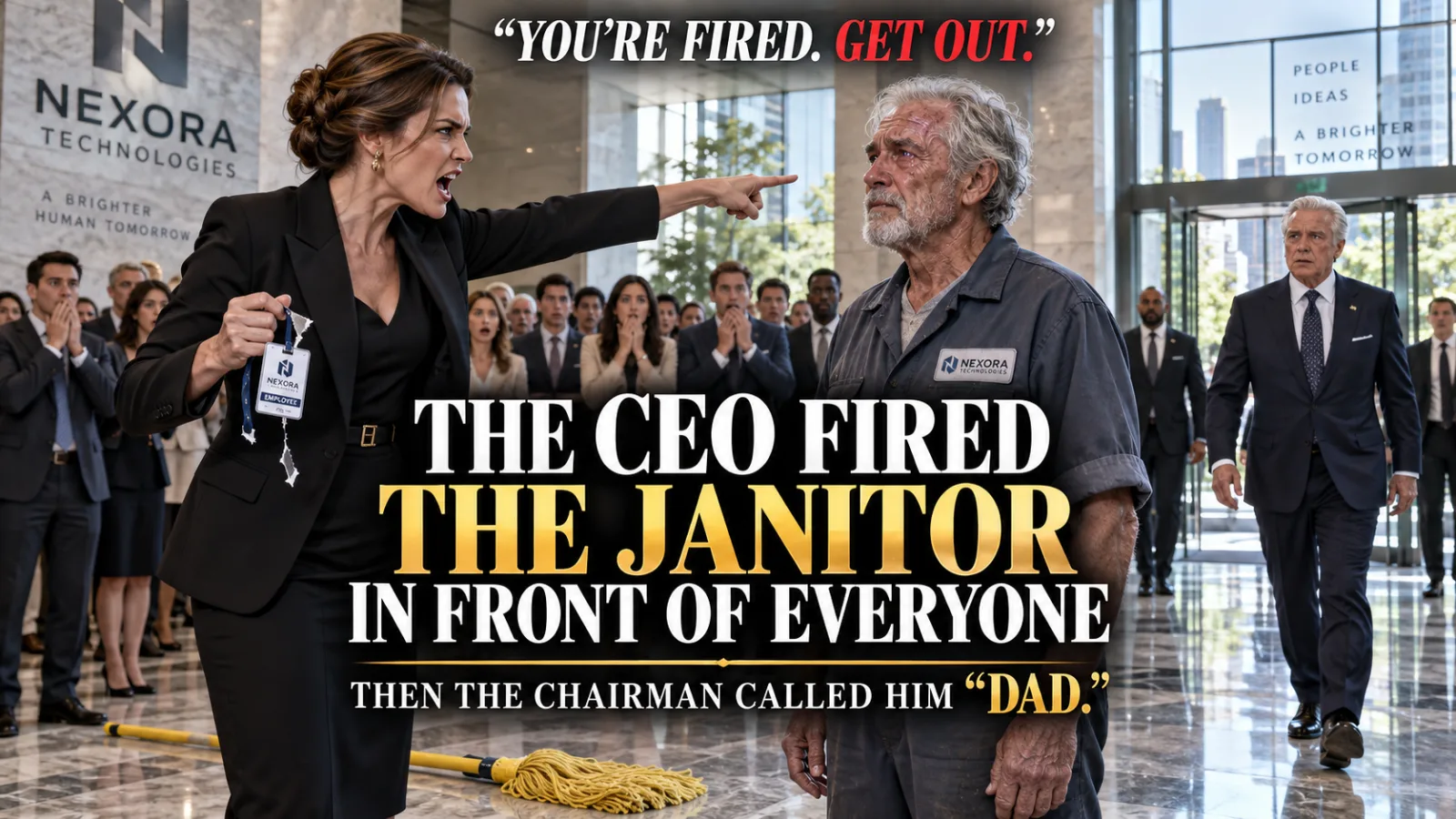
At 9:55, she threw Maya’s papers onto the floor.
At 9:57, Joe told her she did not have to talk to Maya like a dog.
At 9:58, Mara ripped off his badge.
At 10:00, Adam Sinclair entered the lobby.
For everyone watching, that was the moment the story began.
Joe knew better.
Stories like this never began when powerful people finally noticed.
They began much earlier.
Usually with somebody nobody noticed at all.