THE LAST SHIFT
Northstar did not become a good company the morning after Mara Keene left.
Joe would have distrusted any story that claimed otherwise.
Organizations changed more slowly than headlines.
Nolan Price resigned before the board could determine his employment status. Northstar later reached settlement agreements with several employees whose complaints had been mishandled.
ClearPath reopened Rosa Alvarez’s injury claim.
The company paid her medical costs and back wages.
Northstar rewrote its contractor agreement so vendor employees gained direct access to the board ethics channel instead of having complaints filtered through site management.
That sounded boring.
Joe considered it one of the best outcomes.
Boring rules were sometimes what kept ordinary people from needing extraordinary rescues.
The Atlas launch was delayed by twelve weeks.
Northstar disclosed the delay publicly.
Its stock dropped.
Then recovered.
Hospitals received functioning machines later rather than defective promises earlier.
Nobody died because a slide turned red.
That fact should have been obvious.
Apparently it required a board investigation.
Maya remained at Northstar.
She was not promoted overnight.
Joe respected that too.
She moved to a different manager while the company reviewed Finance leadership.
Six months later, she became director of planning after applying through the ordinary process.
On the day she got the job, she found Joe polishing the lobby rail.
“You’re going to say you knew I could do it.”
“No.”
She frowned.
“I was going to say you owe me coffee.”
“That’s less inspiring.”
“I’m a janitor, not a greeting card.”
She bought the coffee.
Priya led the search for a new CEO.
Adam remained chairman but requested that the board formally reduce the chairman’s authority over executive appointments for one year.
Priya thought he was overcorrecting.
Joe thought it was the first intelligent thing Adam had done with guilt.
Mara sued Northstar over the for-cause determination.
Months later, the case settled confidentially without reinstatement and without the executive payout her original contract would have provided after a normal termination.
She disappeared from headlines gradually.
That was another thing Joe learned.
Power rarely ended with a cinematic crash.
Sometimes it simply stopped returning your calls.
Joe remained at Northstar.
That drove Adam insane.
“You don’t need the paycheck.”
They were eating breakfast three weeks after the board vote.
“I needed the paycheck eleven weeks ago?”
“No.”
“Then nothing changed.”
“Everything changed.”
“Not the bathrooms.”
Adam stared at him.
“You are impossible.”
“Your mother said that.”
“She said stubborn.”
“She was being polite.”
ClearPath offered Joe a supervisor position.
He refused.
Northstar offered him a paid advisory seat on a workplace-culture committee.
He refused that too.
Priya called personally.
“You understand this is not charity.”
“I do.”
“Then why no?”
“Because everybody is trying to make the uniform temporary now that they know who my son is.”
Priya became quiet.
Joe continued.
“I wasn’t pretending to be a janitor.”
That sentence traveled through Northstar faster than he intended.
By summer, employees had mostly stopped treating him strangely.
The first month had been terrible.
Vice presidents suddenly held doors for him.
People apologized when he emptied trash cans.
One executive attempted to carry Joe’s supply box.
Joe finally snapped.
“If you spill those chemicals because you’re trying to prove you respect me, I’m going to make you clean the floor.”
Things normalized.
That was what he wanted.
Respect did not mean pretending work was beneath someone.
It meant understanding the person doing it was not beneath you.
Adam struggled more.
He had spent years showing love through solutions.
Joe had spent years rejecting solutions because accepting them felt like surrender.
Neither approach had worked particularly well.
So they tried something new.
Wednesday breakfast.
No assistants.
No agendas.
No discussing Northstar for the first thirty minutes.
The rule failed regularly.
But they kept meeting.
One Wednesday Adam brought Ellen’s old gardening gloves.
“I found these in my garage.”
Joe took them.
“How?”
“She left them there before she got sick.”
Joe turned them over.
Dirt still stained the fingertips.
For a long moment neither spoke.
Adam looked at him.
“I dream about the hospital.”
Joe nodded.
“So do I.”
“In mine I stay.”
Joe’s throat tightened.
“Mine too.”
Adam looked away.
“I can’t fix it.”
“No.”
“I hate that.”
“I know.”
Adam gave him a look.
“You really do say that too much.”
Joe smiled.
They visited Ellen’s grave together the following Sunday.
It was the first time since the funeral.
Adam brought flowers.
Joe criticized them.
“She hated lilies.”
“They were what the florist—”
“Your mother hated lilies.”
Adam sighed.
“What did she like?”
“Daisies.”
“You let me put lilies on her grave for fourteen months?”
“Apparently I still had some revenge left.”
Adam laughed so suddenly he had to sit on the stone bench.
Joe laughed too.
It was the first time grief felt like something they shared instead of a weapon passed between them.
In September, ClearPath informed Joe his one-year contract was ending.
They offered renewal.
He declined.
Adam heard through somebody else.
That annoyed him.
“You could have told me.”
“Where would the fun be?”
“What are you going to do?”
Joe considered.
“Sleep until six.”
“Scandalous.”
“Maybe volunteer at the trade school.”
“That sounds good.”
“Maybe annoy you.”
“You already have tenure.”
On Joe’s final morning shift, he arrived at 4:55.
Northstar headquarters was nearly empty.
The lobby lights glowed softly against the marble.
He changed into the same dark-blue uniform.
The original badge clip had never been repaired properly.
He had kept it.
A piece of wire held it to the pocket now.
Joseph Bell.
Facilities - Contractor.
He liked it that way.
He cleaned the elevators.
Restocked the conference rooms.
Mopped the atrium.
At 6:20, a young engineer hurried across the wet section without noticing the sign and nearly slipped.
Joe grabbed his elbow.
“Slow down.”
“Sorry.”
The engineer looked at the uniform.
Then at Joe’s face.
Recognition appeared.
Joe prepared for the usual awkwardness.
Instead the man said, “Thanks, Joe.”
Then kept walking.
Joe smiled.
Progress.
At 6:45, Maya came downstairs carrying two coffees.
At 6:50, Rosa arrived despite not being scheduled at Northstar anymore.
At 6:55, Luis appeared.
“You people have jobs,” Joe complained.
“So did you,” Rosa said.
“Not in five minutes.”
At seven, the glass doors opened.
Adam entered.
No sedan.
No leather folio.
Jeans.
Sweater.
Joe looked at him suspiciously.
“Board chairman unemployed?”
“Before eight.”
“Dangerous precedent.”
Adam walked toward the mop bucket.
“I thought I’d help.”
Joe immediately grabbed the handle.
“No.”
“Why?”
“You have no training.”
“I built a medical-device company.”
“You ever use a commercial floor wringer?”
Adam looked at it.
“How complicated can it be?”
Everyone laughed.
Joe handed him the handle.
“Fine.”
Adam tried.
The mop head folded under itself.
Rosa groaned.
“Oh, no.”
Maya covered her mouth.
Adam glared.
Joe took the handle back.
“This is why we respect skilled labor.”
“Very funny.”
“Wasn’t joking.”
At 7:08, Joe finished the final section.
He pushed the bucket into the service corridor.
Changed clothes.
Folded the uniform.
Then stopped.
For eleven months, the uniform had meant different things to different people.
To Mara it had meant weakness.
To embarrassed executives, it had become something they needed to perform respect around.
To journalists, it had been a costume in an “undercover chairman’s father” story that had never really existed.
To Joe, it had eventually become much simpler.
Work.
He placed the uniform inside the locker.
Kept the broken badge.
Outside, Adam waited.
They walked across the lobby together.
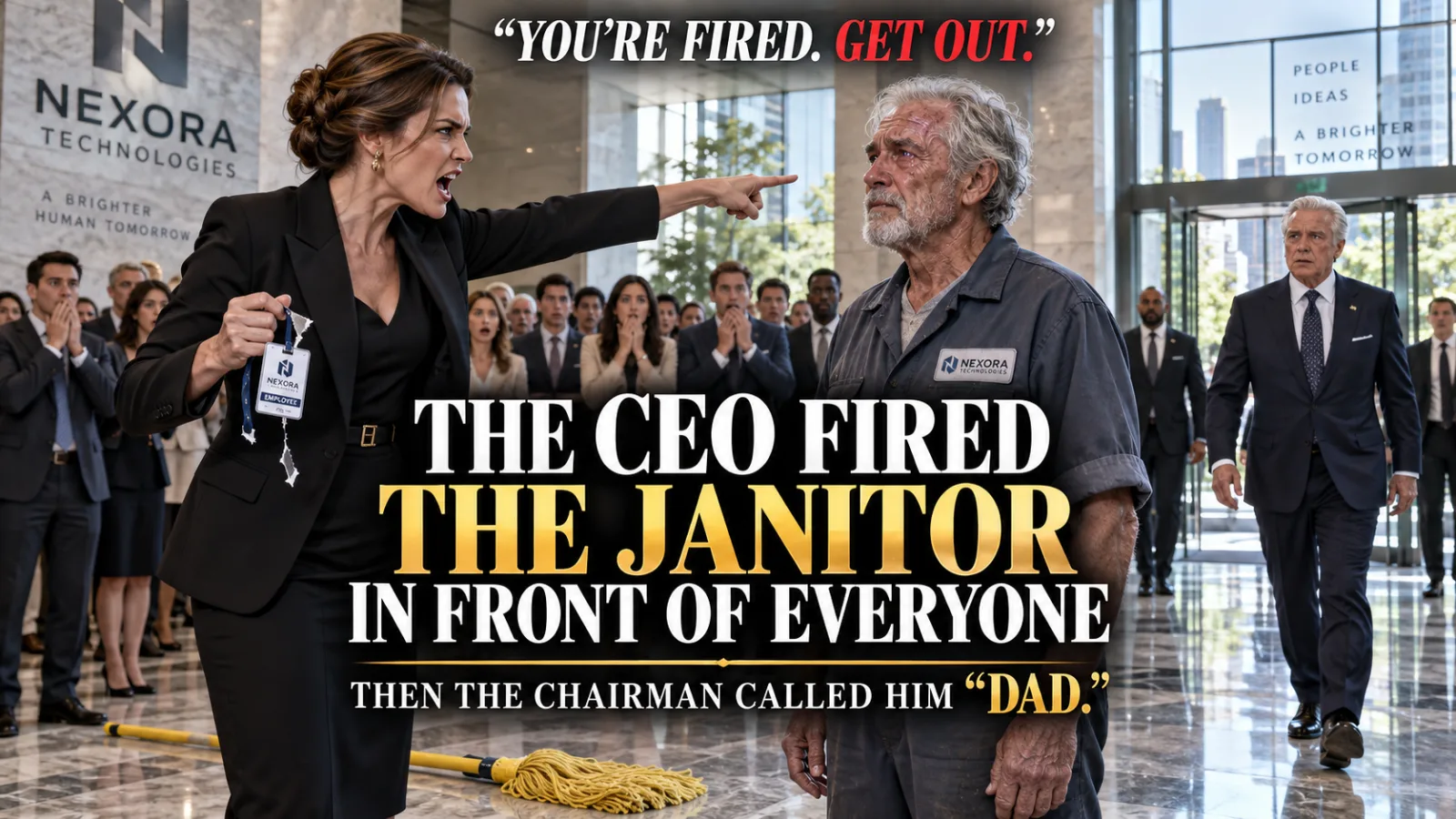
Near Security, Joe glanced at the place where Mara had thrown his mop.
He could still hear her sometimes.
You’re fired.
Get the fuck out of my building.
The memory no longer hurt in the same place.
Adam followed his eyes.
“You thinking about her?”
“Yes.”
“Still angry?”
Joe considered.
“Some.”
“Good.”
Joe looked at him.
“You think?”
“I’m learning not to demand emotional efficiency.”
Joe smiled.
“Therapy language.”
“Very expensive therapy language.”
They reached the glass doors.
Adam opened one.
Joe stopped.
“What?”
Adam looked confused.
Joe nodded toward the door.
“You don’t have to do that.”
“I know.”
That mattered.
Joe stepped outside.
Morning sunlight had begun reflecting off the surrounding buildings.
Adam followed.
“Breakfast?”
“Wednesday rule?”
“It’s Monday.”
“Then no Northstar talk at all.”
Adam winced.
“Cruel.”
“Accountability.”
Adam laughed.
They started walking.
Behind them, Northstar employees entered the building for another ordinary workday.
Most would never know exactly how many small decisions had been made because one elderly janitor refused to keep his head down.
Joe preferred it that way.
He had not needed to become powerful.
Mara’s mistake had been believing power was the only thing that made a person worth hearing.
The revenge was not that the CEO had been fired.
It was that the people she considered invisible were no longer willing to disappear.
Chapters · 8 of 8
Don't stop now.
Choose another Veyra story and keep reading.
More Revenge
One ending should lead naturally into another beginning.