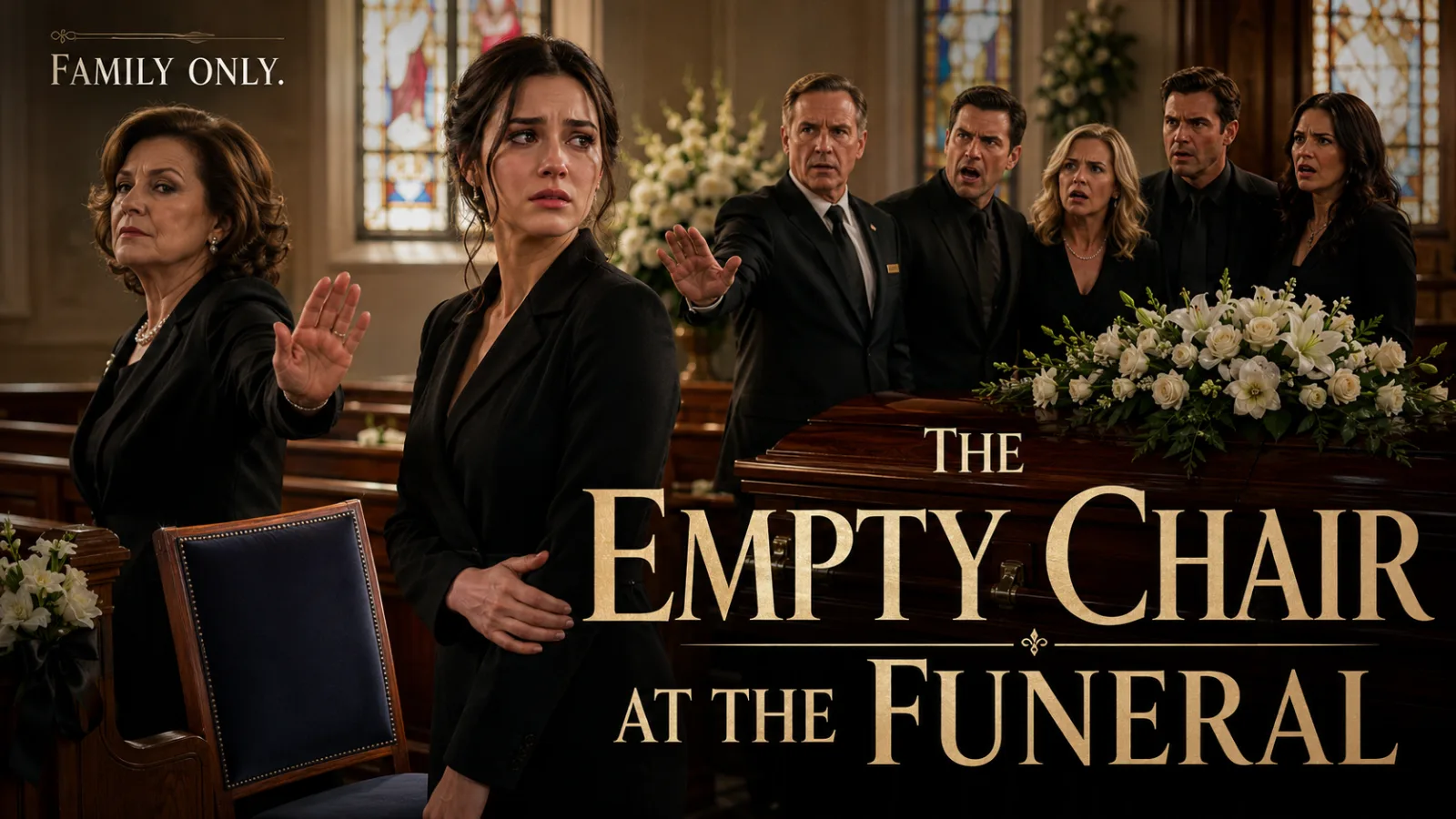
THE EMPTY CHAIR
The first thing Clara noticed was that her stepmother had chosen the pearl earrings.
Not the black onyx pair Evelyn wore when she wanted to seem severe. Not the small diamonds she reserved for hospital visits, charity dinners, and court appearances in support of other people’s scandals. Pearls. Soft, respectable, widow’s pearls. They glowed gently under the church lights as Evelyn Vale turned her head, saw Clara seated in the front pew beside the casket, and crossed the aisle with the expression of a woman correcting a household mistake.
For half a second Clara actually thought Evelyn meant to sit beside her.
Then Evelyn stopped in front of her and said, low enough to pass as civility and cruel enough to cut cleanly, “That seat is for family.”
Clara looked up at her. She was wearing the plain black dress Thomas had once said made her look “too honest for this family,” and her gloved hands were folded in her lap because if she let herself touch the polished wood of the pew she might never stop gripping it.
“I am family,” she said quietly.
Evelyn’s smile did not reach her eyes. “Don’t make a scene in a church.”
Then she put one hand on Clara’s shoulder and pushed.
It wasn’t a dramatic shove. That was what made it worse. It was small, controlled, practiced. The kind of physical correction a woman like Evelyn could later deny with injured dignity. Clara rose because resisting in that moment would have made her father’s funeral about the wrong humiliation. She stepped out into the aisle and felt every pair of eyes in the sanctuary slide toward her and then away again.
A chair remained empty beside the casket.
The church was full. Thomas Vale had been a respected man in Bellchester for forty years—owner of Vale Mercantile, patron of the local library, stubborn donor to the hospice wing, a man whose generosity was often quieter than his name. Former employees filled the back rows. Old friends from the courthouse and the country club stood along the walls. Florists, bank managers, mechanics, pastors, a retired mayor, three women from the choir who had all brought casseroles when he first got sick—they were all there.
And every one of them had seen Evelyn remove Clara from the front row.
Across the aisle, the four biological children watched it happen with varying degrees of satisfaction and caution. Grant, the eldest son, kept his face composed, but Clara caught the brief hard set of his mouth. Vanessa, who always looked as though life had forced her to be surrounded by lesser people, lowered her eyes with a faint air of relief, as if some social balance had been restored. Luke shifted awkwardly but said nothing. Amelia glanced at Clara once, then quickly at Evelyn, and decided what she always decided: comfort was safer than conscience.
The minister finished the final prayer.
Soft organ music faded.
Nolan Pierce, director of Pierce Funeral Home and a man Thomas had known for two decades, stepped toward the casket with the grave calm of someone who had guided hundreds of families through this exact moment. He nodded almost imperceptibly at the four children.
Grant rose first. Vanessa adjusted her veil and stood. Luke buttoned his jacket. Amelia dabbed her eyes and followed. Together they approached the casket, hands already reaching toward the handles.
Nolan lifted one hand.
“Please wait.”
The movement was so precise, so unexpected, that all four stopped.
Evelyn turned sharply. “What is it?”
Nolan kept his posture formal, but when he spoke, his voice carried clearly through the church.
“Mr. Vale left instructions.”
A rustle moved through the room like wind in paper.
Grant frowned. “Instructions about what?”
Nolan faced all of them evenly. “None of you are allowed to carry him.”
It was as if the room inhaled and forgot how to exhale.
Vanessa actually laughed once, a short unbelieving sound. “Excuse me?”
Nolan did not look away. “Those were Mr. Vale’s instructions.”
Evelyn stepped forward, the pearls flashing at her throat. “This is absurd. I am his wife.”
“Yes, ma’am,” Nolan said. “And I was asked to follow his wishes exactly.”
Grant’s voice sharpened. “Who, exactly, is supposed to carry him then?”
Only then did Nolan turn.
He looked past the children, past Evelyn, down the aisle to where Clara stood beside the empty chair she had just been forced to leave.
The edge in his face softened.
“He chose her.”
For a heartbeat no one moved.
Clara felt the words strike her almost physically. Not because she didn’t understand them, but because she did.
Beside the casket, Vanessa’s head snapped toward Clara with naked outrage. Luke seemed unable to decide whether to be embarrassed or angry. Amelia stared as if Clara had somehow pulled off a trick. Grant’s entire expression went still, which on him was always more dangerous than shouting.
Evelyn’s face changed in stages—first disbelief, then fury, then something older and uglier: the panic of a woman discovering that control had limits.
“This is not funny,” she said.
“No one is laughing,” Nolan replied.
He stepped away from the casket and crossed to Clara. Up close, she could see the sympathy in his eyes, but also something else: relief, perhaps, that a long-kept instruction no longer had to stay folded in an envelope.
“Miss Vale,” he said softly, “your father asked for you.”
Clara swallowed. The last time Thomas had spoken clearly, two nights before he died, his breathing had been ragged and his fingers cold despite the heated blankets. He had gripped her hand with surprising strength and said, “Stay through the end, birdie. Don’t leave before the last thing.” She had thought he meant the burial. Now she understood he had meant this.
“I don’t know what I’m supposed to do,” she whispered.
Nolan nodded once. “He left that part covered too.”
Two of the funeral home attendants stepped forward. One moved to the far rear handle. Nolan indicated the front position nearest the aisle.
“That one is yours,” he said.
Clara’s eyes burned. The empty chair beside the casket seemed suddenly to contain its own meaning—not just rejection, but testimony. Thomas had known exactly what kind of family spectacle might unfold after his death. He had anticipated it so clearly that he had built a trap out of public dignity.
She removed her gloves, handed them wordlessly to the woman from the choir nearest the aisle, and stepped into position.
Evelyn hissed, “You cannot be serious.”
Clara looked at her then, really looked at her, and saw not grief, not even righteous anger, but offense. Evelyn was offended that Thomas had managed to defy her from inside a coffin.
The realization steadied Clara more than comfort would have.
“Yes,” she said. “I can.”
If Thomas had wanted a last battle, she would not abandon him to it.
When her hand closed around the casket handle, she felt the polished metal cool against her palm. On the other side, Nolan gave the smallest nod. The attendants lifted with her. The casket rose. For one surreal moment Clara was aware of nothing except weight and silence and the fact that every living member of the Vale family—every one who mattered to the story and every one who would carry its consequences—was watching.
As they moved down the aisle, she did not look back.
Only once they reached the hearse did her hands start trembling.
Nolan lowered the casket with the attendants, then turned to her before anyone else could crowd in. “Mr. Coley’s office called,” he said. “The reading is tomorrow at ten. He asked me to remind you there’s a sealed packet with your name on it.”
“Miles Coley?” Clara asked, surprised.
Thomas’s attorney, gray-haired, patient, and almost impossibly discreet, had handled Vale family business since before Clara turned sixteen.
Nolan nodded. “Your father was very exact.”
From the church steps, Evelyn’s voice cut across the parking lot. “Clara.”
Clara looked up.
The widow was framed by black umbrellas and expensive mourning clothes, with her four children fanned loosely behind her like a court no longer sure of its monarch. Even at a distance, Evelyn’s composure had begun to crack around the mouth.
“If you have any decency,” she said, “you will not make more of this than it was.”
Clara almost laughed. It rose in her chest like something half-broken and died there before it reached her mouth.
For six years she had changed Thomas’s dressings, argued with insurance companies, sat awake through fevers, and learned the difference between every kind of silence a sick man could keep. She had buried her own exhaustion so deeply that politeness began to feel like instinct. But something had shifted inside her when the funeral director stopped the children from touching the casket.
It was not courage exactly.
It was the first clear outline of anger.
“What was it?” Clara asked.
Evelyn took a step forward. “A sentimental overreaction. Your father was ill. He was upset.”
“No,” Clara said. “I asked what this is now.”
Grant descended the steps beside his mother. “Enough.”
His voice had the polished impatience of a man used to closing conversations by deciding they were beneath him. He had Thomas’s height but none of his warmth, and at forty-two he still carried himself like the natural heir to something no one else had any business touching.
“Tomorrow,” he said. “At Coley’s office. Until then, keep whatever performance this is to yourself.”
Clara met his gaze. “I didn’t start the performance. Your mother did. In church.”
Vanessa went pale with outrage. Luke stared fixedly at the gravel. Amelia looked trapped between old habit and new fear.
Evelyn straightened. “You would do well to remember who took you in.”
The words hit harder than the push.
Clara felt the parking lot, the umbrellas, the polished hearse, even Nolan’s quiet presence beside her, all recede slightly as something old uncoiled in her chest.
Thomas had taken her in.
Not Evelyn. Never Evelyn.
“Tomorrow, then,” Clara said.
She turned away before any of them could answer and walked toward her car with her gloves clenched in one hand and the taste of iron rising at the back of her throat.
Only once she was inside, doors locked, hands braced on the steering wheel, did she finally let herself cry.
Not because Evelyn had pushed her out of the front row.
Not even because Thomas was gone.
She cried because for the first time it was impossible to pretend that whatever had poisoned this family had started with neglect.
Thomas had known something. Something grave enough to strip his own children of the right to carry him.
And tomorrow, if the sealed packet had anything to say about it, Clara would begin learning what.