THE DAUGHTER WHO STAYED
In the days after Thomas adopted her, Clara used to line her shoes up by the back door because she was afraid of taking up too much space.
She had been eleven when her father, Daniel Vale, died on County Route 8 in the rain with a ruined ledger bag in the passenger seat and three separate financial accusations hanging over his name. Everyone in Bellchester remembered the crash. Fewer people remembered that Daniel had been a widower already, or that the little girl left behind had spent two months being passed among distant relatives and temporary bedrooms while the adults argued about money, scandal, and what Thomas Vale ought to do.
Thomas did not argue long.
He brought her to Vale House on a cold Thursday afternoon, carried her cardboard suitcase inside himself, and told the staff, “My niece is staying.” When the paperwork was finished months later and “niece” became “daughter,” he never made a ceremony of it. He simply treated the change as settled fact.
Evelyn had smiled through all of it.
That was the first warning sign, though Clara had been too young to read it.
People who truly accepted Clara rarely announced it. They made room at the table. They remembered what tea she liked. They called her down when mail arrived in her name. Evelyn did none of those things. Evelyn specialized instead in the gesture that looked gracious from ten feet away and punishing from two. She bought Clara dresses then criticized the posture inside them. She told guests Clara was “one of ours now” while leaving her out of family photographs unless Thomas was present to notice.
The children learned quickly.
Grant never bothered to hide his resentment. He had been nineteen when Clara arrived and old enough already to understand inheritance, hierarchy, and the threat of affection flowing in a new direction. Vanessa, two years younger, developed the habit of smiling at Clara only when other people were watching. Luke, still a teenager, followed stronger personalities the way he always would. Amelia, the youngest, sometimes seemed almost kind until kindness cost her something.
Only Thomas was uncomplicated.
He taught Clara how to use the old brass telescope in the library tower, how to tell when a steak was properly rested, and how to read the ledgers for Vale Mercantile because, in his words, “Any family worth surviving needs at least one person who can add.” He let her sit in his office and do homework while he worked. When nightmares woke her during the first year, he used to come sit in the hallway outside her bedroom door and talk about weather, baseball, and once—bizarrely—the migration patterns of monarch butterflies until she fell back asleep.
For a long time, that was enough.
It did not remain enough after Thomas got sick.
The diagnosis came when Clara was twenty-three and had just turned down a job offer in Chicago because Thomas hated the idea of the library tower being empty. Congestive heart failure at first, then complications, then a fall that broke his confidence almost as badly as it bruised his ribs. Illness altered the whole architecture of Vale House. Guest rooms became storage for medical equipment. The breakfast room turned into command central for medication schedules and visiting nurses. Thomas, who had once walked the orchards at dawn in leather boots, now measured his victories in whether he could make it to the terrace without assistance.
Everyone swore they would help.
At the funeral, Clara kept hearing those promises in reverse.
Grant had said he’d handle everything, then vanished into “critical business travel” for three months. Vanessa sent expensive blankets from Manhattan and called them comfort. Luke came twice, once to ask Thomas to guarantee a loan and once to complain about how upsetting hospitals smelled. Amelia cried sincerely at the sight of her father’s swollen hands, then took selfies in the rose garden that same afternoon and posted them without context.
Evelyn remained in the house, but presence did not equal care. She detested bodily weakness in the way some people detested mildew or bad manners. She would sit beside Thomas when visitors came, speaking in hushed tones about burden and devotion, then leave the room the moment he needed help with the practical humiliations of being ill.
Clara did the practical things.
She learned how to keep Thomas steady in the bathroom without making him feel pitied. She learned how to hide the pills he hated inside spoonfuls of peach yogurt. She learned the signs that meant he needed extra oxygen and the other signs that meant he simply needed someone to stop talking and sit nearby. She slept lightly for years.
It was not sainthood. It was love mixed with habit mixed with a strange fierce loyalty to the one person who had chosen her before she understood how much choice mattered.
In the final winter Thomas’s voice began to change. The illness ate strength from it first, then breath, then certainty. But his mind remained clear in jagged bursts. Some days he drifted. Other days he became so sharply himself that Clara left the room afterward shaken, as though the stronger version of him had briefly clawed its way back to the surface to settle unfinished business.
Two weeks before he died, he asked her to bring him the blue binder from the study.
She found it on the second shelf behind tax records and returned with it tucked under her arm. Thomas motioned for the door to be closed first.
“What’s in it?” she asked.
“Proof,” he said.
His mouth curled faintly at her expression. “Or maybe the road to it.”
“For what?”
He tapped the binder with one bent finger. “For after.”
She sat on the bed. “You keep saying things like that and then falling asleep before explaining them.”
“Occupational advantage.” Even sick, he could still turn dry. His eyes moved to the window where sleet tapped the glass. “Clara.”
She leaned closer. “I’m here.”
“I was late,” he said.
“At what?”
A long pause.
“Knowing.”
She frowned. “I don’t understand.”
“No,” he said. “You don’t. But you will.”
That was the most Thomas said until the last forty-eight hours.
Once the doctors admitted there was little more to be done, the children returned with alarming speed, as though death had sent out engraved invitations. Grant came first, efficient and solemn, immediately wanting updates on the trust. Vanessa swept in with garment bags and strategic grief. Luke smelled faintly of whiskey the first night and strongly of entitlement by the second. Amelia arrived with flowers and panic and the desperate hope that love might somehow be performative enough to count.
Even then Thomas seemed to measure them differently now.
One evening, as Clara adjusted the blanket over his knees in the sunroom, he caught her wrist.
“They’ll crowd you,” he said.
She smiled tiredly. “They always do.”
“Stay anyway.”
“Of course.”
He searched her face as though checking whether she truly meant it. “No. Listen to me. Stay through the end. Not just with me. Through the end.”
She did not know then that he had already made the funeral arrangements, written the letters, and spoken privately with Nolan Pierce and Miles Coley. She only knew that his grip felt urgent.
“I promise,” she said.
The night he died, the whole family was in the house.
That fact would have looked beautiful from outside.
Grant stood at the foot of the bed in a dark sweater, hands clasped, the image of a grieving eldest son. Vanessa cried into a handkerchief. Amelia whispered prayers she had likely forgotten existed until that week. Luke stayed near the doorway, pale and restless. Evelyn sat closest, spine straight, fingers resting lightly on the mattress in a display of marital devotion so perfect Clara almost hated herself for noticing the performance even then.
Thomas’s eyes moved from face to face.
When they reached Clara, he seemed to settle.
Everyone else eventually drifted out under various excuses—phone calls, air, coffee, medication consults no one had actually requested. Near midnight only Clara remained. Thomas lay in the low amber light with oxygen tubing at his nose, skin papery and colorless, the sharp planes of his once-commanding face softened into something fragile and strange.
He opened his eyes.
“Birdie,” he whispered.
She bent close. He had called her that since she was twelve because, according to him, she had once broken her arm trying to rescue an injured sparrow and then spent three days lecturing the veterinarian as if she were staff.
“I’m here.”
“Top drawer,” he said.
“Which one?”
“Study. Left desk. Bronze key.” He fought for breath, then added, “After.”
Her own throat tightened. “All right.”
“And the funeral man,” he murmured. “I told him.”
“Told him what?”
A ghost of stubbornness entered his expression. “Enough.”
She laughed through tears then, because even dying Thomas Vale preferred partial answers if they let him maintain dramatic control. He squeezed her fingers with surprising strength.
“What’s important?” she asked softly, trying to humor him into speaking more.
He looked at her for a long time.
“You stayed,” he said.
Those were the last clear words he gave her.
By morning he was gone.
The house filled with casseroles, florists, lawyers, sympathy cards, casseroles from people who believed grief could be fed into submission, and the sharp efficient movement of adult children reclaiming corridors they had not cared about until they smelled inheritance in the walls. Clara moved through it all like someone underwater. She chose the navy tie Thomas always wore on formal occasions. She found the cuff links with the tiny brass compasses. She argued successfully against Vanessa’s plan to use a heavily retouched portrait for the memorial display. She slept almost not at all.
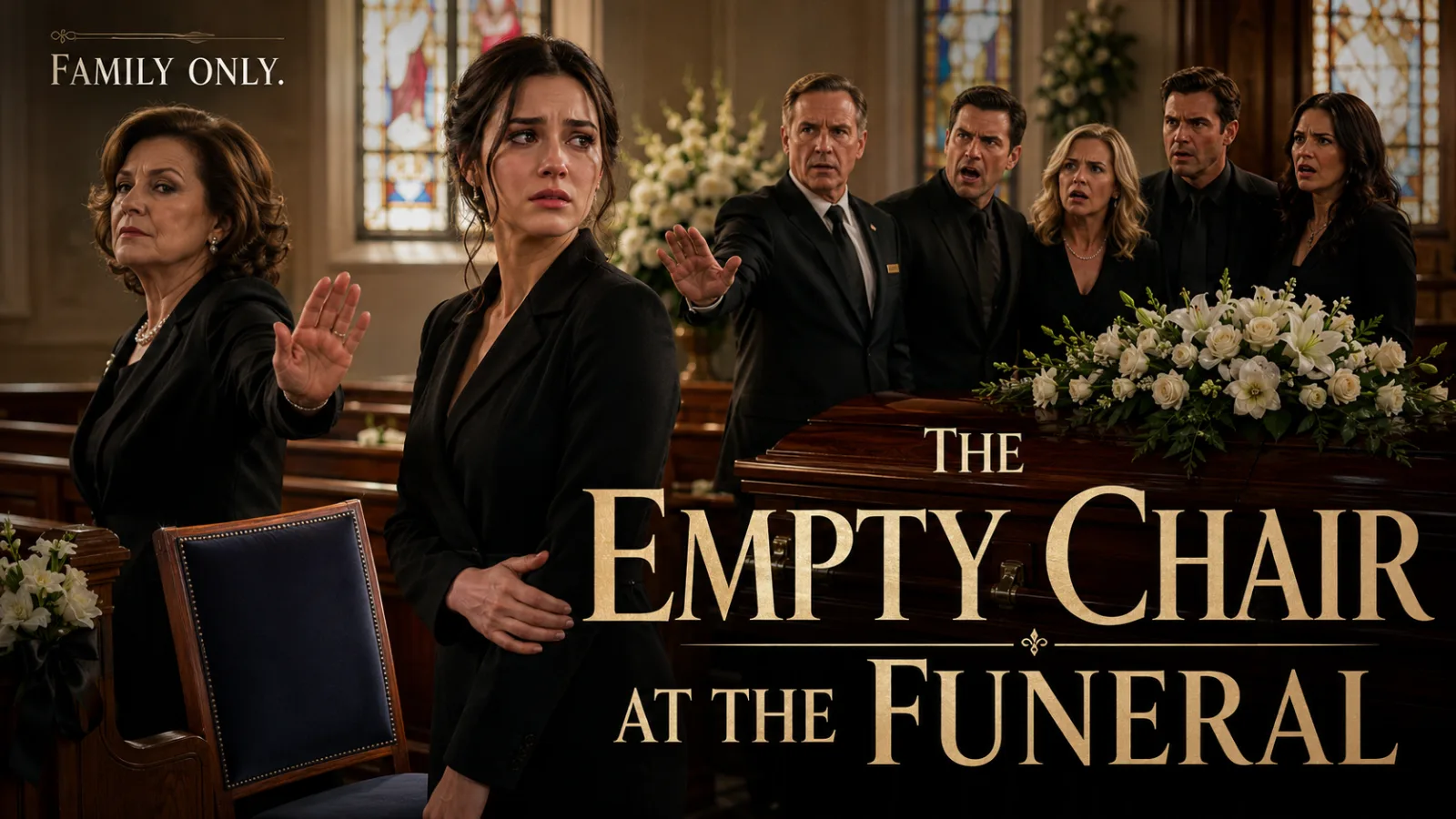
And then came the funeral.
And then the empty chair.
And then Nolan Pierce saying, “He chose her.”
By the next morning, Clara sat in the waiting room outside Miles Coley’s office with a sealed headache behind her eyes and Thomas’s bronze key in her coat pocket. Through the frosted glass she could hear raised voices. Evelyn’s tone carried first, clipped and outraged. Grant’s joined it, lower but harder. Somewhere in the overlap Vanessa said, “No, that is not remotely acceptable.”
Miles’s assistant, a woman named Janine who had known Clara since adolescence and had once smuggled her peppermint candies during a Christmas party at the office, appeared with an expression of practiced calm.
“Mr. Coley will see all of you now.”
The conference room smelled faintly of leather, old paper, and expensive tension. Evelyn sat at the head of the long table as if widowhood had conveyed a throne. Grant stood at the windows with his arms crossed. Vanessa was already leafing through a preliminary packet with disgust. Luke looked hungover. Amelia looked frightened.
Miles Coley waited until Clara took a seat.
Then, with the composure of a man who billed by the hour and did not scare easily, he folded his hands and said, “Your father was unusually specific.”
Clara almost smiled.
“Yes,” she said. “He often was.”
Miles’s gaze met hers for one brief moment, and something in it warned her that Thomas’s last arrangements had not begun and ended with the casket.
The funeral had only been the first blow.