THE DAUGHTER HE CHOSE
Bellchester did what towns like Bellchester always do when a prominent family finally splits open.
For three days everyone pretended they were discussing governance, fiduciary responsibility, or the regrettable complexity of old family matters. By the fourth day, every coffee shop from Main Street to the edge of the county had settled into the simpler and far more honest pleasure of scandal. The local paper ran a restrained headline about the Daniel Vale Memorial Fund opening an independent review. Two days later, after more documents surfaced and the first formal asset freeze became public, restraint evaporated.
THOMAS VALE’S FINAL LETTER CLEARS BROTHER, QUESTIONS FAMILY ACCOUNTING.
Grant called it defamation in a statement his lawyer released before noon.
Vanessa fled back to New York and was photographed there by someone who had the decency not to mention Bellchester and the indecency to leak it anyway. Luke entered a rehab facility, which Clara learned from Amelia rather than the papers. Amelia herself moved into a short-term apartment over a florist’s shop and ignored half of Evelyn’s calls.
Evelyn stayed at Vale House for exactly nine more days.
Under the will she had the right to the west cottage, not the main residence, and once it became clear Clara intended to enforce every line Thomas had written, Evelyn declared the atmosphere intolerable. She said it in the foyer in front of two housemaids, as if atmosphere were the main injury she had suffered.
Clara simply nodded. “The cottage is prepared.”
Evelyn gave her a look suggesting Clara had failed some final test of soft-heartedness. The failure did not trouble Clara.
Their last conversation in the house occurred in the library tower, because Evelyn insisted on “one private word without lawyers, servants, or spectators.” Clara almost refused. Then she thought of Thomas, of unfinished rooms and long silences, and decided she would not spend the rest of her life wondering whether she had been afraid of hearing one last truth.
Evelyn stood by the telescope Thomas used to mock cloudy weather.
“I always hated this room,” she said.
Clara waited.
“Thomas liked you here.” Evelyn turned, one gloved hand resting on the brass scope. “It made him sentimental.”
“He liked my father too.”
At that, the faintest crack appeared in Evelyn’s mask. “Your father made it easy.”
“To love him?”
“To prefer him,” Evelyn snapped. “Daniel had a talent for being forgiven in advance. The generous younger brother. The one with the easy smile and the practical charm. My children were measured against him before they were grown.”
Clara stared. “So you ruined him?”
Evelyn’s breathing changed, just slightly. “I protected my family.”
“You destroyed mine.”
For the first time since the funeral, Evelyn seemed to understand that Clara no longer occupied the old position in the house—the grateful dependent, the useful caregiver, the girl forever almost apologizing for needing anything. Authority had changed shape.
“I never meant for him to die,” Evelyn said.
The words were not an apology. They were self-defense.
“No,” Clara replied. “You only needed him discredited.”
Silence.
Then Evelyn said the thing Clara suspected she had wanted to say since the trustees’ meeting.
“Thomas loved you because guilt is the most possessive form of love.”
Clara felt the blow of it—and also its weakness.
“You’re wrong,” she said. “Guilt may be why he waited too long. It’s not why he chose me in the end.”
Evelyn’s eyes narrowed. “And why did he choose you?”
Because you stayed.
Because blood proved insufficient.
Because love decided trust and evidence decided judgment.
All Thomas’s reasons rose at once, but Clara chose the simplest.
“Because I told the truth when it became expensive.”
Evelyn laughed once, quietly and bitterly. “Enjoy your victory. This town forgives men faster than women. They’ll call me monstrous and Thomas tragic, though he kept the roof over all of it.”
“There’s truth in that,” Clara said.
Evelyn looked startled.
Clara went on. “Thomas failed my father. He said so. He failed me too, in some ways. But he didn’t build the lie. He ended it. Late, yes. But he ended it.”
Evelyn looked away first.
When she left the tower, she looked smaller than Clara had ever seen her.
The independent review took months.
By winter, the findings were no longer ambiguous. Daniel Vale was formally cleared of wrongdoing in the memorial fund’s public statement, which Clara insisted be published in full rather than buried in legal language. Improper transfers from decades earlier were documented as the root of a larger pattern of concealments. Civil actions followed. Several of Grant’s properties were tied up. Vanessa settled some claims privately and contested others noisily. Evelyn disappeared from most local committees under the noble fiction of “needing privacy.” Luke, to the surprise of nearly everyone, remained in treatment long enough to emerge quieter and less certain of his own excuses.
Amelia kept her promise in the only way that mattered.
She began telling the truth even when it diminished her.
Not to the press. Not theatrically. To lawyers, to auditors, to herself. She met Clara twice for coffee in January. The first time she cried so hard she barely spoke. The second time she managed an actual conversation about Thomas that was not entirely poisoned by the rest of them. Clara did not forgive her fully. Forgiveness, she learned, was not a gift people could demand on timelines convenient to guilt. But she stopped hating her.
Vale House changed with the seasons.
For a while Clara thought she would sell it immediately. Too much history, too much tension in the walls, too many rooms built to host people who had mistaken privilege for character. But every time she walked through the study or the breakfast room or the back hallway where young Clara had once lined her shoes up like a temporary tenant, she felt something more complicated than aversion.
The house had held ugliness.
It had also held rescue.
Thomas’s failures lived there. So did his decencies.
By spring she made a decision that surprised nearly everyone and made perfect sense to her. She converted part of the property into a respite program connected to the hospice wing Thomas had funded. A place for short-term family stays, caregiver recovery, and grief support. The main house would remain smaller, quieter, partly private and partly useful—no longer a monument to one family’s name, but no longer surrendered to it either.
She named the new program The Daniel and Thomas House.
When the sign went up, Bellchester had plenty to say.
Clara let it.
On the first anniversary of Thomas’s funeral, she returned alone to the church.
Nolan Pierce met her there because he had arranged to unlock the sanctuary for an hour. He did not ask why. Men who work around grief for long enough learn that some rituals explain themselves.
The church was empty except for filtered light through stained glass and the faint smell of wax. Clara walked slowly down the aisle to the front pew.
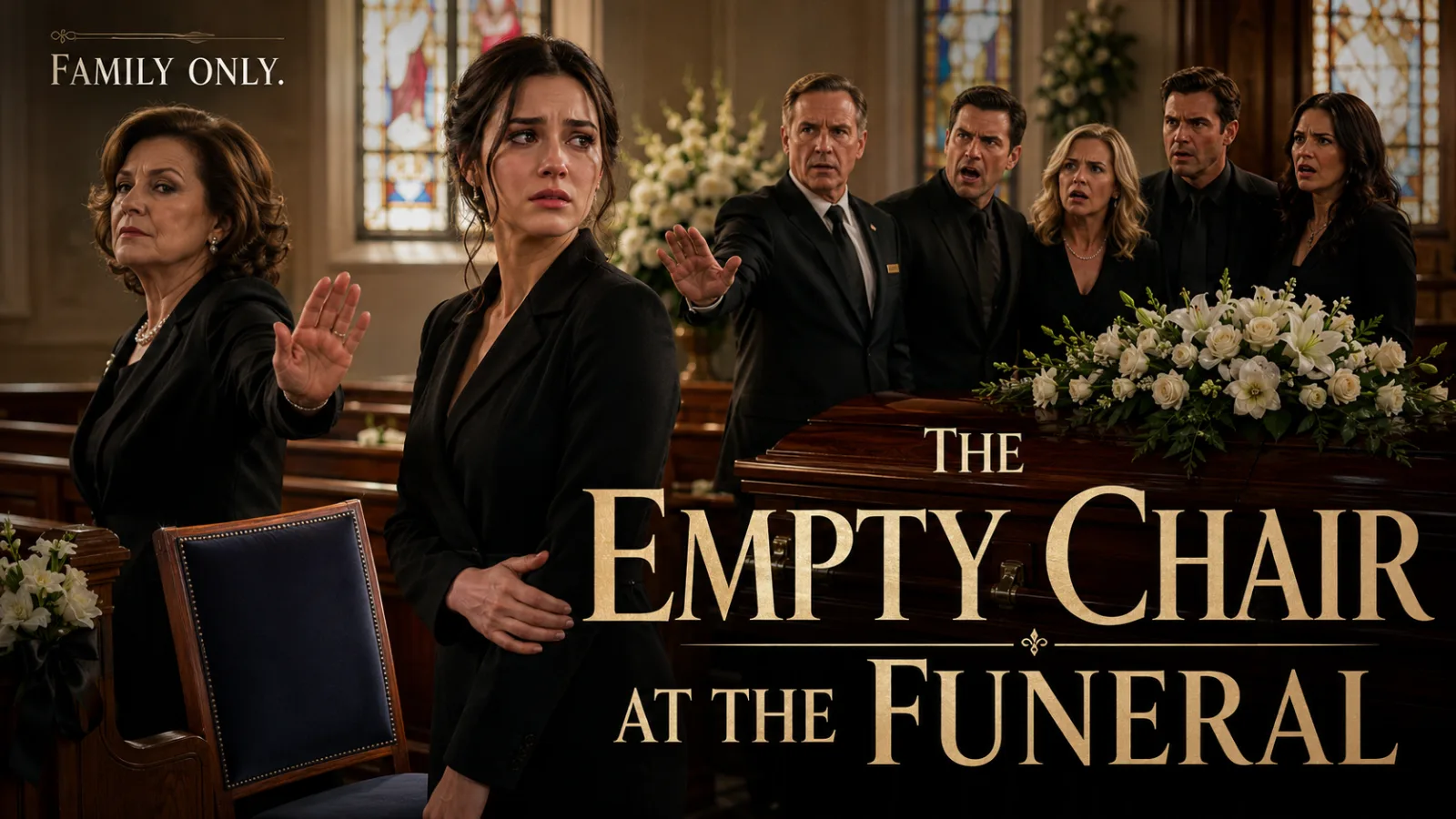
The chair beside where the casket had rested was empty again.
She stood looking at it for a long time.
A year earlier, that emptiness had felt like public rejection. The visible proof that even after decades in the family, Clara could be expelled from its center with one quiet shove and the words Family only.
Now she understood the chair better.
It had not been empty because she did not belong.
It had been empty because the people occupying the rest of the row had emptied the meaning out of family long before the funeral began.
Thomas’s final act had not been to elevate Clara as some sentimental replacement daughter in a melodrama about inheritance. It had been to identify the vacancy honestly. To show, in front of the whole town, who had lost the moral right to the place they claimed by blood.
Clara sat down.
The wood was cool beneath her palms.
For a moment she imagined Thomas beside her, grumbling about the draft and criticizing the florist’s overuse of lilies. She imagined Daniel too, harder because her memories of him were older and thinner, but still enough to picture the easy smile Evelyn had resented and Thomas had mourned.
“You were both right about one thing,” she said softly into the stillness. “This family needed at least one person who could add.”
Her laughter surprised her.
So did the tears that followed—not violent, not broken, just quiet and human.
When she finally rose to leave, Nolan was waiting near the back with the careful patience of a man who knew not to interrupt people inside the private math of memory.
“All right?” he asked.
Clara thought about the question.
Thomas was still dead. Daniel was still dead. Evelyn had not transformed into remorse. Bellchester remained Bellchester, more curious than noble. Some lawsuits would drag for years. Some relationships would never become healthy enough to keep.
So no, not all right.
But right enough.
“Yes,” she said at last. “More than before.”
Outside, the spring air carried the smell of wet earth and cut grass. Clara descended the church steps and looked once toward the cemetery hill beyond the trees.
Thomas had chosen her.
A year ago, that felt like burden.
Now it felt like an answer.
Not because she had won a house.
Not because she had beaten his children.
Not even because the town finally knew the truth.
He had chosen her because when everything false had been stripped away—wealth, performance, blood claims, polished names, public rituals—she was the one person left who still understood that love without truth becomes vanity, and truth without courage becomes silence.
The empty chair at the funeral had marked the absence at the center of the Vale family.
Clara had not filled that absence.
She had exposed it.
And in doing so, she had finally made room for something better to begin.
Chapters · 6 of 6
Don't stop now.
Choose another Veyra story and keep reading.
More Betrayal
One ending should lead naturally into another beginning.