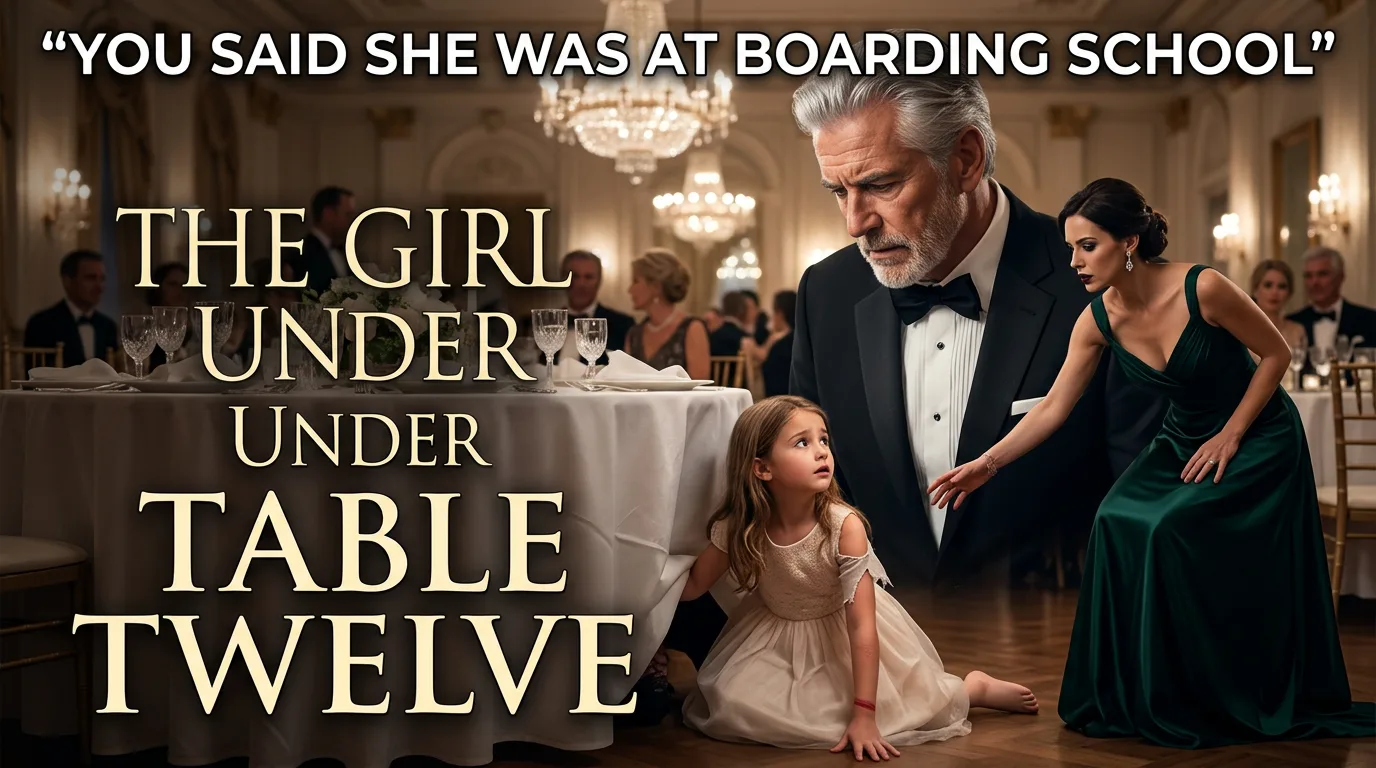
THE GIRL IN THE BALLROOM
By the time Harrison Vale rose to give his birthday speech, the ballroom at the Meridian had already reached that perfect point of expensive warmth wealthy people mistook for intimacy. Chandeliers threw honey-colored light over crystal and polished silver. The string quartet had just gone silent. Men in tuxedos stood with one hand around a champagne flute and the other tucked into a pocket tailored by someone whose business card came without a phone number. Women in silk and jewels smiled the careful smiles of people who had spent decades learning how to reveal nothing while appearing delighted by everything.
The room had been arranged around twelve large circular tables. Harrison knew this because he had approved the seating plan himself, not because he cared who sat where, but because his assistants insisted that a seventieth birthday gala attached to the Vale Foundation fundraiser required choreography. Nothing in his world was ever simply dinner. Every dinner was optics. Every gathering was capital wearing a bow tie.
He stood at the microphone in a black tuxedo that fit him as cleanly as armor and looked out over a life he had built so thoroughly that other people often mistook it for peace.
“Before anyone makes me sit down and pretend I enjoy hearing stories about my age,” he said, drawing the expected ripple of laughter, “I should thank all of you for being here tonight. The foundation has outlived several predictions, two recessions, one scandal the papers wildly exaggerated, and my alleged retirement.”
Another wave of practiced laughter moved through the room.
From where he stood, Harrison could see Celeste Vale seated near the front beside the family attorney and two board members from the foundation. She looked immaculate in dark emerald satin, dark hair in a sleek twist, diamonds at her ears and throat, one hand resting elegantly around the stem of her glass. She had worn widowhood with extraordinary discipline. When his son Daniel died nineteen months earlier, Celeste had not unraveled publicly. She had become quieter, softer at the edges, and almost impossibly composed. For a while Harrison had admired that composure. Then he had begun to suspect he had mistaken composure for control.
He had not seen his granddaughter Ivy in over a year.
Celeste had a story for that too.
The child was at St. Brigid’s, then St. Agnes, then a “small specialist boarding program in Vermont” after grief had allegedly made her timid around crowds. Harrison had objected at first. Nine was too young for distance. But Celeste always had paperwork ready, always had a recommendation from a school counselor, always had some gentle explanation about routine and stability and how difficult transitions had been since Daniel’s death. Harrison had buried his misgivings under business, under guilt, under the knowledge that his relationship with Daniel had been strained at the time of his son’s death. There were men who conquered industries and still failed the emotional arithmetic of fatherhood. Harrison had become one of them so gradually he had almost missed it.
He was halfway through thanking the foundation donors when movement under table twelve caught his eye.
It was so slight at first that he thought a waiter had dropped a napkin. Then the white linen shifted from beneath, bowing outward. A small pale hand appeared, then disappeared, then appeared again gripping the hem of the cloth.
The sentence forming in Harrison’s mouth died unfinished.
Several guests nearest the table began turning in their chairs.
A child crawled out from underneath the tablecloth.
She emerged on her hands and knees in a pale blue party dress, one sleeve torn loose at the shoulder seam. Her dark hair was tangled at the ends, and her small bare feet looked almost shocking against the polished parquet floor. She rose unsteadily into the aisle, blinking against the light and noise as if she had not expected to be seen by so many people at once.
A murmur moved through the ballroom.
Harrison’s chest locked.
Even before he could see her face clearly, before memory could finish traveling the distance between recognition and certainty, he knew whose child that was.
She had Daniel’s eyes.
Not just the color, though they were the same deep gray-blue. The same shape too, the same startled openness Daniel had carried as a boy whenever he forgot to protect himself from being hurt in public. For one irrational second Harrison felt the room tilt with the force of seeing something dead walk back toward him in smaller form.
The girl turned her head toward the stage.
His granddaughter.
Ivy.
The room began to go silent.
Celeste was already moving. She crossed the ballroom so fast that her chair nearly tipped behind her, the soft social mask stripped from her face so abruptly that Harrison saw, perhaps for the first time, the cold machinery underneath it. She reached Ivy in three seconds, gripped her upper arm, and bent slightly toward the nearest tables with an apologetic smile that would have sounded gracious if the fingers around the child’s arm had not been so tight.
“She gets confused,” Celeste said. “Ignore her.”
Harrison stepped away from the microphone.
Ivy flinched.
That was what stopped the room completely. Not the child. Not even Celeste’s grasp. It was the instinctive recoil of a little girl who already knew how pain usually followed being touched in public.
Then Harrison saw the red marks around her wrist where someone had held her hard enough to leave the shape of fingers in the skin.
He came off the stage with a speed that startled even himself.
“Let her go.”
Celeste looked up sharply. “Harrison, please. She shouldn’t be down here.”
He reached them and caught Celeste’s wrist before she could drag the child another step. Harrison did not raise his voice. He did not need to.
“You told me she was at boarding school.”
The words seemed to slice open the center of the room.
For the first time that evening, Celeste lost control of her expression completely. Something defensive and furious flashed there before she arranged her face again. “She was overwhelmed. I was about to explain.”
Ivy’s eyes moved from Celeste to Harrison.
The child was trembling, not theatrically, not with the open crying fear adults recognized easily, but with the rigid animal effort of someone trying very hard not to make things worse by being noticed too much.
Harrison loosened his hold on Celeste only enough to shift his body between her and the child. “Ivy,” he said carefully, lowering himself a fraction so he would not tower over her. “Sweetheart, look at me.”
She did.
“She only lets me downstairs when nobody’s here,” Ivy said.
No one in the ballroom moved.
It was one of the quietest statements Harrison had ever heard. No drama, no accusation, no performance—just information, given plainly because the person receiving it finally seemed capable of doing something with it.
Celeste’s voice came fast now. “She doesn’t understand what she’s saying. She’s had episodes since Daniel died, and—”
“Stop.”
Harrison did not look away from Ivy when he said it.
A dozen things became clear to him in the same moment. The child’s bare feet. The ripped sleeve. The way she watched Celeste from the corner of her eye the way one watched weather or danger. The way several guests were suddenly pretending not to listen even as not one of them could possibly miss what had just happened.
He took off his tuxedo jacket and draped it gently around Ivy’s shoulders. She startled first, then froze. The jacket swallowed her.
To his right, he heard his longtime chief of security, Owen Hart, moving through the crowd.
“Owen,” Harrison said, still looking at Ivy, “I want Mrs. Moreno and the house physician brought here now. Quietly. And no one leaves this room until I say so.”
Celeste gave a brittle little laugh. “Harrison, surely you don’t mean to turn a family misunderstanding into a spectacle.”
He turned his head then and looked at her fully.
For years people had written articles about Harrison Vale’s stare, his negotiating face, his boardroom stillness. Most of it was mythology. Stillness was not magic. It was simply what happened when a man built from self-control reached the point where anger became too cold to move quickly.
“If this is a misunderstanding,” he said, “you are in astonishing trouble for causing it.”
Ivy shifted closer to him without seeming aware she had done so.
That movement finished what her sentence had started.
Mrs. Ana Moreno reached them first. She had been the housekeeper at the main Vale estate for twenty-six years and had known Daniel from the age of eight. When she saw Ivy, her hand flew to her mouth. Then she noticed the marks on the child’s arm, and her expression changed from shock to something much older and harder.
“My God,” she whispered.
“Take Ivy to the Orchid Suite,” Harrison said. “Bring shoes, food, warm milk if she’ll take it, and clean nightclothes. No one enters without my permission. Not even family.”
Celeste stepped forward. “I’m her mother.”
“And tonight,” Harrison said, “that is the reason you will wait outside the door.”
Ana held out her hand to Ivy. The little girl stared at it for a long second before taking it.
As Ana guided her away, Ivy turned once and looked back at Harrison. It was not yet trust in her face. It was calculation, fear, and a tiny uncertain opening underneath both.
Harrison had spent most of his life believing that power was proven in acquisitions, outcomes, the ability to shape institutions. In that moment power became painfully simple.
A child had looked at him to see whether he would make her go back.
“Ivy,” he said.
She stopped.
“You will stay where Mrs. Moreno puts you. No one will take you anywhere tonight without coming through me first.”
The child nodded once.
Then she left the ballroom wrapped in his jacket.
What remained behind was silence, expensive and brittle.
Celeste lifted her chin. “I would appreciate some privacy.”
“You forfeited privacy when my granddaughter crawled out from under a banquet table in front of two hundred witnesses.”
“Harrison—”
“No.”
He looked toward the family attorney. “Martin, my office. Now. And bring every trust instrument concerning Ivy’s guardianship and education fund.”
Then to Owen: “Two female security officers outside the Orchid Suite. No exceptions.”
Celeste’s jaw tightened. “You’re overreacting because you enjoy public authority.”
He almost smiled at that, but there was no warmth in it.
“If I were enjoying myself, Celeste, you would know.”
She held his gaze for exactly two seconds too long. Harrison saw the calculation begin again. This, then, was how she worked. She adapted. She softened. She found the next plausible lie and stepped into it as though it had always been the truth.
“Daniel wanted consistency for Ivy,” she said. “She’s been fragile, and I was protecting her.”
“From whom?”
Celeste did not answer quickly enough.
From upstairs in his own house, Harrison thought. From visitors. From daylight. From witnesses.
From the dead.
He dismissed the guests without apology. Within twenty minutes the ballroom had emptied itself in a rustle of speculation and scandal management. The quartet packed quietly. Flowers remained perfect on the tables. Champagne sweated in silver buckets. Table twelve looked almost innocent again under its white linen, as though children emerged from beneath formal banquet tables every evening.
Upstairs in the Orchid Suite, Ivy was sitting on the edge of a settee when Harrison entered an hour later. She had been bathed. Mrs. Moreno had brushed her hair and put her into soft cotton pajamas printed with tiny stars. The marks on her wrist looked worse now that they were clean. So did the shadows under her eyes.
A tray of untouched food sat on the low table.
Ivy tensed when he entered, but she did not retreat.
“Mrs. Moreno says you like strawberry jam,” Harrison said, taking the armchair opposite her instead of the closer seat. “I have apparently maintained an estate, a company, and a foundation while failing to stock proper strawberry jam in a hotel suite. This has been reported to me as a serious deficiency.”
For a moment she simply stared.
Then, very faintly, one corner of her mouth moved.
It was not a smile. It was the memory of how one might begin one.
“Do you know who I am?” Harrison asked.
“You’re Grandpa Harrison.”
The title hit him harder than he expected. He had not earned it tonight, not yet, but the child had given it anyway, perhaps out of habit, perhaps because Daniel had once used it at home, perhaps because children sometimes extended family titles in hope before evidence.
“Yes,” he said. “I am.”
“She said you were too busy.”
The sentence was so small he almost missed the worst part of it.
“Who said that?”
“Mom.”
Harrison folded his hands to hide the violence of what passed through him. “I see.”
Ivy looked toward the door. “Is she mad?”
“She is not coming in here.”
“That’s not what I asked.”
He sat back.
Children who had learned fear too early often spoke with terrifying precision.
“Yes,” he said. “I think she is angry. But anger is not permission.”
Ivy absorbed that as though it were a new kind of math.
When she finally picked up a piece of toast, Harrison did not pretend the room became safe. Safety did not arrive because a powerful man had announced it. It arrived slowly, if at all, and only after it survived being tested.
Still, before midnight he had the trust documents spread across the desk in his private suite and the first clear shape of Celeste’s architecture in front of him.
Ivy’s inheritance from Daniel sat inside a family trust worth just over one hundred million dollars, including income distributions, future equity, and a controlling minority block of foundation-linked shares. Following Daniel’s death, Celeste had been confirmed as Ivy’s residential guardian and temporary co-manager of several child-related distributions. The language concerning education expenses was broad. Too broad. Broad enough to cover private boarding schools, travel, medical consultants, tutors, live-in staff, and discretionary care.
Broad enough to hide a child while charging for her absence.
At the bottom of one document, beside a recent expense summary, Harrison found recurring tuition payments to St. Helena’s Academy in Vermont.
He called Martin back in and asked him for the school’s direct line.
At 12:43 a.m., with Martin listening and Owen standing silently by the window, Harrison learned from an irritated night administrator that St. Helena’s had never enrolled any child named Ivy Vale.
By one in the morning, whatever remained of his birthday had died.
What replaced it was purpose.
And somewhere down the hall, a little girl who had been kept upstairs until no one was looking was sleeping for the first time in a room guarded from the outside by people who answered to someone else.