NO MORE UPSTAIRS
The formal homicide indictment came four months later.
By then winter had turned the lake steel gray and the fourth-floor locked room had been stripped down to bare walls awaiting renovation. Harrison had considered destroying it immediately. Dr. Shaw advised against it. Some evidence, she said, needed to leave a mark before healing could begin. So the room remained empty for a time, the latch removed, the wardrobe repainted, the carved day marks photographed and preserved.
Celeste was charged with second-degree murder, child endangerment, unlawful imprisonment of a minor, fraud, obstruction of justice, and witness tampering. Her attorneys fought everything, then less, then mostly the murder count. In the end the prosecution’s most powerful witness was not glamour, money, or even the trust trail.
It was sequence.
Daniel preparing to alter the trust and take Ivy to Boston.
Celeste learning she stood to lose control of both money and narrative.
The cut red lanyard.
The child hidden away before and after.
The fabricated schools.
The wet hem.
The attempted removal of Ivy before the next hearing.
Human beings were not crossword puzzles. Their motives rarely fit one box. Celeste had not done one bad thing for one clean reason. She had acted from greed, fear, entitlement, anger, and the conviction—common among the beautiful and socially fluent—that consequences were for less elegant people.
Ivy did not attend most of the proceedings. Dr. Shaw and Mara agreed she needed as little courtroom exposure as possible. She gave one recorded deposition in a child-friendly interview room painted the wrong color yellow, holding the cloth rabbit from the fourth-floor toy chest in her lap. Harrison watched from behind the observation glass and thought, not for the first time, that civilization should be judged almost entirely by how rarely it forced children to become credible through suffering.
Spring returned gradually.
Ivy began school again in person, first with a private educational support plan, then part-time at a small independent day school near the city where the headmistress had enough intelligence not to treat her as a tragic mascot. She did not transform overnight. Healing refused spectacle. Some mornings she still asked whether anyone had changed their mind. Sometimes she hid food. Sometimes loud laughter from another room made her go still. But she slept with the windows slightly open now and no longer counted the lines of light under closed doors.
Harrison changed too, though with less grace.
He stepped back from two boards, delegated more of the foundation’s daily management, and moved his primary residence permanently into the east wing rather than the old master suite. He began having breakfast at a real table every morning because Ivy ate better when someone else was already seated there. He learned the school calendar. He attended a parent conference alone for the first time in his life and was privately delighted when the history teacher seemed too intimidated to hide his surprise.
There were things Harrison could not repair. He could not return Daniel. He could not erase the year Ivy lost inside a house built partly from his money. He could not make guilt noble. But he could refuse to sentimentalize regret and call that redemption.
So he did the practical things.
He amended the trust completely, placing Ivy’s assets under independent management until adulthood with strict educational and welfare oversight, regular judicial review during minority, and no guardian allowed unilateral control of discretionary distributions again. He established a child advocacy fund through the Vale Foundation to support legal intervention in coercive family isolation cases, though he forbade anyone from naming it after Daniel because Daniel, he said, deserved a memorial better than branding.
And he listened.
That, perhaps, was the hardest reform of all for a man who had built an empire by speaking in declarations. Harrison learned to listen when Ivy spoke slowly, when she contradicted him, when she said no to photographs or charity galas or formal church services. He learned that some children expressed trust not by clinging but by arguing. The first time Ivy rolled her eyes at him over homework and announced, “You’re being dramatic,” Harrison nearly laughed with gratitude.
One evening in late June she asked to see the ballroom at the Meridian again.
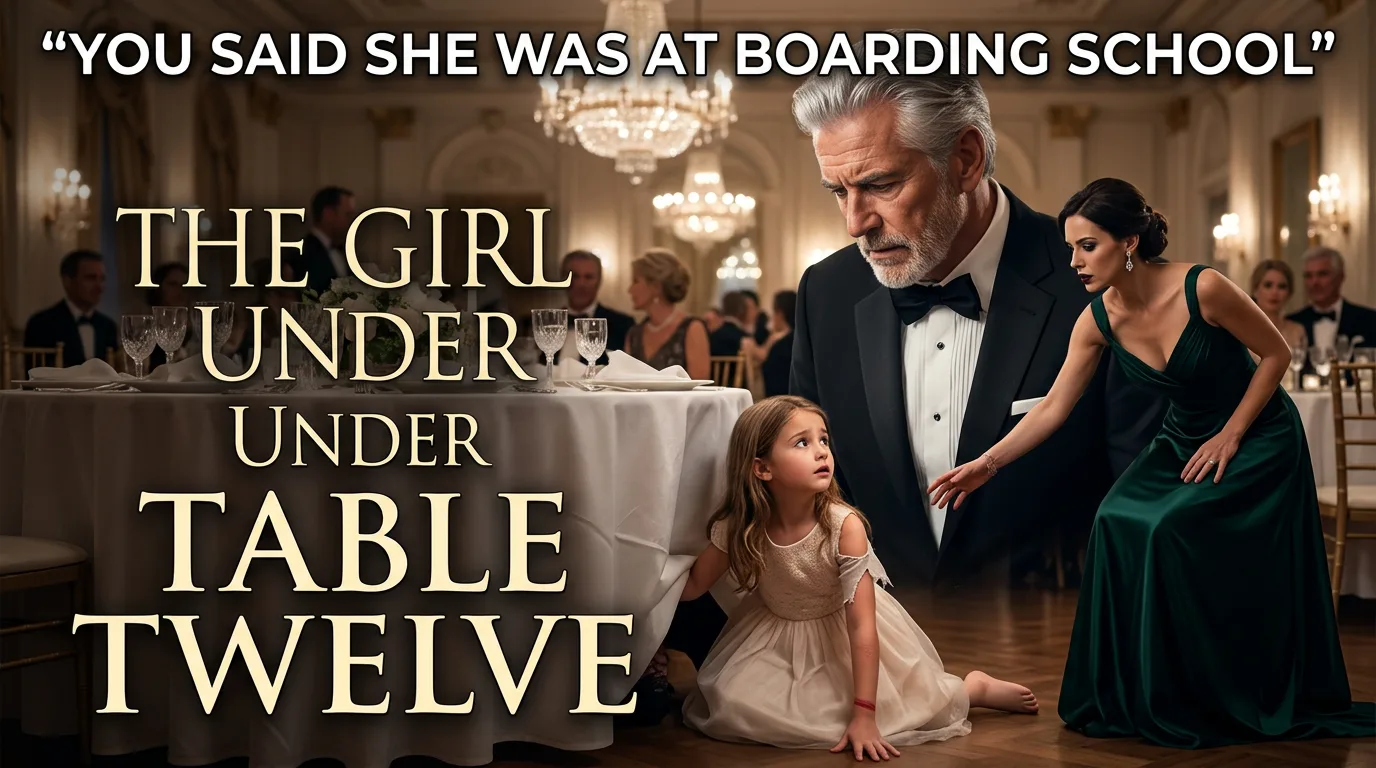
The request alarmed him enough that Dr. Shaw came too, though discreetly, with Ana and Owen waiting at a distance. The ballroom had been empty for the afternoon, chairs stacked, chandeliers dimmed to a golden hush. Harrison expected tears. Ivy walked straight to where table twelve had stood and looked around at the wide polished floor.
“It looked bigger that night,” she said.
“Everything does when you’re frightened.”
She considered that. “Did you know right away it was me?”
“Yes.”
“Why?”
He took a moment before answering.
“Because you looked like Daniel,” he said. “And because some things belong to you even when you’ve neglected them. Recognition doesn’t disappear just because you were absent.”
That was the kind of sentence he would once have considered too emotionally naked to say aloud. Age, scandal, and children rearranged many foolish loyalties.
Ivy touched the edge of one folded tablecloth on the service cart.
“I stayed under there because I thought if I came out and nobody helped, then I’d know for sure.”
Harrison looked at her.
The room seemed to narrow to the exact width of that confession.
“And if someone did?”
She shrugged with one shoulder. “Then I’d know that too.”
He had no language adequate to the fact that a child had designed her own test of human worth beneath a banquet table.
So he told the truth.
“I am very grateful,” he said, “that you decided to test me in public.”
For the first time in weeks, she laughed without immediately glancing over her shoulder to see whether laughter was allowed.
By autumn, the murder trial ended in conviction.
Celeste was found guilty on all child-related counts and on the homicide count after the prosecution tied motive, tampering, concealment, and post-event witness suppression into one coherent structure the defense could not break. The papers called it the Vale Ballroom Scandal. Television preferred The Heiress Hidden Upstairs. Harrison let them have their vulgar titles. The only audience he cared about now was one child who no longer needed permission to come downstairs.
On Harrison’s seventy-first birthday, there was no gala.
There was dinner at the estate with eight people, including Ana, Owen, Martin, Dr. Shaw, and the headmistress from Ivy’s school, whom Ivy insisted counted as “real company.” They ate on the east terrace as the sun dropped over the river. No quartet. No donor wall. No speeches at a microphone.
Still, when dessert arrived, Ivy tapped a spoon lightly against her water glass and stood on her chair.
Harrison raised an eyebrow. “Should I be worried?”
“A little,” she said.
Everyone smiled.
She held up a place card she had drawn herself. On the front she had written in careful blue ink:
TABLE TWELVE IS RETIRED.
On the back:
I SIT NEXT TO GRANDPA NOW.
Harrison took the card from her and did something he rarely did in front of people.
He closed his eyes for one second.
When he opened them again, Ivy had already come around the table and slipped into the seat beside him without asking.
No one made a production of it. That was another gift the child had earned: to be loved without being turned into ceremony.
Much later, after the guests were gone and the house had gone quiet, Harrison passed the old west-wing corridor on his way upstairs. The fourth-floor door stood open now, the room beyond transformed into a bright studio with low shelves, a map wall, and a reading nook under the window that no longer stuck shut. Ivy had chosen the paint color herself. Not blue. Not pink. Green, because, in her opinion, rooms should not look tired.
He stood in the doorway for a moment.
There are some victories that look ridiculous in the vocabulary of power. A removed latch. A child’s shoes by an open door. Jam in the proper flavor. A seat kept warm at breakfast. They do not impress boards or markets. They do not belong in biographies.
They are still, Harrison had finally learned, the victories most worth winning.
Down the hall, Ivy’s voice floated from her room.
“Grandpa?”
“Yes?”
“Can I come downstairs if I’m not sleepy?”
He leaned one shoulder against the doorway and smiled toward the sound of it.
“Sweetheart,” he said, “you never have to ask me that again.”
Chapters · 6 of 6
Don't stop now.
Choose another Veyra story and keep reading.
More Secrets & Lies
One ending should lead naturally into another beginning.