WHAT DANIEL TRIED TO TELL HIM
Harrison spent the following morning in his study with three files open at once: Ivy’s trust documents, Dr. Singh’s preliminary report, and everything his office could compile on Daniel’s final six months. It was an ugly way to revisit grief—through billing records, staffing changes, courier receipts, and overlooked paper trails—but Harrison had built his whole life on the principle that people lied less effectively in ledgers than they did in conversation.
By ten o’clock, Martin had obtained a temporary family court order restricting Celeste’s unsupervised access to Ivy pending an emergency hearing. Celeste received the order with the offended poise of a woman who considered laws vulgar until they benefited her. She moved to the guest cottage on the estate after Harrison made it clear she would not remain in the main house. She also retained a more aggressive attorney by lunchtime.
This did not surprise him.
What did surprise him was how quickly people began talking once it became clear the old order had cracked.
The former night nurse, a weary woman named Paula Evers, admitted in a recorded interview that she had resigned after six weeks because Ivy “looked at locked doors like a person who expected them.” A tutor confessed that she had seen Ivy only twice and both times been dismissed early because the child was “too quiet to engage.” The family driver mentioned that Celeste often had groceries and pharmacy items sent upstairs rather than allowing Ivy in the kitchen or dining room.
Then Owen Hart found Lydia Mercer.
Lydia had been Ivy’s governess for eight months after Daniel’s death. She now worked in Providence caring for an elderly couple and had ignored earlier informal outreach because Celeste’s attorneys had once threatened her with a defamation suit. When Harrison personally offered to meet her at the estate—with legal protection, documented immunity against intimidation, and a promise that no conversation would be buried to save family reputation—she arrived by early afternoon carrying a neat canvas bag and the expression of someone who had waited too long for powerful people to become brave.
She was thirty-four, spare, composed, and visibly furious beneath that composure.
“I should have done more,” she said before she had even sat down.
Harrison did not insult her with easy absolution. “Tell me what you saw.”
Lydia took a breath.
At first, after Daniel’s death, Celeste had presented herself as a grieving mother trying to preserve stability. Ivy was removed from school “temporarily,” then supposedly shifted to private tutoring “for privacy.” Social contact narrowed. Outings stopped. Staff access became conditional. Lydia had objected repeatedly. Celeste claimed the child was in therapy, too delicate for stimulation, too likely to melt down around strangers. Then Lydia began noticing practical contradictions.
There was no therapist arriving regularly.
No real educational plan.
No consistent medical oversight.
Most importantly, Ivy’s fear did not behave like grief alone. It behaved like anticipation.
“She would ask me whether Mrs. Vale had ‘a bad face on today,’” Lydia said. “At first I thought she meant sad. Later I realized she meant dangerous.”
Harrison remained very still.
Lydia continued. Celeste’s discipline was erratic. Some days overly tender in public, almost performative. Other days cold and cutting. Ivy was threatened with “the upstairs room” if she cried, questioned, or mentioned certain subjects. The subject that caused the strongest reaction was Daniel.
“Every time Ivy started to say something about the night he died,” Lydia said, “Mrs. Vale interrupted or removed her.”
“Did Ivy say anything specific?”
“Not at first. Toward the end she kept mentioning a ‘red string’ and saying her father wanted to take her somewhere safe.”
Harrison’s attention sharpened.
Lydia reached into the canvas bag and removed a small stack of printed photographs. They showed Ivy in the garden from the previous winter, bundled in a coat too thin for the weather. Even from the photographs, Harrison could see the tightness in the child’s mouth.
“I took those because of the bruises,” Lydia said. “On the second page there’s one of her shoulder. I also kept copies of my resignation email and Celeste’s response.”
Martin took the papers. Harrison did not need to read far. Lydia’s resignation message cited concern for isolation, improper confinement, and the child’s repeated distress. Celeste’s reply was all velvet poison: accusations of professional overreach, instability, and violation of privacy.
“Why didn’t Daniel stop it?” Harrison asked, and hated himself the moment the question left his mouth.
Lydia answered anyway. “I think he was trying to. I think he was late.”
That afternoon Harrison went through Daniel’s study for the first time since the funeral.
The room had been preserved almost theatrically—books aligned, bar cabinet untouched, framed regatta photograph on the shelf, one old leather weekend bag in the wardrobe. Celeste had called it a memorial. Harrison now suspected memorialization had functioned here the way it did in so many rich houses: as a prettier word for freezing the narrative before anyone could inspect it.
Inside the weekend bag, beneath two sweaters, Harrison found a folder labeled in Daniel’s hand.
IVY — PRIVATE.
The contents shook him more than he expected them to. School brochures. A draft custody petition never filed. A handwritten list titled THINGS SHE SAYS WHEN CELESTE ISN’T IN THE ROOM. A scheduled consultation with a child psychologist in Boston. Notes from two meetings with Martin that, remarkably, Martin had never been told concerned emergency guardianship; Celeste had canceled the second by reporting that Daniel “wasn’t well enough to proceed.”
At the bottom sat a draft amendment to the trust. Daniel had been preparing to remove Celeste’s discretionary control over Ivy’s educational and welfare distributions. Harrison read the document twice.
Motive, he thought.
Not legal motive, not yet, but human motive, financial motive, desperate motive.
He called Martin in and asked the question directly.
“If Daniel had completed this amendment, what would Celeste have lost?”
Martin adjusted his glasses and answered with professional reluctance. “Direct control over a substantial personal allowance tied to Ivy’s residential care. Influence over several voting rights held in trust until Ivy comes of age. Access to discretionary household management funds. And—”
“And?”
Martin exhaled. “A great deal of leverage.”
By evening, Celeste understood enough of Harrison’s direction to stop pretending this was about misunderstanding. She requested a formal conversation in the conservatory and arrived dressed with almost surgical polish, as if silk and restraint themselves could still govern outcomes.
“I have tolerated a great deal in the last twenty-four hours,” she said, “because I assumed grief and ego were clouding your judgment. But you are now maligning me with employees, doctors, and lawyers over a parenting disagreement.”
Harrison, seated beside the long iron table where orchids once flourished under his wife’s care, did not invite her to sit. “You isolated a child.”
“I protected a child.”
“You billed her trust for schools she never attended.”
“That money paid for private care.”
“Care behind a locked door.”
Celeste’s composure thinned. “You know nothing about what it took to manage her after Daniel died.”
“Then enlighten me.”
For the first time her voice sharpened enough to reveal the steel underneath. “She became impossible. She clung, she cried, she repeated nonsense, she woke screaming, she accused people of things she imagined from nightmares. I created structure because no one else was there to live with the consequences.”
Harrison studied her.
There it was again—that subtle habit of telling partial truths as camouflage for the monstrous whole. Ivy may well have cried. She may have woken screaming. Of course she had. Children often do when terror has become domestic furniture. Celeste spoke of symptoms as though they justified the wound.
“Daniel was trying to change the trust,” Harrison said.
Celeste froze for one fraction of a second.
“He thought you were unstable around Ivy.”
Now she smiled, but the smile failed before it fully formed. “Daniel thought many things when he was upset.”
“Was he upset the night he died?”
Something entered her face then and withdrew so fast another man might have missed it.
“I will not discuss that tragedy like gossip.”
“It is not gossip if it becomes evidence.”
At that, the room between them changed temperature.
“You think I killed my husband?”
“I think my son died at a useful moment for you. I think my granddaughter was hidden from the world afterward. I think a woman who can lock a child behind a latched door can do more than one unconscionable thing in private.”
Celeste stepped closer. “And I think you’re an old man discovering too late that power doesn’t repair neglect. Daniel spent years trying to get your attention. You noticed a balance sheet faster than you noticed bruises on your own blood. Don’t stand here pretending righteousness because a child finally crawled into your line of sight.”
The words landed because they were partly true.
Harrison did not flinch from that truth.
“No,” he said. “I will stand here because I finally have her in mine.”
When Celeste left, he remained in the conservatory long after dark.
Later that night Ivy came to the doorway in slippers two sizes too large and asked, with the terrible practicality of children, “If my mom goes away, will people say I’m bad?”
Harrison set aside the legal papers in his hand.
“Come here,” he said.
She crossed the room slowly and climbed into the chair opposite him rather than beside him, which struck him as oddly formal until he realized children often mirrored the social distance adults had taught them. He moved his own chair slightly closer.
“Nothing your mother did makes you bad,” he said.
“She always says I make things hard.”
“That is not the same thing.”
Ivy looked down at her hands. “Daddy said hard things can still be true things.”
Harrison felt something tighten in his chest. “Your father said that?”
She nodded.
“Your father was right.”
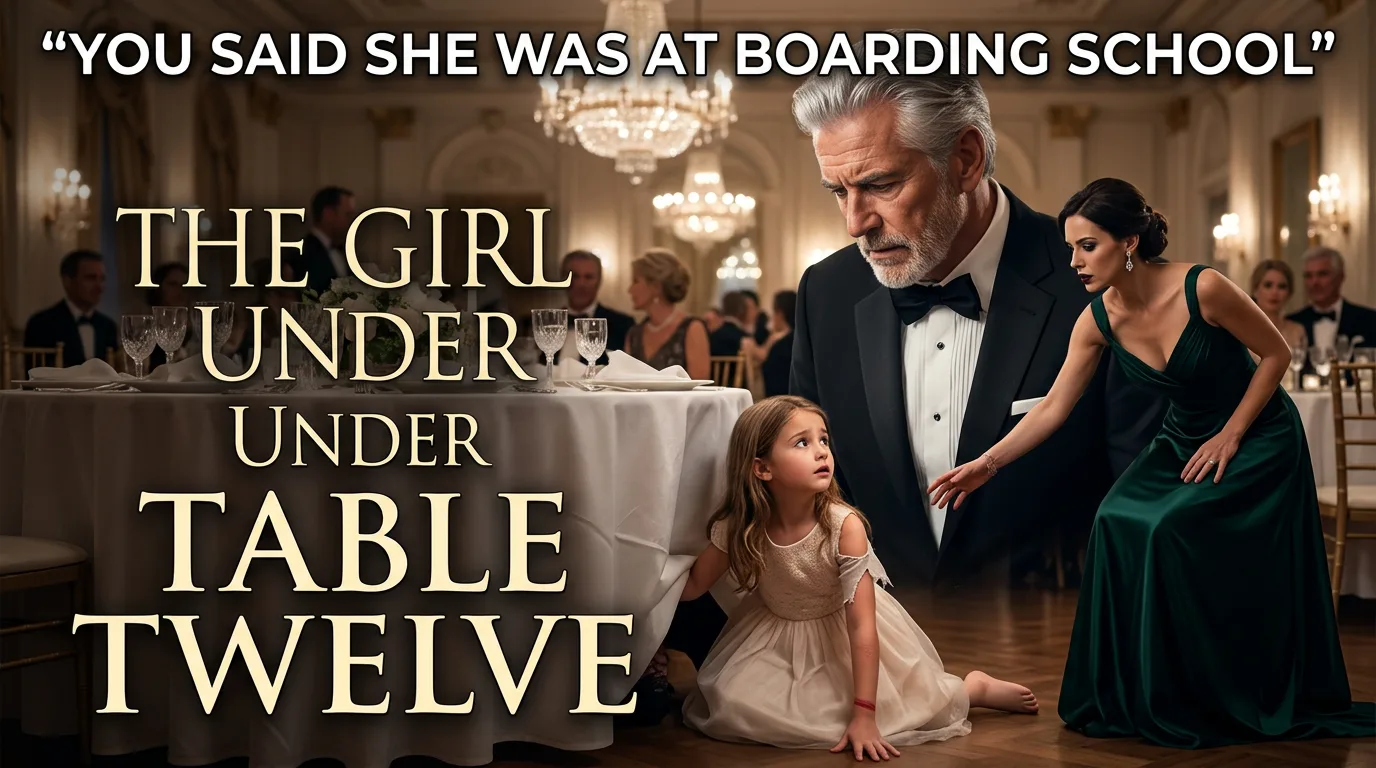
For the first time since the gala, she asked a question that made the path ahead impossible to misread.
“Do you want to know what happened to Daddy?”
Harrison held her gaze.
“Yes,” he said. “Very much.”
Ivy’s voice thinned. “Then I need you to promise you won’t make me tell while she can still hear me.”
The child did not say if. She said while.
Outside, the house settled around them in old-money quiet, every polished surface reflecting back a family that had mistaken secrecy for dignity.
Harrison reached across the small space between their chairs and placed his hand palm-up on the table, close enough to be an offer, not a demand.
“You have my word,” he said.
Ivy looked at his hand for a long time before placing hers in it.